BOSS TU-3 Chromatic Tuner Pedal
As an Amazon Associate I earn from qualifying purchases.
Keeping a guitar properly tuned is one of the simplest ways to improve the playing experience. Even an expensive instrument and a carefully chosen amplifier cannot compensate for strings that are noticeably out of tune.
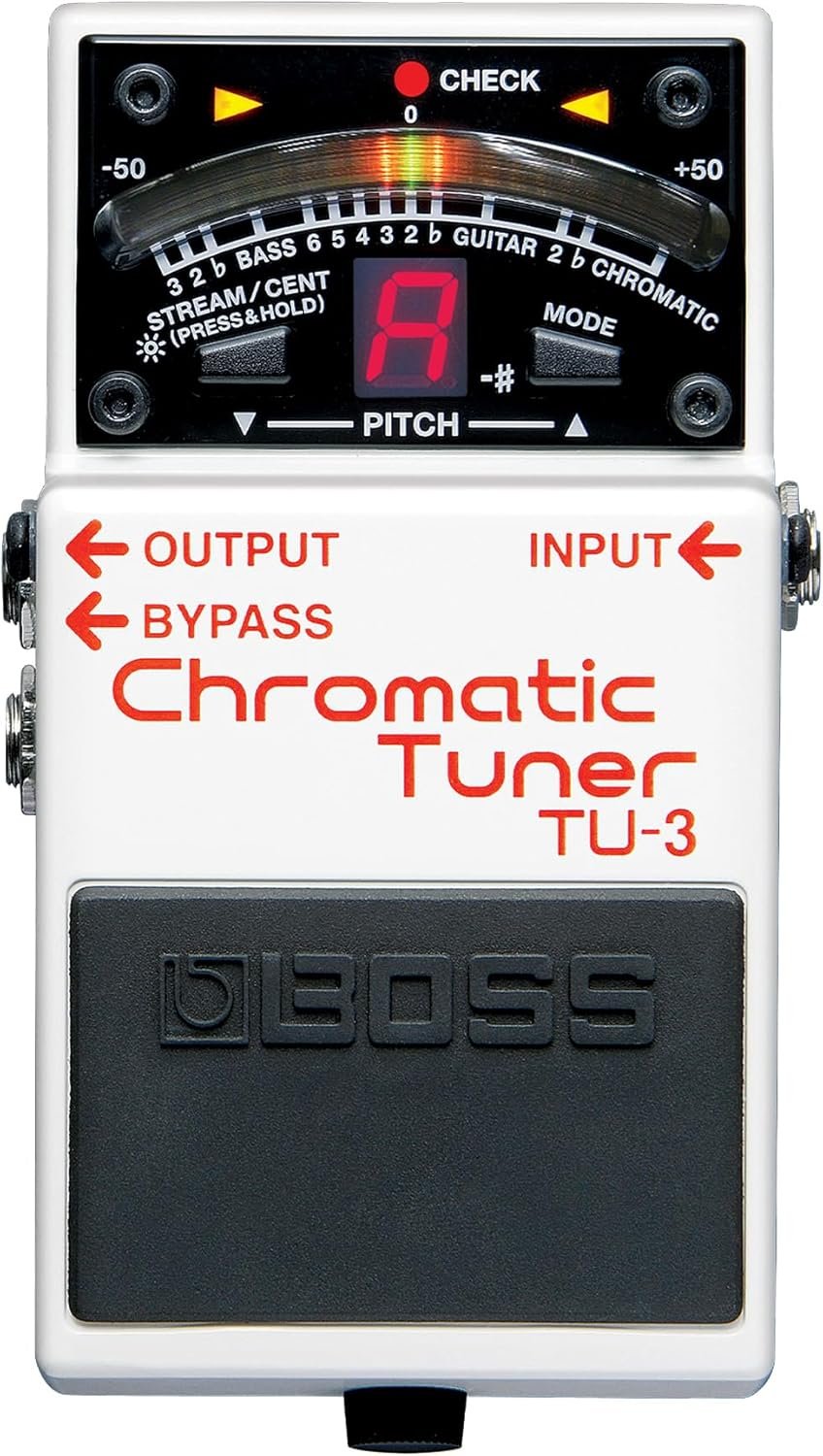
The BOSS TU-3 Chromatic Tuner Pedal provides a practical solution for guitarists and bass players who want accurate tuning without interrupting their playing routine.
Built around BOSS’s familiar compact pedal design, the TU-3 combines a sturdy metal enclosure, bright LED tuning display and straightforward footswitch operation.
It is not designed to produce dramatic effects or change the character of an instrument. Its purpose is more fundamental: helping musicians tune accurately, quickly and discreetly.
For players assembling a dependable pedalboard, that makes it a particularly useful piece of equipment.
Why a Dedicated Tuner Pedal Makes Sense
Clip-on tuners, smartphone applications and handheld tuning devices all have their place.
However, a dedicated pedal tuner offers practical advantages when a guitar is already connected to an amplifier or effects system.
The TU-3 sits directly in the instrument’s signal path. When the tuner is engaged, its main output is muted, allowing the guitarist to check and adjust tuning without sending unwanted sounds through the amplifier.
This is particularly useful during live performances.
A guitarist can tune between songs without distracting the audience, while a bass player can check tuning during a rehearsal without interrupting everyone else.
There is also the convenience of having the tuner permanently connected and positioned alongside other pedals.
No searching for a separate device, attaching something to the headstock or relying on a phone screen.
A Clear LED Display for Accurate Tuning
The TU-3 features a 21-segment LED tuning meter designed to provide clear visual feedback.
BOSS specifies tuning accuracy of ±1 cent, which is suitable for precise everyday guitar and bass tuning.
Two display styles are available.
Cent Mode
Cent Mode uses the LED meter to indicate whether a note is flat, sharp or correctly tuned.
The display moves towards the centre as the string approaches the intended pitch.
This provides a straightforward visual reference that is easy to understand without navigating complicated menus.
Stream Mode
Stream Mode offers a moving LED display, with the movement slowing as the note approaches the correct pitch.
Some players may prefer this presentation, particularly when making small adjustments.
The Accu-Pitch Sign function provides additional visual confirmation when tuning is complete.
A High Brightness mode is also available for situations where stronger illumination is needed, including outdoor performances.
Useful Tuning Options for Guitar and Bass
Although the TU-3 looks relatively simple, it provides more flexibility than a basic six-string guitar tuner.
Chromatic Mode recognises notes across its specified tuning range, making it useful for alternative tunings and different instruments.
Dedicated Guitar and Bass modes display string numbers rather than relying entirely on note names.
The tuner supports seven-string guitars and five- or six-string basses, extending its usefulness beyond conventional instruments.
Flat tuning options are another welcome feature.
In Guitar Flat mode, the TU-3 accommodates tuning down by as much as six semitones. Bass Flat modes support smaller downward adjustments.
These functions are particularly relevant to rock and metal guitarists who frequently play below standard tuning.
For musicians who regularly change instruments or tuning arrangements, this versatility reduces the need for a separate specialist tuner.
Construction and Everyday Pedalboard Use
The TU-3 follows the established BOSS compact pedal format.
Its metal enclosure, broad footswitch and clearly positioned controls give it a functional appearance rather than an unnecessarily complicated design.
The pedal measures approximately 73 mm wide, 129 mm deep and 59 mm high, with a specified weight of 390 grams including its battery.
That makes it compact enough for many conventional pedalboards, although its solid construction gives it more weight than a small plastic tuning device.
A suitable board also makes transporting and organising pedals easier.
Our D’Addario XPND 1 Expandable Pedalboard article explores an adjustable aluminium platform that could accommodate the TU-3 alongside other conventional guitar pedals.
The TU-3 also includes buffered bypass circuitry, designed to maintain a suitable signal when the tuner is disengaged.
An additional BYPASS output allows the connected instrument signal to remain audible even while the main OUTPUT is muted.
Power Supply and Practical Connections
The TU-3 can operate from a 9V battery or a compatible BOSS PSA-series power adapter.
For occasional use, battery operation offers flexibility without requiring another power connection.
However, an external supply is generally more convenient for a pedalboard used regularly.
The tuner also includes a DC output that can distribute power to other compatible pedals when used with the appropriate BOSS adapter and optional PCS-20A cable.
This could help simplify the power arrangement on a modest pedalboard, provided the combined electrical requirements remain within the adapter’s capacity.
The Drawbacks
The BOSS TU-3 is a well-specified tuning pedal, but several limitations deserve consideration before giving it a permanent place in a guitar setup.
The Power Adapter Is Sold Separately
The TU-3 supports battery operation, but musicians planning regular rehearsal sessions or live performances may prefer a dedicated power supply.
The compatible BOSS PSA-series adapter is not included as standard.
Although a 9V battery provides a convenient alternative, battery life depends on operating conditions. High Brightness mode increases power consumption and can shorten running time.
For a permanently connected pedalboard, an appropriate external supply is the more practical arrangement.
Buffered Bypass May Not Suit Every Setup
The TU-3 uses buffered bypass rather than true bypass.
A buffer can be beneficial, particularly when long cables or multiple pedals might otherwise contribute to signal loss.
However, some guitarists prefer a completely true-bypass signal chain, especially when using vintage-style fuzz pedals that respond differently depending on what is connected before them.
The TU-3 is therefore worth considering in relation to the entire pedalboard, rather than treating its bypass arrangement as universally suitable.
It Requires Pedalboard Space
Although compact, the TU-3 is larger and heavier than a clip-on tuner.
Its metal enclosure provides reassuring physical construction, but it still occupies space that could otherwise hold another effect.
Players using very small pedalboards may prefer a miniature tuning pedal.
There is also the need for instrument and patch cables, which adds a little complexity compared with a tuner attached directly to a guitar’s headstock.
Limited Use for Unplugged Acoustic Instruments
The TU-3 is designed to receive an electrical instrument signal through its input.
It does not have a built-in microphone for tuning an unplugged acoustic guitar.
An acoustic instrument with suitable onboard electronics can be connected, but musicians who regularly play purely acoustic instruments without pickups may find a clip-on tuner considerably more convenient.
This is an important distinction for players who alternate between amplified and entirely acoustic performances.
The Display Requires Some Familiarity
The Cent and Stream display modes provide useful alternatives, but not everyone will immediately prefer the moving LED presentation.
Players accustomed to a conventional needle-style display may need time to become familiar with the visual indicators.
The pedal also offers several tuning modes and adjustments that occasional players might never use.
Its flexibility is helpful, but it is more equipment than someone needing only an occasional standard guitar tuning check may require.
It Does Not Address Other Signal Problems
A tuner can help establish accurate pitch, but it cannot repair unstable tuning caused by worn strings, poor nut slots, slipping machine heads or unsuitable guitar setup.
Likewise, the TU-3 is not a dedicated noise suppressor.
Guitarists experiencing significant background noise from high-gain equipment may benefit from investigating a separate solution, such as the BOSS NS-1X Noise Suppressor Pedal.
Understanding these differences helps prevent buying equipment that does not address the actual problem.
Who the BOSS TU-3 Suits Best
The TU-3 is particularly well suited to electric guitarists and bass players who regularly perform, rehearse or use several effects pedals.
Its combination of silent tuning, clear visual feedback and familiar footswitch operation makes it useful where quick adjustments matter.
Players using alternative tunings or extended-range instruments may also appreciate the additional tuning modes.
For musicians planning a complete signal chain, our Pedals & Effects collection offers further equipment choices for organising and developing a practical guitar setup.
However, casual acoustic players and guitarists who prefer the smallest possible arrangement may find a simpler tuning solution more appropriate.
Is the BOSS TU-3 Worth a Place on Your Pedalboard?
The BOSS TU-3 concentrates on doing an essential job properly.
Its sturdy construction, precise tuning specification, adaptable display and silent tuning function make it a sensible option for musicians who regularly use amplified instruments.
There are compromises, particularly the separate power adapter, buffered bypass and the physical space required.
Nevertheless, guitarists who value dependable equipment and straightforward operation have good reasons to consider it.
The TU-3 does not promise to transform a guitar’s sound. Instead, it helps ensure that the instrument starts from the right place: accurately tuned and ready to play.
As an Amazon Associate I earn from qualifying purchases.