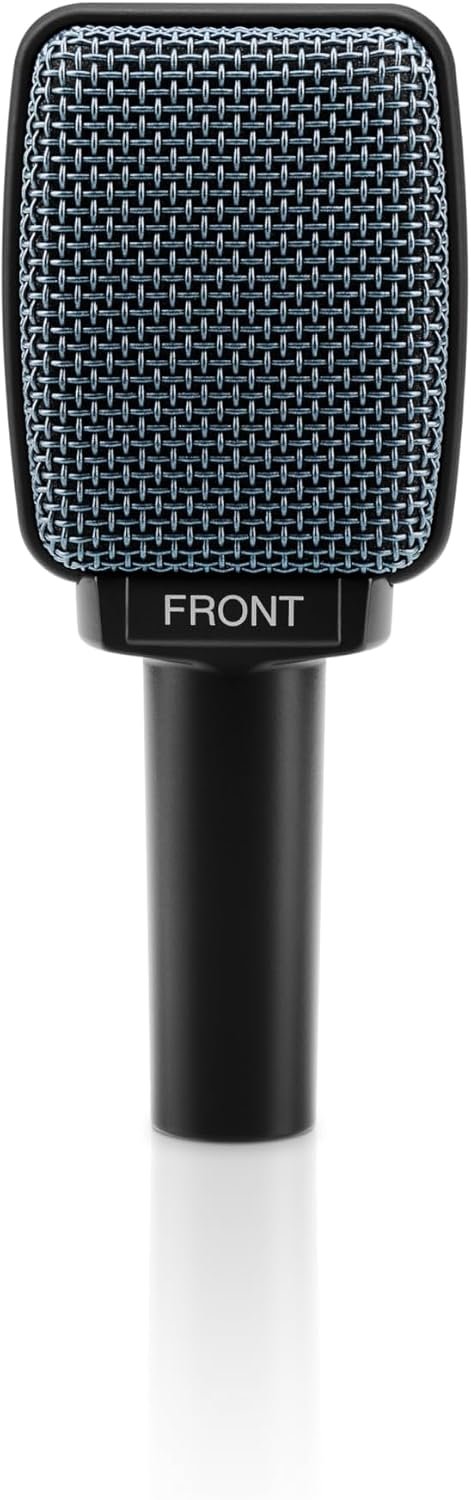
Sennheiser e906 Instrument Microphone
As an Amazon Associate I earn from qualifying purchases.
Recording a guitar amplifier is about capturing more than the signal coming from a guitar. The amplifier, speaker and microphone position all contribute to the finished sound.
The Sennheiser e906 Instrument Microphone is designed specifically for that job.
Its distinctive flat body allows convenient positioning in front of a guitar speaker, while a supercardioid pickup pattern helps concentrate on the amplifier rather than the surrounding room.
There is also a three-position presence filter, giving guitarists a useful way to adjust the microphone’s tonal response before the signal reaches their recording equipment.
For musicians who enjoy the sound of a real amplifier, the e906 offers a practical combination of thoughtful design, rugged construction and useful sound control.
Why the Sennheiser e906 Works for Guitar Amplifiers
Many microphones can record a guitar amplifier, but not all are designed with amplifier cabinets in mind.
The e906 has a flat, side-address design that allows its front grille to sit close to the speaker.
Unlike a conventional end-address microphone, which normally points towards the amplifier from a stand, the e906 can hang in front of a cabinet using its connected microphone cable.
This can be particularly convenient in a home studio or on a crowded stage where floor space is limited.
Sennheiser also designed the microphone to handle the high sound-pressure levels associated with loud guitar cabinets.
Its dynamic capsule captures the amplified sound without requiring external phantom power.
The result is a microphone that concentrates on a specific job rather than trying to provide every possible recording feature.
Three Presence Settings for Different Guitar Sounds
One of the e906’s most useful features is its three-position presence filter.
This allows the microphone’s upper-midrange response to be changed without relying entirely on equalisation elsewhere in the recording chain.
The available settings are:
Bright: Boosts the presence region, adding emphasis that can help distorted guitars sound more aggressive and defined.
Normal: Provides a more neutral response, making it a sensible starting point for a wide range of guitar amplifier sounds.
Dark: Reduces presence, helping tame an excessively bright or harsh amplifier.
Sennheiser centres this adjustment around approximately 4.2 kHz.
That frequency region can be particularly important for electric guitar because it influences how much attack, bite and definition comes through.
A brighter setting may help a heavy rhythm guitar remain noticeable in a dense arrangement.
The darker setting can be useful when an amplifier already produces plenty of treble.
Importantly, these settings do not transform the e906 into three completely different microphones. They offer a practical degree of adjustment around its fundamental character.
The switch is recessed and requires a small pointed tool to operate, so it is better suited to deliberate sound adjustment than frequent changes during a performance.
A Focused Supercardioid Pickup Pattern
The e906 uses a supercardioid pickup pattern.
This means it is particularly sensitive to sound arriving from the front while reducing much of the sound reaching it from the sides.
For close-miking a guitar cabinet, that is a useful characteristic.
It can help reduce unwanted sound from nearby instruments, stage monitors and room reflections.
However, supercardioid does not mean complete isolation.
The microphone retains some sensitivity behind it, and unwanted sound can still enter depending on how equipment is positioned.
This matters when recording several musicians in the same room.
Good microphone placement and sensible monitor positioning remain essential.
For guitarists working in smaller recording spaces, the focused pickup pattern provides a useful starting point without eliminating the need for careful setup.
Finding the Right Microphone Position
Even a high-quality microphone cannot compensate for careless placement.
The position of the e906 in relation to a guitar speaker can make a noticeable difference to the recorded tone.
Sennheiser provides useful guidance for three common positions.
Towards the Speaker Centre
Placing the microphone towards the centre of the speaker generally produces a brighter, more aggressive sound.
This can work well when a guitar needs a strong attack and clear upper-frequency definition.
However, some amplifiers may sound excessively sharp in this position.
Between the Centre and Outer Edge
Moving the microphone towards the area between the centre and edge generally produces a more balanced response.
The treble becomes less prominent, while the lower-middle frequencies are more noticeable.
This is a sensible starting position when trying to capture a natural guitar sound.
Towards the Outer Edge
Moving further towards the speaker’s edge generally softens the upper frequencies.
This can help with amplifiers that have an especially bright or aggressive character.
The important point is that microphone positioning should be explored before making extensive EQ adjustments.
Small changes can make a meaningful difference, and there is no single position that suits every amplifier.
What It Feels Like to Use
The e906 has a purposeful design.
Its reinforced metal housing is intended for regular studio and stage use, while the shock-mounted capsule helps reduce mechanical vibration and handling noise.
The microphone measures approximately 134 mm long and weighs 140 grams.
Its flat shape makes it relatively unobtrusive in front of a guitar cabinet.
There are no batteries to charge, complicated digital menus or applications to configure.
The basic process is straightforward: connect a suitable XLR cable, position the microphone, select the preferred presence setting and adjust the microphone gain on the connected equipment.
Sennheiser also includes a microphone clip and storage pouch.
These details make the e906 practical for musicians who want professional recording equipment without unnecessary complexity.
Recording a Real Amplifier
A major attraction of the e906 is its ability to capture the actual sound coming from a guitar speaker.
For a home recording setup, the signal path is straightforward:
Guitar → Amplifier → Sennheiser e906 → XLR Cable → Audio Interface → Computer
This captures the sound produced by the amplifier and its speaker rather than relying exclusively on a digital simulation.
That can be particularly satisfying for guitarists who have spent time developing a sound using their own amplifier and effects pedals.
However, recording a microphone is not always the most convenient approach.
Our Marshall CODE25 Digital Guitar Amp article explores an alternative amplifier with USB recording capabilities.
Direct recording can be convenient when working quietly, whereas microphone recording allows players to experiment with the relationship between the real speaker and microphone.
Neither method is automatically better. They offer different approaches to capturing a guitar performance.
How It Compares With a Traditional Instrument Microphone
Guitarists considering the e906 may already be familiar with the Shure SM57.
Both are respected dynamic microphones used extensively for close-miking instruments, but their designs are different.
The e906 features a flat body and three selectable presence settings.
The SM57 has a more conventional microphone shape and a fixed tonal response.
Our Shure SM57 Instrument Microphone article explains that microphone’s approach to recording guitar cabinets and other instruments.
The e906’s advantage is not that it automatically makes every amplifier sound better.
Its particular appeal lies in convenient speaker placement and the ability to adjust presence at the microphone.
Which design works best ultimately depends on the amplifier, recording environment and preferred guitar sound.
The Drawbacks
The Sennheiser e906 offers several genuine advantages, but there are important limitations worth understanding before choosing it.
It Requires Additional Recording Equipment
The e906 is not a USB microphone.
It uses a conventional three-pin XLR connector and needs a compatible microphone input with suitable preamplification.
For computer recording, this normally means using an audio interface or mixing equipment.
An XLR cable is also required and should not be assumed to be included with the microphone.
Musicians starting their first recording setup may therefore need more than the microphone itself.
Microphone Placement Still Takes Practice
Although the flat design makes positioning convenient, it does not automatically guarantee a good recorded guitar sound.
Moving the microphone across the speaker can substantially change the tonal balance.
The amplifier’s volume, room acoustics and speaker construction can also influence the result.
Finding the best position may involve recording several short passages and comparing them carefully.
Players expecting an instantly finished sound may find this process less convenient than direct digital recording.
The Flat Design Has Limitations
Allowing the microphone to hang in front of a cabinet can eliminate the need for a separate stand in some situations.
However, the cable needs to be routed carefully, and the microphone must remain positioned correctly.
A cable that shifts or becomes caught on nearby equipment could move the microphone away from its intended position.
A conventional microphone stand and the supplied clip may still be preferable when precise placement or a particular angle is needed.
The hanging arrangement is convenient, but it isn’t necessarily the best solution for every setup.
The Presence Filter Is Not an Equaliser
The three sound settings are useful, but they only adjust a particular region of the microphone’s frequency response.
They cannot replace a full equaliser.
If an amplifier produces excessive bass, unpleasant resonances or other tonal problems, the presence switch will not solve everything.
The settings are best understood as useful refinements rather than comprehensive sound-shaping controls.
The recessed switch also makes quick adjustments less convenient.
Supercardioid Pickup Requires Careful Positioning
The focused pickup pattern helps reduce unwanted surrounding sound, but it does not reject everything outside the front of the microphone.
Supercardioid microphones retain a region of sensitivity towards the rear.
This can matter on a stage where loud monitors or other equipment are positioned behind the microphone.
Poor positioning may allow unwanted sound or increase the possibility of feedback.
Its directional characteristics are useful, but they still require sensible placement.
Not an Ideal General-Purpose Microphone
The e906 is primarily designed for instrument recording.
Its flat body and frequency response make particular sense when placed close to guitar speakers.
Although it can also capture drums, percussion and brass instruments, it would not necessarily be the first choice for a singer looking for a conventional handheld vocal microphone.
Likewise, musicians who mainly record quiet acoustic performances, room ambience or detailed vocal sessions may prefer another microphone design.
A specialist product is most valuable when its intended purpose matches the buyer’s requirements.
Recording a Real Amplifier Can Be Inconvenient
Microphone recording normally requires the amplifier’s speaker to produce sound.
That can be a disadvantage for musicians recording late at night or sharing accommodation.
A guitar amplifier may sound excellent at a comfortable playing volume but become disruptive when used in a small room.
Players whose main priority is completely silent recording may find a suitable digital amplifier, modelling processor or audio interface arrangement more convenient.
The e906 is most rewarding when recording a physical guitar speaker is actually part of the intended setup.
Who It Suits Best
The Sennheiser e906 is particularly suitable for guitarists who want to record or amplify real guitar cabinets.
It makes sense for home studio musicians, recording engineers and performers who appreciate a focused instrument microphone with useful tonal flexibility.
The flat profile and selectable presence settings are especially attractive to players who regularly experiment with amplifier sounds.
Its durable construction and straightforward XLR operation also make it a sensible choice for musicians who value dependable, purpose-built equipment.
For more practical equipment covering guitar playing, amplification and recording, explore our Accessories collection.
Musicians who only need a USB microphone for computer calls, or who primarily record directly through software amplifier simulations, may have little need for a dedicated cabinet microphone.
Is the Sennheiser e906 Worth Considering?
The Sennheiser e906 succeeds because it concentrates on a particular task and provides useful features for doing that task well.
Its flat shape, supercardioid pickup pattern, reinforced metal housing and three-position presence filter all have practical relevance when recording guitar amplifiers.
The limitations are equally important. It requires appropriate recording equipment, rewards careful microphone placement and is less suitable for musicians who need an all-purpose microphone.
For guitarists who enjoy the character of a real amplifier and want greater control over how that sound is captured, the e906 is a professional instrument microphone with genuine purpose.
It earns consideration through thoughtful engineering and practical usefulness rather than unnecessary features.
As an Amazon Associate I earn from qualifying purchases.