Marshall CODE25 Digital Guitar Amp
As an Amazon Associate I earn from qualifying purchases.
The Marshall CODE25 digital guitar amp brings a surprisingly extensive range of amplifier sounds and effects into one compact practice combo. Designed for guitarists who enjoy experimenting with tone, it combines classic Marshall-inspired sounds with modern digital modelling, Bluetooth connectivity and editable presets.
With 25 watts of output, a custom 10-inch speaker and 100 onboard presets, the CODE25 offers plenty to explore without needing a collection of separate amplifiers and effects pedals.
Its greatest appeal is flexibility. Whether you’re learning your first riffs, working on a familiar rock sound or experimenting with something entirely different, this is an amplifier designed to encourage exploration.
Why It Works for Home Guitar Practice
A good home amplifier needs to do more than produce plenty of volume. It should make practising enjoyable, offer useful sounds at manageable levels and fit comfortably into an everyday playing space.
The Marshall CODE25 addresses these requirements with an all-in-one design that keeps the amplifier, speaker and digital effects inside a relatively small cabinet.
Measuring approximately 350mm wide, 340mm high and 215mm deep, it can sit in a bedroom, home studio or dedicated practice area without demanding much floor space.
At approximately 6.1kg, it is also manageable to move between rooms or take along to informal playing sessions.
Its 25-watt output provides more than enough scope for everyday home practice. Unlike an amplifier that relies on being driven hard to produce distortion, the CODE25 uses digital modelling to offer a variety of sounds without demanding excessive volume.
For someone practising regularly at home, that flexibility is particularly useful.
What It Feels Like to Use
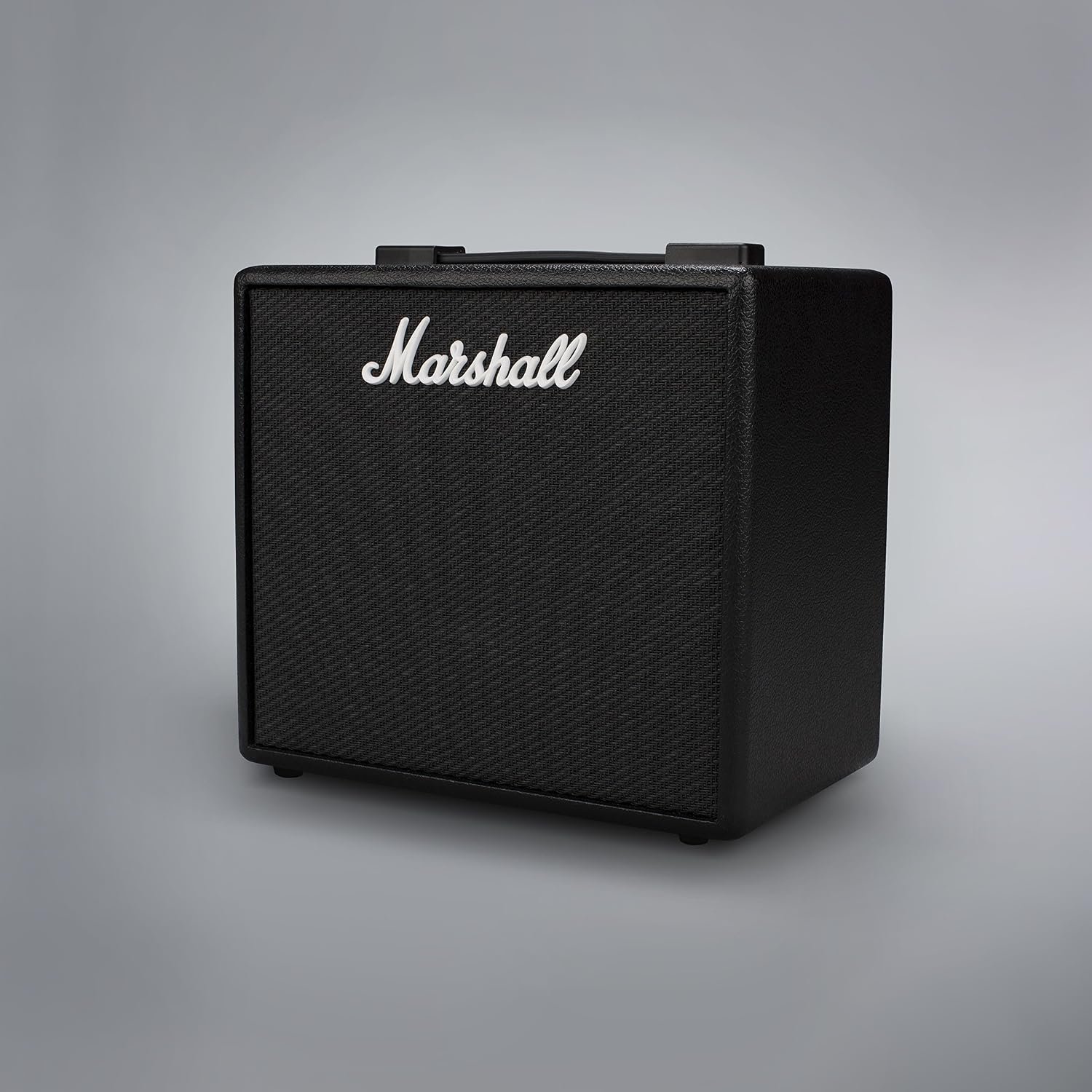
The CODE25 retains the familiar appearance of a traditional Marshall amplifier, with its black cabinet, prominent logo and straightforward rectangular shape.
It looks like a proper guitar amplifier rather than a piece of desktop computer equipment, which will appeal to players who appreciate Marshall’s established styling.
Across the control panel are familiar adjustments for gain, bass, middle, treble and volume, alongside controls for selecting amplifier models and effects.
However, this is more than a conventional amplifier with a handful of knobs.
Behind those controls is an extensive digital sound-shaping system, allowing the player to change the character of the amplifier, select effects and store favourite combinations.
The 100 editable presets provide a convenient starting point. Instead of adjusting every setting from scratch, players can begin with an existing sound and refine it to suit their guitar and playing style.
Once a useful combination is found, it can be saved for future sessions.
That makes the CODE25 particularly appealing to guitarists who move regularly between clean passages, blues-inspired crunch, classic rock distortion and heavier modern sounds.
Classic Marshall Character With Digital Flexibility
One of the CODE25’s strongest features is its selection of digital amplifier models.
Marshall’s modelling system includes 14 preamp models, four power-amp models and eight speaker-cabinet models.
These options allow players to explore different combinations rather than being restricted to one fixed amplifier voice.
The modelling technology draws inspiration from Marshall’s long history of guitar amplification, providing a selection of sounds associated with different eras and styles.
There is plenty of scope for warm clean tones, British-style crunch, saturated rock sounds and more heavily driven settings.
The CODE25 also includes 24 built-in digital effects, with up to five available simultaneously.
These include useful sound-shaping options such as modulation, delay and reverb, allowing players to add depth, movement or atmosphere without immediately buying separate effects pedals.
For guitarists still discovering which sounds they enjoy, having so many possibilities inside one amplifier can be genuinely useful.
It also makes the CODE25 an interesting option for players who want to experiment with effects before investing in a larger pedalboard.
Bluetooth, Presets and Everyday Convenience
The CODE25 combines traditional amplifier controls with additional digital features.
Bluetooth connectivity allows compatible mobile devices to connect to the amplifier, while Marshall’s Gateway app provides access to further sound-editing functions.
Through the app, guitarists can adjust settings, work with presets and manage sounds from a phone or tablet.
This is particularly convenient when exploring more detailed combinations of amplifier models and effects.
Marshall also provides an online preset-sharing platform, allowing CODE users to discover and exchange sounds.
For home practice, Bluetooth audio streaming is another useful feature. Players can listen to music or backing tracks through the amplifier while practising their guitar parts.
A 3.5mm auxiliary input provides an alternative wired connection, while the headphone output offers a practical option for quieter sessions.
The amplifier also supports USB connectivity for computer-based audio recording, adding another useful possibility for players developing a home recording setup.
These features give the CODE25 a broader role than a simple practice amplifier. It can support learning, tone experimentation, backing-track practice and basic recording activities from one compact unit.
The Drawbacks
The Marshall CODE25 offers considerable flexibility, but its digital approach will not suit every guitarist.
Its extensive sound options can feel complicated.
With numerous amplifier models, cabinet simulations, effects and editable presets, there is considerably more to learn than on a traditional amplifier with a few controls.
Players who simply want to connect their guitar, turn up the volume and start playing may find the selection process distracting.
Although the factory presets provide a useful introduction, finding a particularly satisfying sound can require patience.
The factory presets will not appeal to everyone.
Some guitarists may find certain presets too heavily processed or bass-heavy for their preferences.
A sound that initially appears impressive can become less satisfying during extended practice, particularly when distortion, cabinet simulation and effects are combined.
Adjusting the equalisation, amplifier model and effects can help, but buyers should understand that the CODE25 rewards experimentation rather than offering perfect results from every factory setting.
The 10-inch speaker has practical limitations.
The compact speaker suits the amplifier’s home-practice purpose, but players accustomed to a larger 12-inch speaker or a substantial guitar cabinet may miss some of the physical fullness and low-frequency presence.
This is particularly relevant when playing heavier material or expecting the sound and feel of a larger stage amplifier.
It is not necessarily a problem for bedroom practice, but it matters when deciding what role the amplifier needs to fulfil.
Digital modelling does not reproduce every characteristic of a valve amplifier.
The CODE25 offers sounds inspired by classic Marshall equipment, but its response and feel are not identical to a traditional valve-driven Marshall.
Players who particularly value the interaction between their guitar, amplifier and valves may prefer a simpler analogue or valve-based design.
The CODE25 is better understood as a versatile digital amplifier than a direct replacement for every classic amplifier it models.
Bluetooth and app operation introduce another layer of complexity.
Although the amplifier can be controlled directly from its own panel, some advanced editing functions are more convenient through the Gateway app.
Pairing, reconnecting and maintaining compatibility with mobile devices may occasionally require troubleshooting.
Anyone who prefers equipment that operates entirely independently of apps and wireless connections should consider this before buying.
Expansion options are limited.
The CODE25 does not include a conventional effects loop or an external speaker-cabinet output.
That makes it less suitable for guitarists planning to expand into more complicated amplifier and effects arrangements.
Its 25-watt output and compact speaker are also better matched to home playing than consistently competing with loud acoustic drums during rehearsals.
Although small performances may be possible in suitable circumstances, players whose main requirement is a powerful live amplifier should consider larger alternatives.
None of these limitations makes the CODE25 unsuitable for its intended purpose. They simply underline that it is designed primarily around convenient digital flexibility rather than traditional simplicity or substantial stage volume.
Who It Suits Best
The Marshall CODE25 is particularly well suited to guitarists who enjoy experimenting with different amplifier sounds and effects.
Beginners may appreciate having a broad selection of tones available without needing to purchase additional pedals immediately.
Intermediate players can use the editable presets to develop favourite sounds for different songs and playing styles.
Home guitarists who practise with backing tracks, use headphones or explore recording will also find its connectivity useful.
It makes particular sense for anyone who enjoys the Marshall sound but wants greater tonal variety than a basic practice amplifier can provide.
On the other hand, players who mainly use one clean or overdriven sound and dislike navigating presets may be happier with a simpler amplifier.
Likewise, guitarists concentrating on regular band rehearsals or live performances should consider whether a larger combo would be more suitable.
Is the Marshall CODE25 Worth the Space?
For a compact home guitar amplifier, the Marshall CODE25 manages to include an impressive range of practical features.
Its combination of digital amplifier modelling, built-in effects, editable presets and Bluetooth connectivity creates plenty of opportunities for learning and musical experimentation.
The familiar Marshall styling is another attraction, giving it the appearance of a traditional guitar amplifier despite its modern digital design.
It is not the obvious choice for someone seeking the simplicity and physical response of a classic valve amplifier. Nor is it intended to replace a substantial amplifier for demanding stage work.
However, for a guitarist who wants numerous Marshall-inspired sounds, useful practice features and creative flexibility in one manageable cabinet, the CODE25 makes a sensible option.
The key is being prepared to spend some time exploring its settings rather than expecting every sound to be ideal immediately.
For more options, explore our Guitar Amplifiers collection, featuring equipment for different playing styles, practice spaces and musical requirements.
As an Amazon Associate I earn from qualifying purchases.