Shure SM57 Instrument Microphone
As an Amazon Associate I earn from qualifying purchases.
The Shure SM57 Instrument Microphone is one of those pieces of recording equipment with a very straightforward job: place it in front of an instrument or amplifier and capture the sound without requiring a complicated setup.
For guitarists, its most obvious use is close-miking a guitar cabinet. The compact body can sit close to the speaker, while the cardioid pickup pattern concentrates on the sound in front of the microphone and reduces sound arriving from behind it. Shure specifically lists guitar and bass amplifiers among the SM57’s intended applications.
It is equally at home around drums, percussion and acoustic instruments, which makes it useful beyond one guitar setup.
Why it works for guitar amplifiers
Recording an electric guitar amplifier is not only about the microphone. Where that microphone sits in relation to the speaker can make a surprisingly large difference.
The SM57’s cardioid pattern makes it particularly practical for this kind of close placement. Point it towards the speaker and it focuses strongly on what is directly in front while reducing unwanted room sound and spill from behind.
That gives you room to experiment.
Moving the microphone closer to the centre of a guitar speaker generally produces a brighter, more immediate sound, while moving it towards the outer part of the cone usually softens the top end. Even small changes in position can alter the recorded tone noticeably.
The SM57 therefore encourages a useful habit: moving the microphone before reaching for EQ.
For home recording, that can be far more satisfying than trying to repair an awkward guitar sound afterwards.
What it feels like to use
Physically, the SM57 feels dense and purposeful.
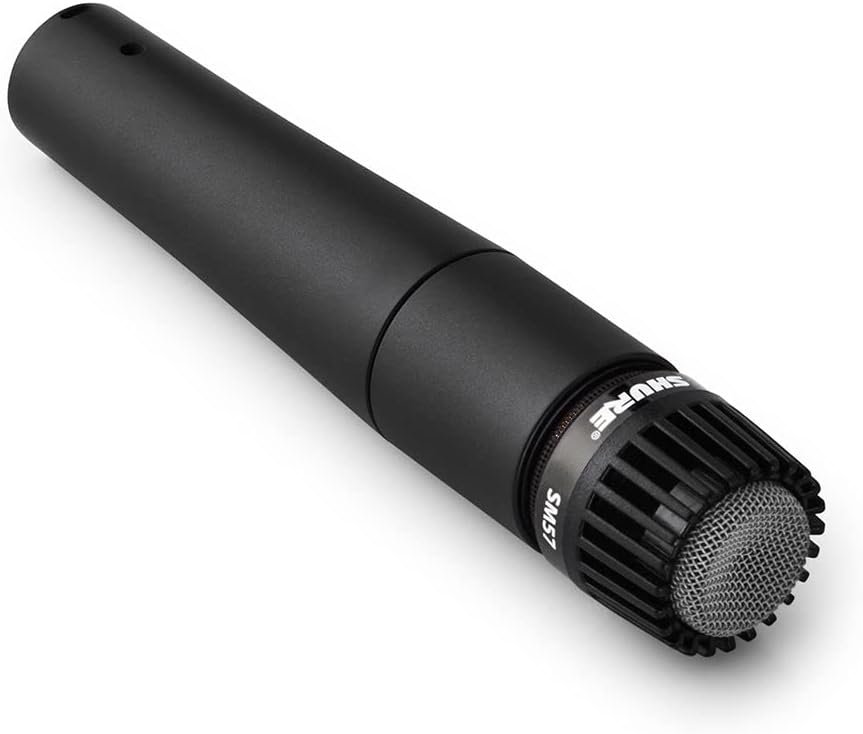
Shure uses a die-cast steel body with a polycarbonate grille and stainless-steel screen. It weighs about 284g, so it has enough heft to feel substantial without making microphone positioning awkward.
The narrow head is particularly useful around guitar cabinets and drum kits because it can get close to the sound source without taking up much room.
There are no switches, batteries, displays or controls on the microphone itself.
Connect an XLR cable, position the microphone and set the input gain on your interface or mixer.
That simplicity is part of what makes the SM57 easy to keep permanently available in a recording setup.
A focused instrument sound
Shure gives the SM57 a frequency response of 40Hz to 15kHz with a contoured response intended to help instruments remain clear in a mix.
It does not aim to capture every frequency with the flat, open character associated with some studio condenser microphones.
Instead, there is a deliberate presence to the upper midrange that can help electric guitar, snare drum and other instruments maintain definition.
For a guitar cabinet, that can be particularly useful.
Distorted guitar already produces a lot of harmonic information. A microphone that keeps the important midrange clear can help the recorded part sit naturally alongside drums and bass without needing extreme processing later.
The SM57 can also handle the high sound levels produced by instrument amplifiers, which is one reason Shure continues to position it for close-miking amplified instruments.
Useful beyond electric guitar
Although guitar amplifiers are an obvious match, the SM57 does not need to spend its entire life in front of one speaker.
Shure recommends it for drums, percussion, saxophone, trumpet and acoustic instruments as well as guitar and bass amplifiers.
That versatility is useful in a small home studio.
One microphone might record a guitar cabinet one day, sit over a snare drum another day and be used on an acoustic instrument later.
Its pneumatic shock-mount system is designed to reduce handling and mechanical noise reaching the microphone element.
That does not replace sensible microphone positioning, but it helps make the SM57 less fussy in everyday use.
XLR connection and recording setup
The SM57 uses a standard three-pin male XLR connector.
That means you normally connect it to a microphone preamp, mixing desk or audio interface with a suitable microphone input.
For a home guitarist, a common setup would be:
Guitar → amplifier → SM57 → XLR cable → audio interface → computer.
The microphone captures the actual speaker rather than taking a simulated amplifier signal directly into the recording software.
That approach also captures some of the interaction between the amplifier, speaker and microphone position.
Moving the SM57 a few centimetres can produce a different tone without changing a single setting on the amplifier.
The drawbacks
The first limitation is that the SM57 is not a USB microphone.
It has an XLR connection, so it cannot simply be plugged into an ordinary computer USB socket. You need an audio interface, mixer or microphone preamp with a suitable XLR microphone input.
An XLR cable is also required, and the standard SM57-LCE package should not be assumed to include one. Shure lists the stand adapter, thread adapter and storage pouch with the LCE version, while cables are separate accessories.
That means somebody beginning from absolutely nothing needs more than just the microphone.
The output level is another consideration.
Shure specifies sensitivity of -56 dBV/Pa, which is quite normal for a dynamic microphone but considerably lower than many powered condenser microphones.
In practice, your audio interface needs enough clean microphone gain to bring quieter sources up to a useful recording level.
A loud guitar amplifier is unlikely to present much difficulty, but soft acoustic sources or quiet speech may require noticeably more preamp gain.
The SM57 also has a very recognisable tonal character.
That upper-midrange presence can help a guitar cut through a mix, but it will not suit every source or every guitarist.
If you want a very broad, airy recording with lots of room detail and high-frequency extension, a good condenser microphone may provide more of that character.
The SM57 stops at 15kHz rather than extending far into the ultrasonic range claimed by many studio condensers.
That is not a problem when the goal is recording an electric guitar cabinet, but it is worth understanding what kind of tool this is.
Microphone placement also matters enormously.
The SM57 will not automatically make an amplifier sound good simply because it has been placed somewhere in front of the grille cloth.
Put it close to the centre of the speaker and the tone can become quite bright and aggressive. Move it too far towards the outer edge and the result may become dull.
Finding the useful position can involve several small adjustments and test recordings.
The cardioid pattern reduces sound from behind, but it does not completely remove the room.
Reflections from walls, floors and nearby surfaces can still enter the recording, particularly as the microphone is moved further away from the source.
A poor-sounding room therefore does not magically disappear.
There is also no built-in pad, high-pass filter or output-level control.
Some microphones provide switches for changing their response before the signal reaches the preamp. The SM57 deliberately keeps things simpler.
Any filtering, EQ or level management happens elsewhere in the recording chain.
Its shape can also make it slightly awkward for conventional vocals.
The grille is narrower than the rounded ball grille of something like an SM58, so it offers less physical protection against breath and plosive air when somebody sings directly into it.
The SM57 can certainly capture vocals, and Shure notes its suitability for vocal pickup, but singers may prefer a microphone with a built-in spherical windscreen or an external pop filter.
Then there is the fact that microphone technique takes time to learn.
A guitarist used to plugging directly into an interface may initially find cabinet miking less predictable. The amplifier volume, room, speaker position, microphone angle and microphone distance can all affect the result.
That extra effort is precisely why many players enjoy miking a real amplifier, but it is not the fastest possible recording method.
And finally, the SM57 is best appreciated as a focused tool rather than a microphone that is automatically ideal for everything.
It can cover a remarkable number of sources, but a studio with several microphones may still choose a different model for vocals, room ambience, delicate acoustic guitar or low-frequency-heavy instruments.
Its strength is not that it makes every other microphone unnecessary.
Its strength is that there are a great many situations where putting an SM57 in the right place simply works.
Who it suits best
The Shure SM57 makes particular sense for guitarists who record real amplifiers rather than relying entirely on amp-modelling software.
It should also suit home musicians who want one rugged microphone capable of handling guitar cabinets, drums and other instruments without requiring delicate treatment.
Its compact shape is useful in a small studio, and the cardioid pattern helps when several sound sources are present in the same room.
It can also be a sensible first instrument microphone for somebody who already owns an audio interface with a microphone input.
Is it worth the studio space?
The Shure SM57 earns its place by being simple, durable and extremely focused on practical instrument recording.
There are no apps to install, batteries to charge or menus to learn. Its dynamic capsule, cardioid pattern and pneumatic shock mounting are designed around capturing instruments reliably, while the narrow body makes close positioning around guitar cabinets and drums straightforward.
It does require an XLR recording setup, and its focused tonal character will not replace a good condenser microphone when you want a very open, detailed room sound.
But for recording guitar amplifiers and a wide range of other instruments, the SM57 remains a very straightforward piece of equipment to understand and use.
Explore more useful recording gear in our Accessories section.
As an Amazon Associate I earn from qualifying purchases.