D’Addario XPND 1 Expandable Pedalboard
As an Amazon Associate I earn from qualifying purchases.
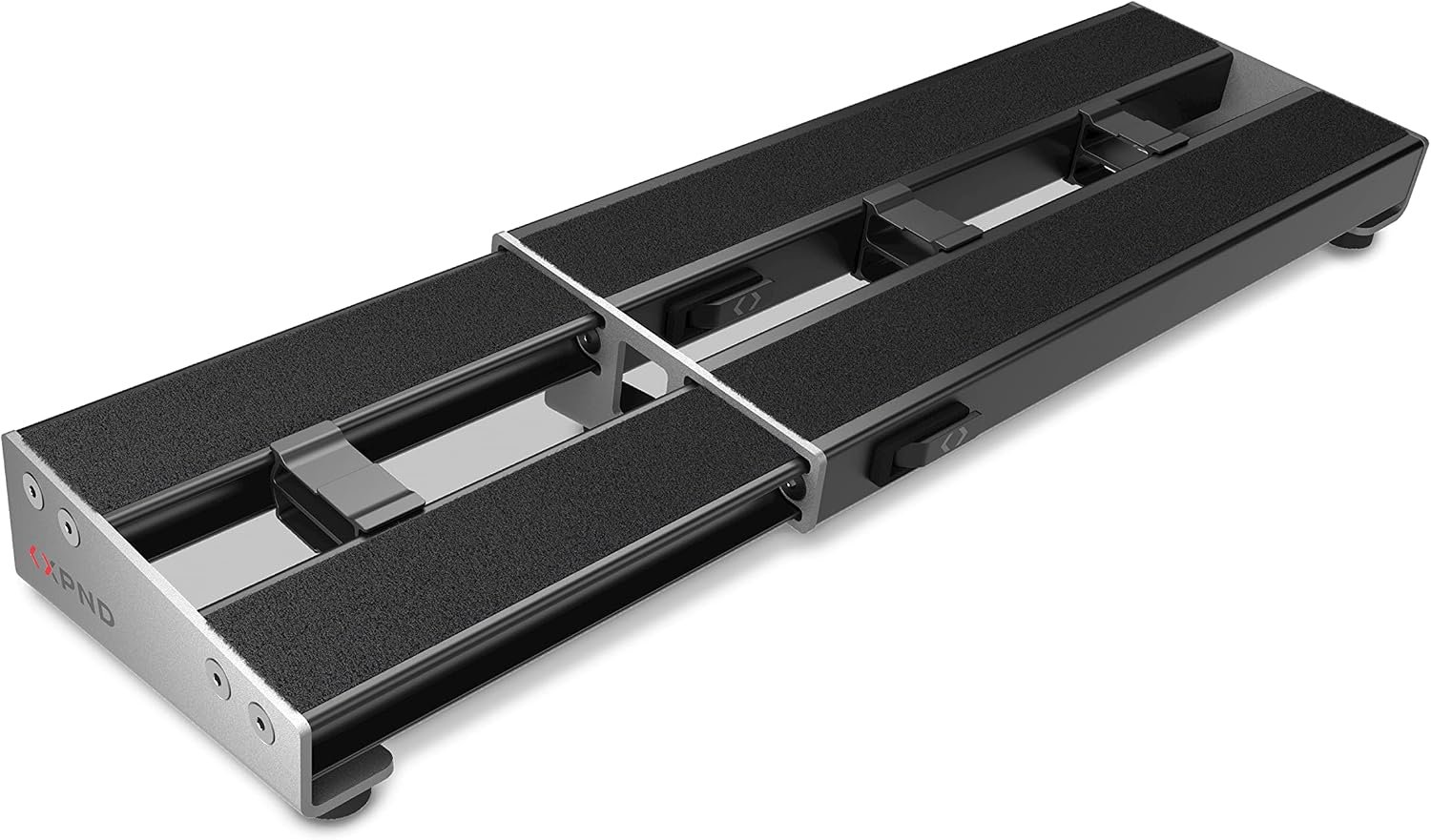
The D’Addario XPND 1 Expandable Pedalboard offers a practical solution for guitarists who want to organise their effects pedals without committing to a fixed-size board.
Constructed from aluminium, it features a telescoping frame that expands from approximately 14 to 24 inches, allowing the available space to change as a pedal collection grows.
Its single-row arrangement, integrated cable management and pre-applied hook-and-loop fastening make it particularly appealing to guitarists who prefer an organised, manageable setup.
Unlike a traditional fixed pedalboard, the XPND 1 can be adjusted to accommodate different combinations of effects without immediately replacing the entire platform.
However, its relatively narrow depth, limited space beneath the frame and single-row design introduce some important compromises.
For guitarists who value flexibility, practical construction and a tidy pedal arrangement, the D’Addario XPND 1 is an interesting option.
Why It Works for Guitarists
A pedalboard should make guitar equipment easier to organise, connect and transport.
Individual effects pedals can quickly become untidy when they are placed directly on the floor.
Patch cables run between them, power connections become tangled, and moving the complete setup can be inconvenient.
A dedicated pedalboard provides a secure platform that keeps the equipment together.
The XPND 1 takes this familiar concept further by allowing the length of the board to change.
Its telescoping mechanism means guitarists can begin with a relatively small collection and extend the frame when additional pedals become necessary.
This is particularly useful for players who regularly experiment with different effects.
A guitarist might initially use only a tuner, overdrive and delay pedal.
Later, they may decide to add modulation, compression or another drive pedal.
Rather than immediately purchasing a larger fixed board, the XPND 1 provides room for adjustment within its specified limits.
The advantage is practical flexibility, not additional sound processing.
The pedalboard itself does not alter guitar tone. Its job is to keep the equipment organised and accessible.
What It Feels Like to Use
The XPND 1 has a straightforward black aluminium design.
It avoids unnecessary decoration and concentrates on providing a stable platform for guitar effects pedals.
D’Addario specifies the following dimensions:
- Adjustable length: 14–24 inches
- Depth: 5.85 inches
- Height: 2.57 inches
- Configuration: Single row
- Construction: Aluminium
The relatively shallow design is one of its defining characteristics.
Rather than creating a large platform with multiple rows, the board arranges pedals in a line.
This makes it practical for conventional stompboxes that can sit comfortably within the available depth.
The black finish also provides a neutral background for pedals of different colours and sizes.
The Telescoping Frame
The expanding mechanism is the feature that distinguishes the XPND 1 from ordinary pedalboards.
The frame adjusts in length to accommodate changing equipment requirements.
This allows guitarists to use a smaller configuration when only a few pedals are required and extend the board when their setup becomes more involved.
However, expansion should be planned around the actual dimensions of the pedals.
Adding length does not increase the available depth.
A physically large pedal may still be unsuitable even when plenty of length remains.
Organising Your Pedals
The XPND 1 is particularly suited to conventional individual effects pedals.
A compact tuner, overdrive, modulation pedal and delay can form the basis of a useful guitar setup.
For example, our BOSS BD-2 Blues Driver article explores a traditional overdrive pedal that could form part of a compact effects arrangement.
Another interesting option is the BOSS RC-1 Loop Station, which introduces looping functionality for practice and creative playing.
Both illustrate the type of individual pedal that guitarists may want to organise on a dedicated board.
Planning the Signal Chain
Before attaching anything permanently, it is worth deciding how the pedals will connect.
A conventional arrangement might place a tuner near the beginning of the signal chain, followed by drive and modulation effects.
Delay and reverb are often positioned later, although there are no universal rules.
The correct order depends on the equipment and the sounds the guitarist wants to achieve.
Pedal placement should also account for input and output sockets.
Some pedals use side-mounted connections, while others have top-mounted jacks.
These differences can influence how closely the pedals can sit together.
The XPND 1 provides adjustable space, but thoughtful planning remains important.
Cable Management and Pedal Fastening
D’Addario includes an integrated cable management system with the XPND design.
This provides a more organised way to route connections rather than leaving cables spread across the floor.
Keeping patch cables tidy can reduce accidental snags and make individual connections easier to identify.
However, cable management does not automatically eliminate unwanted electrical noise.
That depends on factors such as power-supply quality, grounding, cable condition and the equipment being used.
Pre-Applied Loop Fastening
The XPND 1 comes with loop fastening already applied to the frame.
Compatible hook material on the pedals allows them to be secured to the board.
This makes the arrangement easier to change than permanently attaching equipment with screws.
It is useful for guitarists who frequently experiment with different pedal combinations.
Nevertheless, the fastening must be applied correctly.
Pedal surfaces should be clean, and the attachment material should be suitable for the weight and shape of the equipment.
Larger pedals may need additional consideration to remain secure during transport.
Power Supply Considerations
A pedalboard is only part of a working effects system.
Most guitarists also need a reliable way to power their pedals.
This is one area where the XPND 1 requires careful planning.
Because the single-row frame is relatively low, there is limited clearance beneath it.
D’Addario confirms compatibility with selected compact power supplies, including the CIOKS DC7 and Voodoo Lab Pedal Power X4.
However, buyers should not assume that every conventional pedalboard power supply will fit underneath.
The manufacturer’s current compatibility guidance should be checked before selecting a unit.
An alternative is to position a suitable power supply on top of the board, although this uses space that could otherwise accommodate another pedal.
A compatible external or daisy-chain power arrangement may also be possible, depending on the equipment.
For guitarists who want several isolated power outputs hidden neatly underneath their board, the limited clearance could be a significant drawback.
Rehearsals and Live Performance
The aluminium construction and adjustable dimensions make the XPND 1 relevant to guitarists who regularly move their equipment.
Keeping effects pedals attached to one platform can simplify setting up for rehearsals and performances.
Instead of arranging individual pedals on the floor every time, the guitarist can position the board and connect the necessary cables.
However, a pedalboard is not a protective carrying case.
A suitable transport bag or case is important when moving equipment regularly.
D’Addario offers a compatible transporter separately.
Players should check the dimensions of the board, including its extended length and any attached pedals, before choosing a carrying solution.
The Drawbacks
The D’Addario XPND 1 has a clever adjustable design, but it is not the ideal pedalboard for every guitarist.
Its compact single-row construction introduces several limitations that are important to understand.
Limited Space Beneath the Board
The most significant drawback is the restricted clearance for power supplies.
Many guitarists prefer to mount an isolated power supply underneath their pedalboard.
This keeps the upper surface available for effects and creates a tidier arrangement.
The XPND 1 does not provide enough clearance for every commonly available power unit.
Although D’Addario identifies several compatible models, musicians using an existing larger power supply may need to reconsider its position.
A board that expands to accommodate more pedals is less convenient if the power supply consumes valuable space on top.
This issue deserves attention before buying.
The Single-Row Design Restricts Larger Pedals
The XPND 1 is intended primarily for a single line of pedals.
Its 5.85-inch depth works well with many conventional stompboxes, but not every effect has a compact footprint.
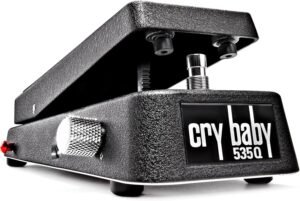
Large multi-effects processors, expression pedals and certain wah pedals may extend beyond the available platform.
Even when a pedal physically fits, its controls and connections must remain accessible.
Guitarists using unusually large equipment may prefer a deeper, two-row board.
Expanding Length Does Not Increase Depth
The telescoping frame makes the board more adaptable, but only in one direction.
Increasing its length provides more room for pedals arranged side by side.
It does not create additional space behind them.
This matters when using pedals with large rear-mounted connectors or cables that require extra clearance.
A guitarist whose setup becomes more complicated may eventually need a different pedalboard arrangement rather than simply extending the XPND 1.
The Carrying Case Is Separate
A secure pedalboard is useful, but transporting exposed effects pedals still requires care.
The XPND 1 does not automatically provide the protection of a dedicated carrying case.
D’Addario sells a compatible transporter separately.
That introduces another item to consider when planning a complete setup.
Guitarists who frequently travel to rehearsals or performances should assess the complete transport arrangement rather than the board alone.
Hook-and-Loop Fastening Has Limitations
Pre-applied fastening is convenient, but it requires compatible material on the pedals.
Attaching adhesive material to pedal enclosures may not appeal to every guitarist.
Some musicians prefer to avoid adhesives on collectible or particularly valuable equipment.
The grip can also become less effective if the fastening becomes dirty or worn.
Heavy pedals need to be checked carefully before transport.
A pedalboard should never be carried carelessly simply because its equipment appears securely attached.
Cables Still Need Careful Planning
Integrated cable management helps keep connections organised, but it cannot compensate for unsuitable cable lengths or awkward plug arrangements.
Pedals with side-mounted jacks may require more space than expected.
Poorly routed power and signal cables can also create clutter despite the available management features.
Guitarists should plan the arrangement before attaching everything permanently.
The board provides useful organisation, but it does not remove the need for sensible cable selection.
Not Everyone Needs an Expandable Design
The ability to adjust the board is appealing, but it may be unnecessary for guitarists with a permanent setup.
Someone using the same four pedals for years may be perfectly happy with a fixed-size board.
An expandable mechanism adds versatility, but that flexibility only becomes valuable when the equipment arrangement changes.
For a stable collection of pedals, simplicity may be more important.
The Board Cannot Replace Proper Pedal Protection
The aluminium frame provides a practical base, but pedals remain exposed to impacts, moisture and accidental damage.
Cables and connectors can also be vulnerable during transport.
The board does not provide the protection of an enclosed pedal case.
For frequent travel, suitable storage and careful handling remain necessary.
Who It Suits Best
The D’Addario XPND 1 is particularly suitable for guitarists who use a small or moderately sized collection of individual effects pedals.
It should appeal to players who want a tidy setup but expect to add or rearrange pedals over time.
Its compact single-row design makes sense for home practice, recording, rehearsals and suitable live performances.
The aluminium construction and adjustable length are useful features for musicians who prefer equipment that can adapt to changing needs.
However, players using large multi-effects processors, several expression pedals or a substantial underneath-mounted power supply may find the XPND 2 or another deeper board more practical.
Is the D’Addario XPND 1 Worth the Space?
The D’Addario XPND 1 Expandable Pedalboard offers a thoughtful alternative to a conventional fixed-size board.
Its aluminium frame, adjustable length, integrated cable management and pre-applied fastening create a practical foundation for a collection of guitar effects pedals.
The ability to expand from 14 to 24 inches is particularly useful for players whose equipment changes over time.
However, its limited depth and restricted power-supply clearance mean that careful planning is essential.
For guitarists using conventional compact pedals who appreciate a clean, adaptable arrangement, the XPND 1 is a worthwhile piece of practical guitar equipment.
Its greatest advantage is simple: the board can grow alongside a changing pedal collection without immediately requiring a complete replacement.
Explore more useful guitar equipment in our Accessories collection.
As an Amazon Associate I earn from qualifying purchases.