BOSS NS-1X Noise Suppressor Pedal
As an Amazon Associate I earn from qualifying purchases.
Unwanted noise can make an otherwise excellent guitar setup frustrating to use. A high-gain amplifier might sound powerful while playing, yet produce an irritating hiss or hum between notes. Add overdrive pedals, distortion and several cables, and the problem can become even more noticeable.
The BOSS NS-1X Noise Suppressor is designed to address these issues while preserving the natural response of the instrument.
Using BOSS Multi-Dimensional Processing technology, it analyses the incoming signal and applies noise suppression according to what the guitarist is playing. The aim is to reduce unwanted background sound without sacrificing the attack, sustain and dynamics that make guitar playing expressive.
With three operating modes, adjustable controls and a dedicated send/return loop, the NS-1X provides a more sophisticated approach to noise management than a conventional on/off noise gate.
It is particularly interesting for guitarists using distortion, high-gain amplifiers or elaborate pedalboards where unwanted noise can become part of the everyday playing experience.
Why Noise Suppression Matters for Guitarists
Every guitar setup produces some level of background noise.
Single-coil pickups can be susceptible to electrical interference, while distortion and overdrive pedals amplify not only the musical signal but also unwanted sounds already present in the chain.
High-gain amplifier settings can make these problems more obvious.
A little background hiss may be acceptable during casual practice, but the situation changes when recording quiet passages or playing live.
Noise between notes can make rhythmic sections sound untidy, while sustained hum during pauses can distract from the performance.
Traditional noise gates address this by reducing the signal when it falls below a selected threshold.
The difficulty is distinguishing unwanted noise from quiet musical information. If a gate operates too aggressively, softly played notes or naturally decaying chords can disappear prematurely.
The NS-1X uses more advanced processing to manage that balance.
Its purpose is not to change the character of the guitar sound, but to make unwanted background noise less intrusive.
How BOSS Multi-Dimensional Processing Works
The central feature of the NS-1X is BOSS’s proprietary Multi-Dimensional Processing, usually shortened to MDP.
Rather than relying solely on a basic signal-level threshold, this digital system analyses several characteristics of the incoming audio in real time.
BOSS describes the technology as examining elements including frequency content, dynamics and the relationship between different parts of the signal.
This information helps the processor determine how noise suppression should respond as the guitarist plays.
The practical intention is important.
A guitarist playing softly should not have to use exactly the same noise gate behaviour as someone performing fast, heavily distorted rhythm passages.
Likewise, a sustained note should be allowed to decay naturally rather than disappearing abruptly simply because its volume becomes lower.
MDP is designed to accommodate these differences.
However, it remains an electronic noise-management system, and correct settings are still necessary to achieve the most natural results.
Three Operating Modes for Different Playing Styles
The NS-1X provides Reduction, Gate and Mute modes.
Each serves a different purpose, making the pedal adaptable to several guitar and bass applications.
Reduction Mode for Everyday Noise Control
Reduction is the more general-purpose operating mode.
It is designed to reduce unwanted noise while allowing the natural attack and decay of the instrument to remain audible.
This makes it particularly relevant for guitarists who use moderately driven amplifiers, single-coil pickups or a mixture of clean and distorted sounds.
For example, a guitarist moving between clean rhythm playing and an overdriven lead sound may want noise suppression that remains unobtrusive.
Reduction mode provides a starting point for that approach.
Rather than demanding an abrupt transition between full sound and complete silence, it is intended to manage background noise more gradually.
This can be especially useful when playing sustained chords, blues phrases and quieter musical passages.
Gate Mode for High-Gain Playing
Gate mode is designed for situations where immediate silence between notes is particularly important.
Heavy rock and metal guitarists often use substantial amounts of gain, which can make unwanted noise very noticeable during rhythmic stops.
Fast palm-muted passages, percussive riffs and sharply articulated playing all benefit from controlled separation between notes.
Gate mode responds more aggressively than Reduction mode, aiming to produce a clean stop when the player is no longer generating a musical signal.
BOSS developed this mode with high-gain techniques in mind, including tapping, sweep picking and tightly controlled rhythm work.
The effect is particularly relevant when sudden silence forms an intentional part of the music.
However, achieving the right balance requires careful adjustment, especially when moving between aggressive playing and softer passages.
Mute Mode for Practical Stage Use
Mute mode adds a useful secondary function.
When configured for this mode, pressing the pedal switch silences the instrument signal rather than simply bypassing the noise suppression.
This can be convenient when changing guitars, tuning or taking a break during a performance.
When the mute function is disengaged, the pedal operates using the previously configured Reduction or Gate behaviour.
For musicians who regularly change instruments or need a quick way to silence their rig, this is a practical feature.
It may reduce the need for a separate mute pedal, depending on the existing setup.
Understanding the Four Main Controls
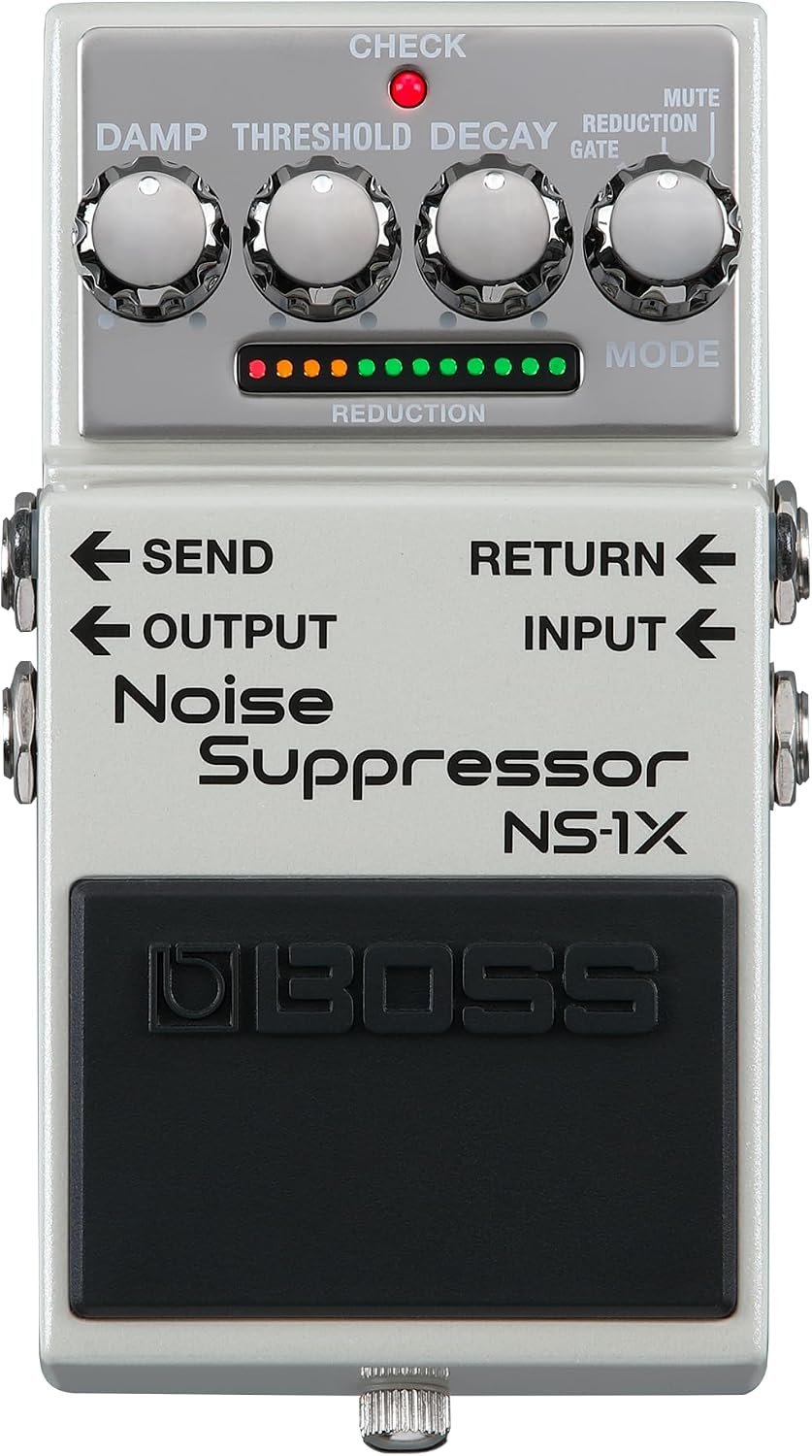
The NS-1X uses four rotary controls: Mode, Threshold, Decay and Damp.
Although the functions are more sophisticated than those of a basic gate, their purpose is relatively straightforward.
Threshold
Threshold determines the signal level at which noise suppression begins.
If it is set too low, unwanted background noise may remain audible.
If it is set too high, quieter guitar notes can become affected.
The best setting depends on the pickup output, amplifier gain and equipment connected to the pedal.
A clean guitar played gently will generally require a different adjustment from a heavily distorted guitar.
Decay
Decay controls how quickly the signal is attenuated after it falls below the selected threshold.
A faster response can provide tight, controlled silences between rhythmic phrases.
A slower response can be more appropriate for sustained chords, expressive bends and melodic playing.
This control deserves particular attention because an unsuitable decay setting can make the effect feel less natural.
Damp
Damp determines the maximum amount of noise reduction applied.
Increasing it produces stronger suppression, while reducing it allows a gentler transition.
This provides additional control over how noticeable the noise gate becomes.
For delicate playing, a less aggressive setting may be preferable.
For high-gain rhythm work, stronger suppression may provide clearer separation between musical phrases.
Mode
The Mode control selects Reduction, Gate or Mute operation.
Together, these four controls allow the player to adjust the pedal around the instrument and playing style rather than relying on one fixed noise-reduction behaviour.
A multi-LED reduction indicator also provides visual feedback about the amount of suppression being applied.
Using the Send and Return Loop
One of the NS-1X’s most useful features is its dedicated send/return loop.
This allows noisy effects to be placed within the suppressor’s signal-routing arrangement.
The advantage becomes clearer when considering how a conventional pedalboard works.
An overdrive or distortion pedal can increase background noise substantially, particularly when the guitar is not being played.
The NS-1X can monitor the cleaner guitar signal at its input while applying suppression after the noisy effects connected through its loop.
A typical arrangement is:
Guitar → NS-1X Input → NS-1X Send → Overdrive or Distortion → NS-1X Return → NS-1X Output → Amplifier
This allows the suppressor to respond to the player’s original guitar signal while managing noise generated by effects within the loop.
For example, our BOSS BD-2 Blues Driver guide explores a traditional overdrive pedal that could be included in this type of signal chain.
The NS-1X does not replace the overdrive or change its purpose. Instead, it provides a method of managing unwanted noise around it.
This distinction is particularly valuable when using several gain-producing pedals together.
However, the send/return system requires additional patch cables and some thought about pedal placement.
Construction and Pedalboard Practicality
The NS-1X follows the familiar BOSS compact pedal design.
Its silver-grey metal enclosure, broad footswitch and four rotary controls give it the straightforward appearance associated with the manufacturer’s traditional effects range.
BOSS specifies dimensions of 73 mm wide, 129 mm deep and 59 mm high.
The pedal weighs approximately 460 grams including its battery.
That makes it relatively compact, although it is not particularly lightweight for its size.
The enclosure is designed around conventional pedalboard use, with connections arranged to accommodate the input, output, send and return sockets.
Because the NS-1X requires more signal connections than a simple distortion pedal, allowing enough space for patch cables is important.
A suitable pedalboard can help organise this arrangement.
Our D’Addario XPND 1 Expandable Pedalboard guide explores a practical option for arranging individual effects pedals and managing their connections.
For guitarists assembling a larger rig, sensible cable routing is just as important as choosing the effects themselves.
Power Supply and Everyday Operation
The NS-1X operates from a 9V alkaline battery or a compatible BOSS PSA-series power adapter.
BOSS specifies a current draw of 60 mA and estimates approximately 6.5 hours of continuous operation from an alkaline battery.
For regular practice, rehearsals and live performance, an appropriate external power supply is generally more convenient.
The pedal also includes a DC Out connection, allowing power to be distributed to another compatible effect using the specified optional cable and a suitable adapter.
This function is only available when the NS-1X is powered by an external adapter, not when operating from its battery.
The combined current requirements of connected pedals must remain within the power adapter’s rated capacity.
For a permanent pedalboard, it is worth planning the power arrangement carefully rather than relying on batteries.
The Drawbacks
The BOSS NS-1X offers sophisticated noise suppression, but it is not necessarily the right choice for every guitarist.
Its specialised purpose, additional connections and control requirements introduce several compromises worth understanding.
It Cannot Fix Every Source of Unwanted Noise
Perhaps the most important limitation is that a noise suppressor does not repair the underlying cause of electrical noise.
Poor grounding, defective cables, unsuitable power supplies and problems within an amplifier may still require separate attention.
The NS-1X can reduce unwanted sound at appropriate points in the signal chain, but it cannot correct faulty electrical equipment.
Noise generated after the suppressor’s output may also remain outside its control.
Before adding any noise suppression pedal, guitarists should investigate obvious causes such as damaged cables, unsuitable adapters and problematic connections.
A quieter signal chain begins with properly functioning equipment.
Incorrect Settings Can Affect Sustain
Although MDP is designed to preserve the natural response of the instrument, the NS-1X still requires careful adjustment.
An excessively high threshold can interfere with quiet notes, while aggressive suppression settings may make sustained passages sound less natural.
This is particularly important for guitarists who use expressive bends, volume-knob techniques or long, fading notes.
A setting that works beautifully for tight metal rhythms may be unsuitable for a slow blues solo.
The pedal provides the controls needed to adjust its behaviour, but finding the best settings requires listening carefully to the entire guitar signal.
Automatic processing does not eliminate the need for musical judgement.
The Send and Return Loop Adds Complexity
The send/return arrangement is one of the pedal’s strengths, but it makes installation more involved.
Instead of connecting one input and one output, guitarists using the loop must route signals through four audio connections.
This requires additional patch cables and adequate room around the pedal.
On a crowded pedalboard, finding suitable cable lengths and positions can be inconvenient.
The arrangement is also less straightforward to troubleshoot if something stops working.
A missing signal could result from a disconnected return cable, an incorrect pedal order or another problem within the effects loop.
Players who prefer the simplest possible setup may find a conventional two-jack noise suppressor easier to manage.
It Does Not Add Creative Guitar Effects
The NS-1X is designed specifically for noise suppression.
It does not provide overdrive, distortion, delay, reverb or modulation effects.
For guitarists with a genuine noise problem, this focus is sensible.
However, someone building their first pedalboard may benefit more from buying a useful musical effect before adding dedicated noise-management equipment.
A good amplifier, suitable cables and a carefully organised power supply may already provide an acceptably quiet setup.
The NS-1X becomes more relevant when the existing equipment and playing style produce noise that needs active management.
Gate Mode Is Not Ideal for Every Performance
Gate mode is particularly useful for tight, high-gain rhythm playing, but its more assertive operation may not suit every musical situation.
A guitarist moving between forceful picking and delicate fingerstyle passages could find that one setting does not provide the ideal response for both.
Likewise, guitarists who regularly allow notes to decay into near silence may prefer the gentler character of Reduction mode.
The ability to choose between operating modes helps, but changing playing styles may still require adjusting the controls.
The NS-1X is versatile within its intended purpose, yet it cannot anticipate every musical preference.
No Programmable Presets
The four-knob interface makes adjustments accessible, but the NS-1X does not provide programmable memories for storing different configurations.
A guitarist using several instruments with different pickup outputs may need to change the threshold and other settings manually.
The same applies when switching between very different amplifier gain levels.
For musicians who use a consistent guitar and amplifier arrangement, this may not be troublesome.
Players who frequently change between clean, moderate-gain and heavily distorted setups could find it less convenient.
The pedal is designed for direct control rather than storing a library of settings.
Battery Life and Separate Power Adapter
The estimated 6.5-hour battery life may be sufficient for occasional sessions, but it is not especially convenient for musicians who play regularly.
Battery performance also depends on operating conditions.
A compatible external power supply is preferable for consistent use over longer periods.
However, the BOSS PSA-series adapter is sold separately.
Guitarists using an existing power supply should confirm that it provides the correct voltage, polarity and sufficient current.
The DC Out function introduces further requirements because power distribution must remain within the adapter’s limits.
Careless power connections can create problems that a noise suppressor is not designed to solve.
The Extra Controls May Be Unnecessary for Simple Rigs
Some guitarists need only modest background noise reduction.
For a straightforward home setup with one guitar, a clean amplifier and minimal effects, the NS-1X may provide more adjustment options than necessary.
Threshold, Decay and Damp interact to determine the final suppression behaviour, and understanding these controls takes a little time.
A simpler noise gate may be sufficient for players who do not require sophisticated handling of note dynamics.
The NS-1X makes more sense when preserving playing response and managing noise across different gain settings are genuine priorities.
Who It Suits Best
The BOSS NS-1X is particularly suitable for guitarists who use high-gain amplifiers, distortion pedals or several overdrive effects.
Players who perform tightly controlled rock and metal rhythms may appreciate Gate mode, while guitarists using expressive leads and more varied playing dynamics may find Reduction mode more appropriate.
It is also worth considering for bass players and other musicians who need to manage unwanted noise without relying solely on a basic threshold gate.
The send/return loop makes it particularly relevant to established pedalboards containing several effects.
Guitarists exploring additional equipment can find more useful options in our Pedals & Effects collection, including individual stompboxes and more comprehensive effects systems.
However, musicians with a naturally quiet setup or those looking for creative sound-shaping effects may have little need for a dedicated noise suppressor.
Is the BOSS NS-1X Worth a Place on Your Pedalboard?
The BOSS NS-1X takes a focused approach to a problem that becomes increasingly important as guitar setups grow more complicated.
Its combination of MDP processing, Reduction and Gate modes, adjustable controls and send/return routing provides useful flexibility for players who need more than basic noise reduction.
The compact metal enclosure and familiar BOSS operating format also make it a practical addition to conventional pedalboards.
There are compromises, particularly the need for careful setup, additional cables and manual adjustment when changing instruments or playing styles.
Nevertheless, for guitarists dealing with persistent noise from distortion pedals and high-gain equipment, the NS-1X is a well-specified option worth considering.
Its greatest appeal is not in adding another effect to the music, but in helping the sounds a guitarist already enjoys remain clearer and more controlled.
As an Amazon Associate I earn from qualifying purchases.