Lindo Dandelion Left-Handed Guitar
As an Amazon Associate I earn from qualifying purchases.
Finding an attractive, well-equipped left-handed acoustic guitar isn’t always straightforward. Right-handed players can browse enormous collections of instruments, while left-handed musicians often face a much smaller selection.
The Lindo Dandelion Left-Handed Guitar offers something refreshingly different.
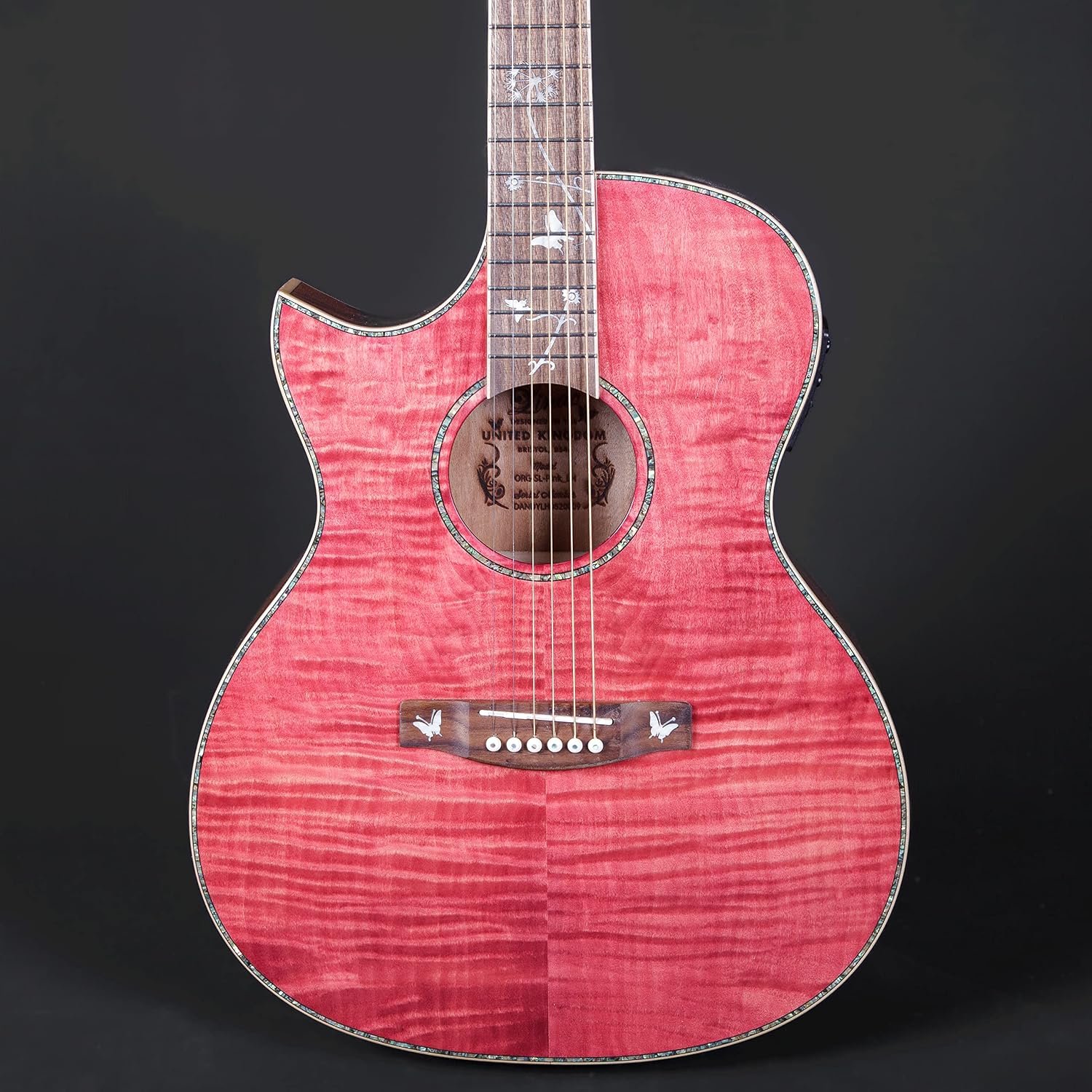
With its distinctive pink finish, slim cutaway body and detailed decorative touches, this electro-acoustic guitar makes a strong visual impression. But there is more to it than its appearance.
Designed in Bristol by Lindo Guitars, the Dandelion combines a full-length neck with a shallower acoustic body, quality Wilkinson machine heads and a versatile onboard preamp system.
For left-handed guitarists who want an instrument that’s comfortable to hold, enjoyable to play and ready for amplification, it deserves consideration.
However, its unusual design also involves compromises, particularly in acoustic projection and the limited amount of independent customer feedback available.
Why It Works for Left-Handed Guitarists
One of the most important things about the Dandelion is that it’s a purpose-built left-handed instrument.
This matters more than simply reversing the strings on a conventional guitar.
A properly configured left-handed acoustic uses a suitable nut, string arrangement and playing orientation. On a cutaway instrument, the body shape must also provide upper-fret access for the left-handed player.
The Dandelion offers these features in a design specifically intended for left-handed musicians.
Its slim body is another attraction.
Traditional acoustic guitars can feel rather bulky, particularly when sitting down for extended practice sessions.
Lindo specifies a body depth of approximately 75–80mm, making the Dandelion noticeably shallower than many conventional dreadnought acoustics.
That reduced depth should make it easier to position against the body, especially for guitarists who find larger instruments uncomfortable beneath the picking arm.
Importantly, it isn’t a miniature guitar. Its 25.5-inch scale length and 41-inch overall size maintain familiar full-size playing dimensions.
A Distinctive Pink Finish With Thoughtful Details
The Dandelion’s appearance is undoubtedly one of its strongest attractions.
Its pink flame-maple veneer creates a distinctive surface, with natural-looking figuring that gives the instrument considerably more personality than a conventional plain acoustic.
The contrasting koa back and sides introduce warmer wood tones around the body.
Lindo has also incorporated decorative detailing inspired by the natural world.
Abalone purfling around the body and headstock, a decorative soundhole rosette and detailed fingerboard inlays give the guitar an individual character.
Maple binding ties the different materials together.
The overall effect is decorative without relying entirely on artificial-looking embellishments.
For someone who enjoys instruments with a little personality, the Dandelion offers a welcome alternative to another anonymous natural-finish guitar.
Of course, appearance is personal. Some players will love the pink finish, while others may prefer something quieter.
Fortunately, its practical features provide more substantial reasons to consider it.
A Slim Body Designed for Comfortable Playing
The Dandelion’s reduced body depth may be particularly appealing to electric guitarists moving into acoustic playing.
A deep acoustic body can feel unfamiliar when you’re accustomed to the relatively thin profile of an electric guitar.
The Dandelion offers a more compact body without shortening the normal playing scale.
Its mahogany neck, walnut fingerboard and 43mm nut width provide a fairly conventional steel-string playing arrangement.
The cutaway gives access to higher positions on the neck, which is useful for melodic playing and arrangements that extend beyond open chords.
Lindo specifies 21 frets and a two-way adjustable truss rod.
The truss rod allows a technician to adjust neck relief when necessary, helping maintain suitable playing action as conditions or string preferences change.
For everyday practice, the combination of a full-length neck and shallower body provides an interesting balance between familiar acoustic dimensions and physical comfort.
A Versatile BS5M Preamp System
One of the Dandelion’s most substantial features is its onboard ACME BS5M preamp.
This is more sophisticated than the basic volume-and-tone systems found on many electro-acoustic guitars.
It combines an under-saddle piezo pickup with a microphone positioned inside the guitar body.
The system allows the player to blend these two sound sources.
The piezo pickup captures string vibration directly, helping provide definition and clarity when amplified.
The internal microphone adds another element of the guitar’s acoustic character.
Blending the two can help produce a fuller, more natural amplified sound than relying entirely on the piezo signal.
The preamp also includes five-band equalisation, covering bass, low mids, high mids, treble and presence.
That provides considerable control over the amplified tone.
A notch filter and phase control offer additional tools for managing feedback, particularly when playing through a PA system or acoustic amplifier.
These features make the Dandelion interesting for musicians who want an instrument capable of moving between home practice, recording and small performances.
Useful Connections for Amplification and Recording
The Dandelion includes both a standard quarter-inch output and a balanced XLR connection.
That gives players useful options when connecting external equipment.
The conventional jack output can be used with a suitable acoustic guitar amplifier or recording interface.
The XLR connection provides another option for compatible mixing desks and audio equipment.
This arrangement may be particularly convenient for singer-songwriters who occasionally perform through a PA system.
The built-in chromatic tuner is another practical addition.
Its illuminated display allows the player to check tuning without needing a separate clip-on tuner.
For rehearsals, home practice or preparing to perform, having the tuner integrated into the instrument reduces the amount of additional equipment required.
What It Feels Like to Play
The Dandelion’s body design suggests a playing experience somewhat different from a traditional full-depth acoustic.
The shallower construction should make the instrument easier to hold close to the body.
For seated playing, that can reduce the feeling of reaching around a large acoustic soundbox.
The satin-like appearance of the decorative finish gives the guitar a contemporary character, while the wooden binding and inlays add visual warmth.
The mahogany neck retains conventional acoustic dimensions, so the instrument shouldn’t feel like a shortened travel guitar.
Wilkinson 1:19 ratio machine heads provide fine adjustment when tuning.
That gearing can make it easier to settle accurately on the intended pitch, although tuning stability also depends on the nut, strings and overall setup.
Lindo states that its guitars receive a professional setup before dispatch.
As with any instrument purchased online, it’s still sensible to check the string action, tuning and fret condition when it arrives.
A well-adjusted guitar can make a substantial difference to playing enjoyment, particularly for someone practising regularly.
How It Compares With Other Electro-Acoustic Guitars
The Dandelion takes a different approach from the more conventional acoustic guitars featured on Techstore1.
Our guide to the Fender California Debut Redondo CE explores a fuller-bodied electro-acoustic designed around traditional acoustic playing and straightforward amplification.
The Fender’s larger body is likely to appeal to players who prioritise unplugged projection and a familiar acoustic shape.
The Lindo instead concentrates on a shallower body, distinctive styling and more extensive onboard sound controls.
Another useful comparison is the Yamaha FGX800C Electro-Acoustic Guitar.
Its conventional dreadnought-style body and solid spruce top provide a different balance of acoustic construction and amplified versatility.
These comparisons help illustrate the trade-offs between traditional body depth and slimmer designs. Left-handed buyers must, of course, confirm that any alternative is available in the correct playing orientation.
The Lindo’s strongest distinction remains its combination of genuine left-handed construction, unusual appearance and flexible electronics.
The Drawbacks
The Lindo Dandelion has several appealing features, but its distinctive construction introduces important limitations. These are particularly worth considering for left-handed players who may have fewer opportunities to try an instrument before buying.
A Slim Body May Sacrifice Acoustic Projection
The reduced body depth is helpful for comfort, but it changes how much air the guitar can move acoustically.
A full-depth dreadnought generally has more internal volume to support strong bass response and powerful unplugged projection.
The Dandelion’s shallower construction may sound less full or commanding when played without amplification.
For quiet home practice, this might not be a problem.
However, musicians who regularly play acoustic guitar alongside other instruments without amplification may prefer a deeper-bodied design.
The Dandelion’s electronics help address this limitation when plugged in, but they cannot change the physical acoustic properties of its body.
Decorative Wood Finishes Are Not the Same as Solid-Tonewood Construction
The pink flame-maple appearance is attractive, but buyers should understand the distinction between decorative veneer and solid-tonewood construction.
Lindo describes the top using flame maple and a decorative veneer finish.
It should not be assumed to have a solid maple or solid spruce soundboard.
The company also specifies koa for the back and sides without clearly identifying them as solid wood.
That means buyers shouldn’t expect the same construction characteristics as an acoustic guitar specifically advertised with a solid soundboard.
The decorative appearance is part of the attraction, but it isn’t proof of superior acoustic resonance.
The Electronics Require Some Understanding
The BS5M preamp offers considerable flexibility, but its controls introduce a learning curve.
Blending an internal microphone with a piezo pickup requires experimentation.
Too much internal microphone signal can increase the possibility of feedback at higher stage volumes.
The five-band EQ also provides enough adjustment to make a poorly balanced sound if used without care.
The notch filter and phase control can help manage feedback, but they won’t eliminate every problem caused by loud monitoring or unfortunate speaker positioning.
Players who want the simplest possible plug-in-and-play acoustic may find the additional controls unnecessary.
Limited Customer Feedback
This is one of the Dandelion’s more significant drawbacks.
At the time we examined the Amazon.co.uk listing, it showed only one customer rating.
Lindo’s own website carried four customer ratings, which were positive, but still represented a very small sample.
That isn’t enough evidence to establish how consistently the guitar performs across a large number of owners.
Long-term durability, electronic reliability and individual setup quality therefore remain harder to judge than with widely purchased models.
Before ordering, buyers should examine the seller’s return conditions and warranty arrangements carefully.
The Pink Design Won’t Appeal to Everyone
The Dandelion’s distinctive appearance is one reason to consider it, but it also limits its appeal.
The pink finish, decorative fingerboard and detailed purfling create a strong visual identity.
For some musicians, that’s exactly what makes the guitar attractive.
Others may prefer a simpler natural wood or understated dark finish.
There is also the possibility that a highly individual appearance may feel less versatile in certain performance settings.
This is entirely a matter of personal preference, but it is worth considering when choosing an instrument intended for long-term ownership.
The Gig Bag Offers Limited Protection
Lindo includes a padded gig bag, which is a useful addition for storage and ordinary transport.
However, a gig bag doesn’t offer the same protection against heavy impacts or crushing forces as a properly fitted hard case.
The decorative finish and headstock are still vulnerable if the guitar is transported carelessly.
Musicians travelling frequently, particularly those using public transport or carrying equipment alongside heavy cases, may want more substantial protection.
A suitable left-handed guitar case should be chosen according to the actual body dimensions rather than appearance alone.
Buying Left-Handed Instruments Online Can Be Difficult
Although the Dandelion is designed specifically for left-handed players, finding somewhere to try one may prove difficult.
Left-handed guitars are frequently available through fewer retailers, and particular finishes or models may not be displayed in ordinary guitar shops.
This creates uncertainty about neck comfort, balance and acoustic character.
Specifications and photographs help, but they cannot fully describe how an instrument feels in your hands.
A sensible returns policy becomes especially important when buying a specialist guitar without trying it first.
Buyers should also check that the delivered instrument matches the exact left-handed model advertised.
It Won’t Suit Every Playing Style
The Dandelion appears best suited to players who value comfort, distinctive design and amplified acoustic versatility.
Those who primarily use aggressive acoustic strumming may prefer a guitar with greater natural projection.
Traditional acoustic enthusiasts might also want a more conventional body shape and simpler electronics.
Meanwhile, players who rarely amplify their instruments may not benefit from the sophisticated BS5M preamp.
The Dandelion isn’t a universal replacement for every acoustic guitar. Its appeal depends on matching its particular strengths to the way you play.
Who It Suits Best
The Lindo Dandelion makes particular sense for left-handed guitarists who want something different from the limited selection of traditional acoustic finishes and shapes.
Its slim body may appeal to players who find deep acoustic guitars uncomfortable, while the cutaway provides useful access to higher frets.
The integrated preamp also makes it relevant to singer-songwriters, home-recording musicians and occasional performers.
Players who appreciate decorative craftsmanship and distinctive colour may find its appearance particularly attractive.
However, guitarists who prioritise powerful unplugged projection, conventional solid-top construction or extensive independent customer feedback should consider alternatives.
You can explore more instruments in our Acoustic Guitars collection, including traditional full-bodied designs and electro-acoustic models.
Is It Worth the Guitar Space?
The Lindo Dandelion Left-Handed Guitar brings together several features that are not always easy to find in one instrument.
Its distinctive pink finish, slim cutaway body and full-length neck make it an interesting choice for left-handed players seeking comfort without moving to a smaller-scale guitar.
The BS5M preamp adds genuine practical value, especially for anyone who wants control over amplified tone and the flexibility to connect to recording or performance equipment.
Nevertheless, the limited customer feedback, decorative veneer construction and potential reduction in unplugged acoustic projection deserve careful consideration.
For musicians wanting a traditional, powerful acoustic guitar, a conventional full-depth model may be more appropriate.
But for a left-handed guitarist looking for an unusual, comfortable electro-acoustic with useful onboard electronics, the Dandelion offers a distinctive alternative.
It is the combination of proper left-handed design, practical amplification and individual appearance that makes this guitar worth considering.
As an Amazon Associate I earn from qualifying purchases.