BOSS GX-100 Guitar Effects Processor
As an Amazon Associate I earn from qualifying purchases.
The BOSS GX-100 Guitar Effects Processor combines advanced amplifier modelling, an extensive collection of effects and a colour touchscreen in one substantial floor-based unit.
Designed for guitarists and bass players who want greater control over their sound, it brings together BOSS’s AIRD amplifier technology, 170 effects types, flexible signal routing and an integrated expression pedal.
The GX-100 can serve several purposes. It can become the centre of a live performance setup, provide amplifier and effects sounds for home recording, or work alongside a traditional guitar amplifier.
Its appeal lies in bringing equipment that might otherwise occupy a complicated pedalboard into one organised system.
However, the GX-100 is not a particularly simple processor. Its impressive range of sounds and editing options requires time to understand, making it better suited to players prepared to explore its capabilities.
Why It Works for Guitarists
A conventional pedalboard often develops gradually.
A guitarist begins with an overdrive pedal, adds delay or reverb, then perhaps introduces modulation, compression and an additional boost.
Before long, the collection requires several power connections, patch cables and individual controls.
The BOSS GX-100 offers an alternative.
Its collection of amplifier models and effects can be arranged into custom signal chains, allowing players to develop complete guitar sounds without connecting numerous separate pedals.
The AIRD amplifier technology is designed to reproduce the behaviour of different amplifier types, providing options for clean playing, blues, classic rock and heavier modern styles.
With 200 user memories and 100 factory presets, there is considerable space for creating and organising sounds.
A guitarist could prepare different configurations for rehearsal, recording and live performance, then recall them without manually readjusting every effect.
This makes the GX-100 particularly useful for musicians who regularly move between different styles or need several sounds during a performance.
What It Feels Like to Use
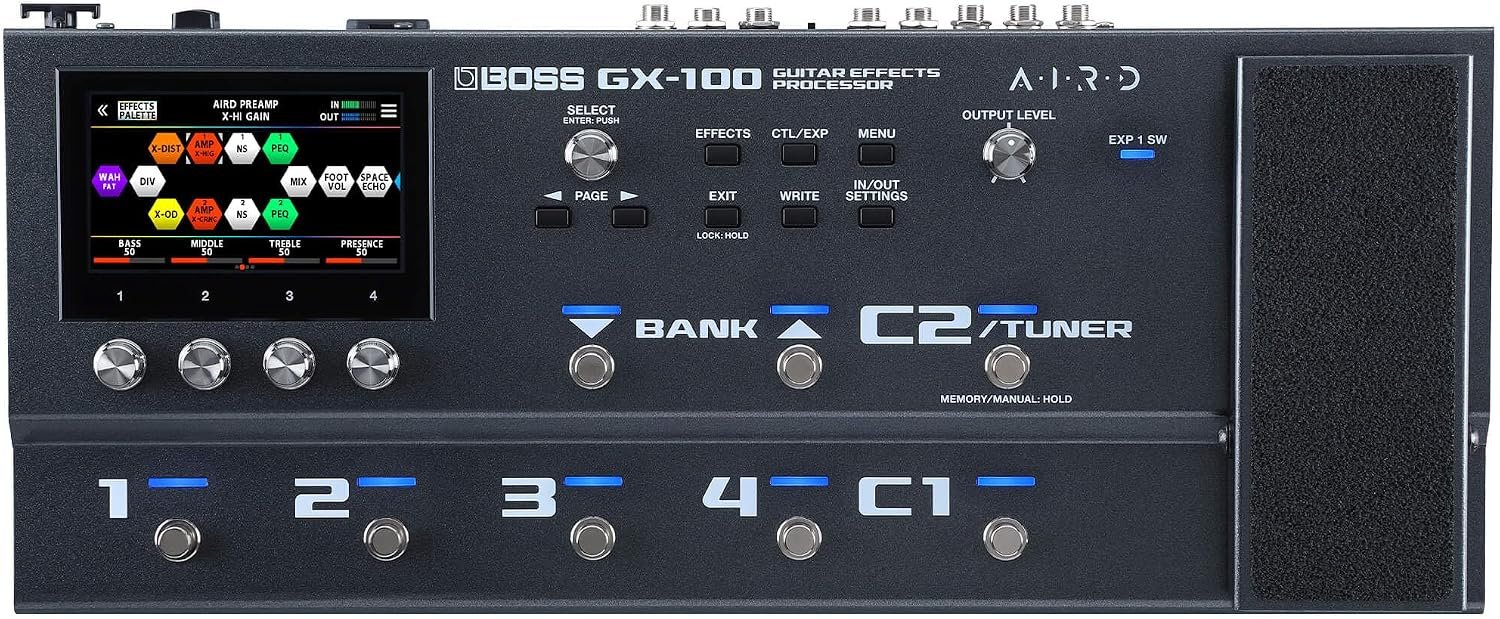
The GX-100 has a substantial metal chassis, with a broad, low-profile shape designed for floor operation.
Measuring approximately 460mm wide and 193mm deep, it occupies noticeably more space than a collection of two or three compact pedals.
At 3.5kg, it also has a reassuring physical weight.
The main attraction is the large colour touchscreen, positioned where the player can see the selected sounds and effects arrangement.
Rather than presenting every function through a collection of small buttons, the touchscreen allows users to navigate patches, select processing blocks and adjust signal chains visually.
Four rotary controls below the display provide another way of adjusting settings.
The eight footswitches are arranged across the lower portion, providing accessible control over sounds, banks and assigned functions.
An integrated expression pedal sits to the right.
This creates a familiar arrangement for players accustomed to larger multi-effects processors.
The metal construction and substantial controls give the unit a purposeful appearance, although the number of available functions means there is still plenty to learn.
AIRD Amplifier Modelling
BOSS’s AIRD technology is central to the GX-100.
AIRD stands for Augmented Impulse Response Dynamics and is designed to recreate aspects of amplifier behaviour, including how the simulated amplifier responds to different playing conditions.
The GX-100 provides a selection of guitar and bass amplifier models that cover different tonal characters.
Clean sounds can be used for rhythm playing, jazz or atmospheric effects, while crunch and high-gain models provide options for blues, rock and heavier styles.
The GX-100 Version 2.0 update also introduced additional guitar and bass amplifier models, extending its original collection.
An important feature is AIRD Output Select.
This allows the player to adapt the output processing for different destinations, including suitable guitar amplifiers, full-range monitors and PA systems.
That matters because an amplifier simulation can behave very differently depending on the equipment reproducing it.
The GX-100 also supports speaker cabinet simulations and compatible user-loaded impulse responses.
These allow further adjustments to the sound without changing physical speaker cabinets.
An Extensive Effects Collection
With 170 effects types listed in BOSS’s current specifications, the GX-100 offers considerably more than the usual selection of distortion, delay and reverb.
Its effects include modulation, compression, filtering, pitch processing, overdrive, distortion and numerous other sound-shaping options.
Traditional BOSS effects sit alongside more elaborate digital processing.
The GX-100 allows complex signal chains, including arrangements with parallel signal paths.
This is useful for creating sounds that would be difficult to reproduce with a simple chain of conventional pedals.
For example, a player could combine clean and distorted signals or experiment with different processing arrangements for rhythm and lead playing.
Up to 15 effect blocks can be used alongside additional routing and utility functions, subject to processing limitations.
The important benefit is freedom.
Rather than accepting one fixed arrangement, guitarists can build sounds around their preferred playing style.
However, having so many possibilities also makes it important to exercise restraint. A carefully selected combination of effects will often be more useful than filling every available processing position.
Touchscreen Editing and Footswitch Control
The GX-100 combines touchscreen editing with physical footswitches.
This is an appealing arrangement because creating sounds and performing with them require different types of control.
At home, a touchscreen makes it easier to examine the signal chain and rearrange effects.
During a performance, the guitarist needs reliable foot-operated switching.
The GX-100 provides eight customisable footswitches and an expression pedal with a toe switch.
The switches can be assigned to functions such as changing memories, controlling effects or adjusting particular parameters.
Manual Mode allows the processor to behave more like a collection of individual stompboxes.
For guitarists who prefer direct effects control, this can be particularly useful.
The expression pedal can operate volume, wah or compatible effects parameters.
Additional external footswitches and expression pedals can also be connected when more control is required.
The result is a flexible system that can be adapted to different playing arrangements rather than forcing everyone to use the same switching layout.
Home Recording and Quiet Practice
The GX-100 also functions as a USB audio interface.
Connecting it to a compatible computer allows guitarists to record directly into music production software without necessarily using a microphone and conventional amplifier.
It can also support re-amping, allowing previously recorded guitar parts to be processed through different sounds.
This is useful when experimenting with arrangements or changing amplifier settings after the original performance.
A dedicated headphone connection provides another practical benefit.
Players can practise without using an external speaker, making the processor suitable for quieter home environments.
The built-in phrase looper offers up to 38 seconds of mono recording or 19 seconds in stereo.
Although that is not especially long, it is enough for short chord progressions, practising lead phrases or experimenting with effects combinations.
For musicians regularly recording at home, the GX-100 can combine several jobs normally handled by separate equipment.
Computer Editing and Bluetooth Options
BOSS Tone Studio provides additional editing and sound-management facilities through compatible Mac and Windows computers.
Users can edit parameters, organise memories and manage collections of sounds.
BOSS Tone Exchange also provides access to downloadable Livesets created for compatible equipment.
This is useful for musicians who prefer developing their sounds on a larger computer screen.
Wireless connectivity is available through the optional BOSS BT-DUAL Bluetooth Audio MIDI Adaptor.
With the adaptor installed, users can access supported mobile editing functions and stream audio from a compatible device to the GX-100.
However, Bluetooth is not built into the processor, and the adaptor must be purchased separately.
For ordinary computer recording and editing, the GX-100 uses its USB-B connection.
The Drawbacks
The BOSS GX-100 offers extensive flexibility, but there are several compromises worth considering before making it the centre of a guitar setup.
Its capabilities are impressive on paper, although not every player needs this level of complexity.
The Learning Curve Is Considerable
The biggest drawback is the amount of time required to understand the processor fully.
Although the touchscreen simplifies navigation, the GX-100 contains numerous amplifier models, effects, routing options and assignable controls.
Creating a basic sound is relatively straightforward.
Developing a complicated signal chain with parallel processing, expression assignments and several switching options requires considerably more attention.
Guitarists accustomed to turning a few amplifier knobs may initially find the interface distracting.
The GX-100 rewards musicians who enjoy building and refining sounds.
Those who want to connect their guitar and begin playing immediately may be happier with a simpler processor.
It Is Quite Heavy and Wide
At 3.5kg, the GX-100 is not particularly lightweight.
Its metal chassis contributes to the substantial construction, but that weight becomes noticeable when carrying it regularly.
The 460mm width also demands reasonable floor or pedalboard space.
For musicians travelling by public transport or carrying equipment to frequent rehearsals, a smaller processor may prove more convenient.
The GX-100 can replace several individual pedals, but it remains a sizeable piece of equipment in its own right.
It is worth checking the dimensions of any intended carrying case before purchasing.
The Touchscreen Has Practical Limitations
A touchscreen is convenient when editing sounds at home, but it introduces considerations during live use.
Small on-screen controls can be less convenient when the player is standing, particularly in poor lighting or when making adjustments between songs.
The display may also require occasional cleaning to remove fingerprints and dust.
Unlike a conventional amplifier with dedicated controls for every function, some settings remain inside menus.
The physical footswitches and rotary controls reduce this limitation, but they do not eliminate it entirely.
Guitarists who strongly prefer traditional knobs may find the editing approach less immediate than expected.
Bluetooth Requires an Additional Adaptor
Although Bluetooth functionality is supported, the GX-100 does not include built-in wireless connectivity.
Users need the separately available BT-DUAL adaptor.
This is an important distinction because buyers may reasonably expect a modern digital processor to include Bluetooth as standard.
The adaptor also provides Bluetooth audio reception rather than turning the GX-100 into a general-purpose wireless audio transmitter.
Anyone planning to use mobile editing or wireless backing-track playback should account for the additional equipment.
For players who do not need Bluetooth, the GX-100 remains fully usable without it.
External Power Is Essential
The GX-100 requires its supplied AC power adaptor.
There is no conventional battery-powered operating mode.
This is normal for a processor with a large touchscreen and extensive digital processing, but it reduces flexibility for informal outdoor playing or locations where power sockets are inconvenient.
A damaged or misplaced adaptor could also interrupt a rehearsal or performance.
For regular live use, sensible cable management and protecting the power connection are important.
Musicians wanting completely portable battery-powered equipment should consider a different type of processor.
The Looper Is Fairly Limited
The built-in phrase looper is useful for short practice passages, but its recording capacity is modest.
BOSS specifies 38 seconds in mono and 19 seconds in stereo.
This is enough for a short rhythm progression or experimenting with sound layers.
However, musicians who build complete performances around looping will probably find it restrictive.
There is no extensive library of long recorded phrases comparable with a dedicated looping workstation.
Anyone making looping a central part of their music may still need separate equipment.
Amplifier Modelling Requires Suitable Monitoring
The GX-100 can reproduce a broad range of amplifier and cabinet sounds, but it does not contain a conventional guitar loudspeaker or built-in power amplifier.
To hear those sounds, it must be connected to headphones or suitable external amplification.
The quality and character of the monitoring system can influence the result considerably.
A patch prepared through studio headphones may sound different when played through a PA system or guitar amplifier.
Although AIRD Output Select helps accommodate different destinations, players still need to adjust their sounds for the equipment they are using.
The GX-100 is therefore not a complete replacement for every component in a guitar amplification system.
Too Many Effects Can Become Distracting
Having access to 170 effects types encourages experimentation.
That can be enjoyable, but it also introduces the temptation to spend more time programming sounds than actually playing.
A complicated signal chain does not automatically produce a better guitar tone.
Multiple modulation, compression and distortion stages can make the result difficult to balance.
For musicians who prefer a straightforward clean sound and one or two favourite effects, much of the GX-100’s capability may remain unused.
A smaller processor or conventional pedalboard may provide everything they need with fewer adjustments.
Software and Firmware Require Attention
BOSS provides firmware updates and editing software that can extend or improve the processor’s features.
However, computer-based equipment management introduces another layer of responsibility.
Users need to follow update instructions carefully and ensure that their computer and software versions are compatible.
Backing up important memories before substantial changes is also sensible.
The GX-100 can operate independently for normal playing, but anyone wanting access to the latest software features should expect occasional maintenance.
This is different from owning a completely analogue effects pedal that requires no software management.
It May Be More Than Some Players Need
The GX-100 is designed for musicians who appreciate detailed sound creation and flexible performance control.
Someone primarily using a clean amplifier sound with occasional overdrive may not benefit from its extensive processing options.
The processor also requires more preparation than a basic collection of familiar pedals.
For musicians prioritising immediate hands-on operation, our BOSS ME-90 Guitar Multi-Effects Processor article explores an alternative with a more traditional knob-based control layout.
The important consideration is whether the GX-100’s advanced routing, editing and sound-management features match the player’s actual requirements.
Who It Suits Best
The BOSS GX-100 is particularly suitable for guitarists who regularly move between different musical styles and want their sounds organised in one processor.
Live performers may appreciate the customisable footswitches, expression pedal and extensive memory capacity.
Home recording musicians can benefit from the USB interface and amplifier modelling, especially when using a conventional guitar amplifier is inconvenient.
Bass players also have dedicated amplifier models and effects available.
However, musicians looking for a smaller processor with an emphasis on practice features may want to explore our MOOER GE150 Pro Multi-Effects Pedal article.
The GX-100 makes the most sense for players who are prepared to invest time in creating sounds and organising their equipment.
Is the BOSS GX-100 Worth the Pedalboard Space?
The BOSS GX-100 combines an extensive collection of amplifier models, effects and performance controls in a robust floor-based processor.
Its colour touchscreen makes complex signal chains easier to understand, while the eight footswitches and expression pedal provide practical hands-free control.
The AIRD modelling technology, flexible output options and USB recording facilities also make it adaptable to several playing environments.
However, the 3.5kg weight, considerable learning curve and additional cost of Bluetooth connectivity are genuine compromises.
It is not the obvious choice for guitarists who need only a handful of simple sounds.
For musicians who enjoy detailed tone shaping and want one central processor for rehearsals, recording and live performances, though, the GX-100 offers a thoughtful balance of flexibility, construction and practical control.
Explore more carefully selected guitar processors, stompboxes and creative sound-shaping equipment in our Pedals & Effects collection.
As an Amazon Associate I earn from qualifying purchases.