One Pedal at the Center of It All
As an Amazon Associate, we may earn from qualifying purchases. This comes at no extra cost to you and helps support our website.
The Pedalboard Puzzle Every Guitarist Eventually Faces
At some point, most guitarists who collect pedals hit the same wall. The board that started with a tuner and an overdrive has grown into something with a dozen boxes, a tangle of patch cables, and a power supply that barely has enough outputs left. Everything works, technically, but setting it up before a gig takes twenty minutes, and troubleshooting a dead signal chain mid-soundcheck has become its own occasional ritual.
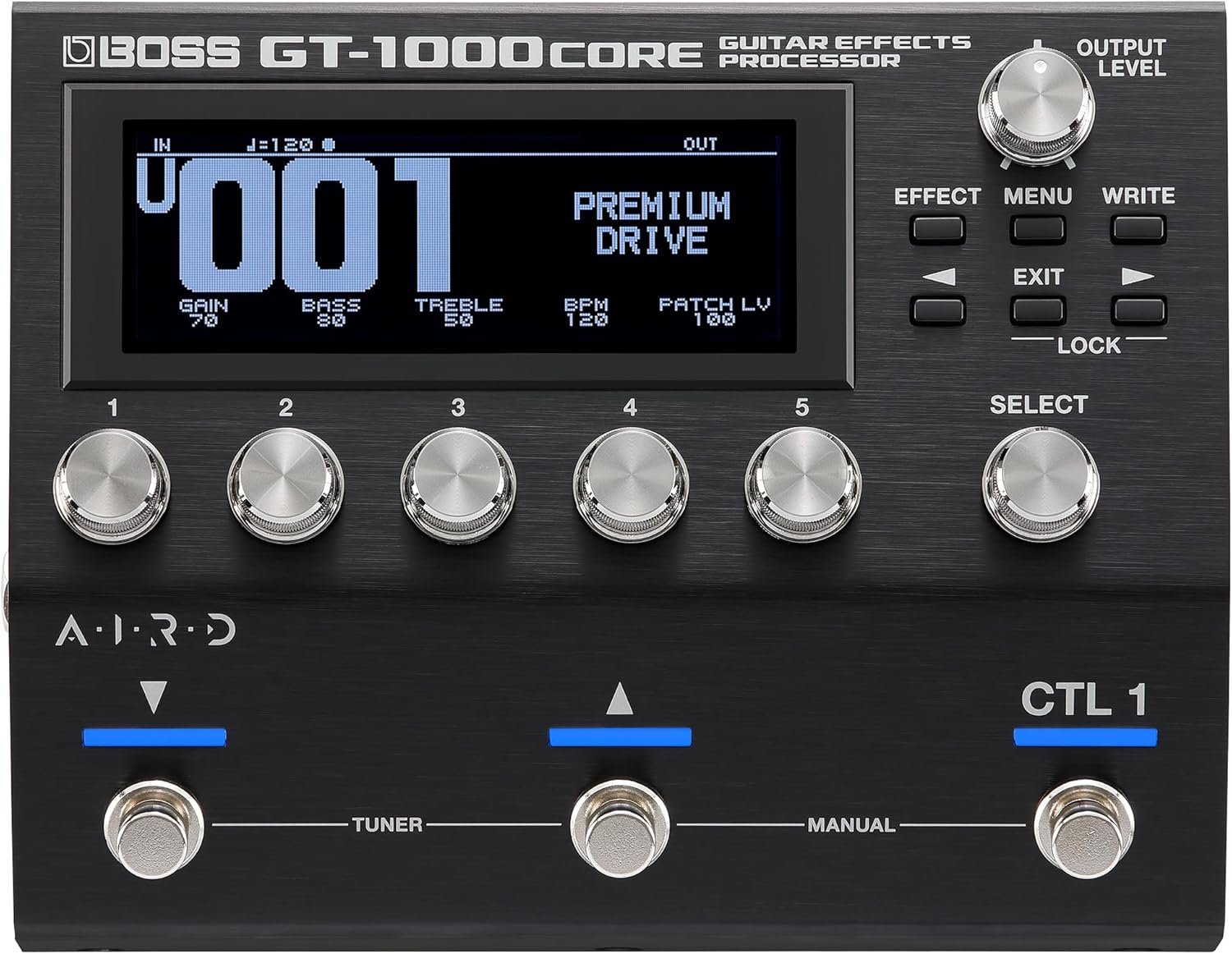
A compact guitar processor built around consolidating that sprawl into one central unit tends to appeal most to players who’ve lived through that exact stage. Rather than adding yet another box to an already crowded board, something like the GT-1000CORE is built to sit at the center of the rig — handling amp modeling, effects, and routing in one place, while still leaving room for a handful of favorite analog pedals if a player isn’t ready to give those up.
Bringing Flagship Processing Into a Smaller Footprint
What separates this from a typical compact multi-effects unit is what’s actually happening inside it. The same DSP engine found in BOSS’s larger flagship processor lives inside this smaller stompbox, which means the sound quality and processing depth aren’t scaled down just because the physical unit is. Running 24 simultaneous effects blocks and drawing from more than 140 amp and effect types gives a player enough range to build genuinely complex signal chains — several modulation effects, delay, reverb, and amp modeling all running at once — without needing separate hardware for each stage.
For players chasing a very specific, layered tone, that depth matters in a way that’s hard to appreciate until you’ve hit the ceiling of a simpler pedal and found yourself wanting more control over how effects interact with each other.
Sound That Holds Up Under Scrutiny
There’s a meaningful difference between an effect that sounds fine at low volume through headphones and one that holds together through a full band mix or a proper studio recording. AIRD technology, BOSS’s approach to modeling analog circuitry with more natural feel and response, is aimed specifically at that gap — trying to preserve the way a real amp or pedal actually behaves under different playing dynamics, rather than just approximating its tone.
Paired with 32-bit processing throughout, the result tends to hold up better under close listening, which matters most in situations where the guitar tone isn’t just present but actually needs to carry weight — a recorded track, a mix that needs the tone to sit correctly, or a live set through a quality PA where every inconsistency becomes more audible.
A Practical Home for Studio-Grade Effects
Some of the most useful elements here come directly from BOSS’s own well-regarded standalone pedals. Algorithms ported from the DD-500 delay, MD-500 modulation, and RV-500 reverb bring studio-caliber versions of those effects into the same unit, rather than requiring a player to own and route through three separate specialized pedals to get comparable results. For a home recordist or a gigging player trying to keep a pedalboard from growing indefinitely, that consolidation is genuinely useful rather than just a marketing detail — it’s the difference between needing three dedicated boxes and needing one.
A Looper That Actually Gets Used
A looper is one of those features that sounds nice in theory but often goes untouched once a pedal makes its way onto a board. Built into this processor, though, it becomes a lot more accessible simply because it’s already there — no extra box, no extra cable run, no separate power connection to manage.
In practice, that tends to change how it gets used. Instead of a looper being something reserved for a dedicated songwriting session, it becomes something a player might reach for in the middle of an ordinary practice — laying down a chord progression, then soloing over it to test an idea, or building a simple backing part to rehearse a solo against. During live performance, that same looper can support layered arrangements that would otherwise require a second guitarist or a backing track running from somewhere else entirely.
Fitting Into a Rig That’s Already Taking Shape
For players who already have a setup they like — a specific amp, a couple of trusted pedals, maybe an existing MIDI controller — the appeal here isn’t necessarily starting over. It’s about having a processor flexible enough to slot into what’s already working. Support for external footswitches, expression pedals, USB, and TRS MIDI means it can be controlled by gear a player already owns, rather than demanding an entirely new control setup just to function properly.
That flexibility extends to how it’s used physically, too. Because it works equally well as a standalone processor or as one component within a larger pedalboard, it doesn’t force a player into a single way of building a rig. Someone who prefers routing a few analog pedals in front of it for coloration can do that. Someone who wants a single all-in-one effects stompbox handling everything from clean tones to heavily layered lead sounds can run it that way instead.
From Bedroom Writing Sessions to the Studio Chair
A lot of songwriting happens in fairly unglamorous conditions — a guitar, an idea, and whatever gear happens to be within reach at the time. Having a processor capable of studio-quality tone sitting right there during those sessions changes what’s possible in the moment. An idea that might otherwise wait until “proper studio time” can instead be captured with a tone close to what would end up on a final recording, which tends to keep more of the original creative spark intact.
For players who record at home regularly, the same quality that makes it useful for a quick writing session carries over directly into finished tracks. Flexible I/O means it integrates reasonably easily into an existing recording setup, whether that’s going direct into an interface or being used as part of a hybrid rig involving a real amp.
Where This Fits Depending on How You Play
For a gigging musician tired of managing a sprawling board, a compact guitar processor like this offers a way to centralize a rig without giving up tonal depth. For a home recordist, it offers effects and amp tones detailed enough to hold up in a finished mix, without requiring a rack full of separate studio gear. And for anyone who writes music in scattered, unpredictable moments, having a capable looper built in means those moments are a little easier to actually capture and build on.
It isn’t aimed at players looking for something simple and minimal — there are lighter, more beginner-friendly options for that. What it offers instead is depth: a processor built for guitarists who already know roughly what they want from their tone and are looking for a single, capable core to build the rest of their rig around.
Check It Out!