Finding Studio Clarity in a Hollowbody
Amazon Associate Disclaimer: As an Amazon Associate, we may earn from qualifying purchases. This comes at no extra cost to you and helps support our website.
A Hollowbody That Rewards Patience
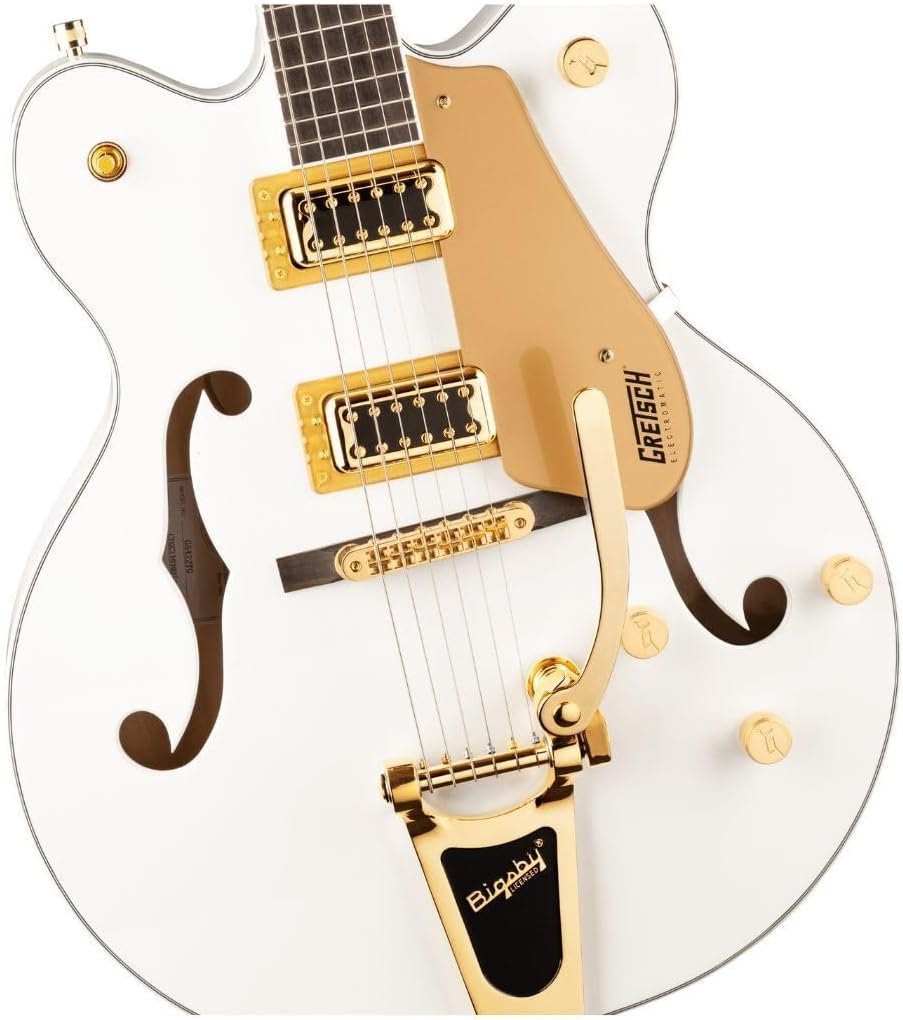
There’s a particular kind of listening that happens when you pick up a hollowbody. The body itself seems to ask something of you — a lighter touch, a moment to let a chord ring before moving to the next one. The Gretsch G5422TG Electromatic, built from maple across its top, back, and sides, invites that kind of attention. It’s the sort of instrument that changes how you sit with a phrase, not just how you play one.
Maple has a way of keeping things clear. Where some woods soften the edges of a note, maple tends to let it stay defined, which matters when you’re working out a part you want to remember later. A single-note run through the neck pickup keeps its shape instead of blurring into the next. That clarity becomes useful the moment you start recording ideas rather than just playing through them.
Filter’Tron Pickups and the Shape of a Tone
The G5422TG carries a pair of FT-5E Filter’Tron humbucking pickups, a design that traces back to 1957 and has stayed in continuous use since. These pickups are built to deliver output and sustain without the hum that can creep into a quieter passage. For a guitarist working late in a home studio, after everyone else has gone to bed, that quiet matters. A hum-free pickup means you can leave more space in a recording — pull the gain back, let a chord decay naturally, and trust that what you hear in the room is what ends up in the take.
The 3-way pickup switching, paired with four controls including a master volume, gives you a practical way to shape tone in real time rather than reaching for a pedal or reworking a signal chain mid-session. Switching from the bridge pickup’s brighter cut to the warmer roundness of the neck pickup can happen inside a single take, which opens up small structural choices — a verse that sits differently than its chorus, a bridge section that pulls back in brightness before the song opens up again.
The Bigsby B60 and Playing With Movement
A Bigsby vibrato tailpiece changes the physical relationship between your hand and the note you’ve just played. Rather than bending a string with your fretting hand, you’re shaping pitch after the fact, with your picking hand resting near the bridge. It’s a different kind of expression — less precise in the way a bend is precise, more atmospheric in what it adds to a sustained chord.
The B60 on this model responds to small movements. A slight push can add a wobble to a held note without pulling it far out of tune, which makes it useful in a rehearsal setting where you want texture without drawing too much attention to the effect itself. For a guitarist working through a set list, that kind of subtlety can sit under a song instead of announcing itself — present in the sound, but not the focus.
Where the Neck Meets the Hand
The G5422TG’s neck is maple, paired with a laurel fretboard, and the scale length runs 24.6 inches. That’s a touch shorter than many electrics, which tends to soften string tension slightly. For players working through longer practice sessions, that difference can matter more than it seems on paper — a shorter reach between frets, a slightly looser feel under the fingers when bending or vibrato-ing a note by hand.
The Adjusto-Matic bridge, secured to a laurel base, keeps intonation steady across the neck. That kind of reliability is easy to take for granted until you’re deep into a recording session and don’t want to stop to retune between takes. Consistency here isn’t dramatic — it’s just one less thing standing between an idea and getting it captured.
Bringing It Into a Practice Routine
A hollowbody like this tends to reward a particular kind of practice session — one built around listening as much as playing. Because the body resonates more than a solid-body instrument, notes tend to bloom slightly even before they reach an amplifier. That makes it a reasonable instrument for quieter, unplugged practice too, where you’re working out chord voicings or fingerstyle patterns and want to hear the shape of what you’re playing without needing volume behind it.
When it is plugged in, the combination of Filter’Tron pickups and a responsive Bigsby opens up a wider range of what a single afternoon of practice can cover. A player might start with clean, articulate runs through the neck pickup, move into something with a bit more edge on the bridge pickup, and finish by exploring how the vibrato tailpiece adds movement to a sustained chord — all without changing instruments or reaching for additional gear.
A Guitar for Different Musical Moments
Weighing eleven pounds and finished in Snowcrest White, the G5422TG carries a presence that suits both a living room practice corner and a small stage. Its double-cutaway shape keeps upper-fret access open, which matters for players who like to explore beyond the twelfth fret without the body getting in the way.
For songwriting, the instrument’s resonance can shape a part before it’s even fully written — a chord voicing might sound different, and more interesting, played on a hollowbody than it would on a solid one, simply because of how the wood responds. That’s a useful thing to have on hand during the early, exploratory stage of writing, when a song is still finding its shape.
Settling Into the Instrument Over Time
Instruments like the G5422TG tend to reveal themselves gradually. The first few sessions might focus on getting comfortable with the pickup switching and the feel of the Bigsby. Later sessions tend to shift toward using those tools more deliberately — reaching for the vibrato at a specific moment in a song, or choosing a pickup position because of how it sits against a particular chord progression, rather than out of habit.
Whether it ends up as a rehearsal-room guitar, a recording tool for capturing ideas at home, or simply an instrument that makes an evening of practice more enjoyable, the G5422TG Electromatic fits into a range of everyday musical situations. Its combination of a resonant maple build, Filter’Tron pickups, and a responsive Bigsby tailpiece gives players room to explore tone and touch in ways that stay useful across different stages of a musical routine — from quiet practice sessions to fuller band rehearsals to focused studio time.
Check It Out!