JOYO BSK-40 Acoustic Guitar Amplifier
As an Amazon Associate I earn from qualifying purchases.
The JOYO BSK-40 Acoustic Guitar Amplifier is designed for musicians who want to take their acoustic guitar and vocals beyond the living room without carrying a collection of separate amplifiers, effects units and speakers.
With 40 watts of power, a rechargeable battery, separate guitar and microphone channels, built-in effects and Bluetooth connectivity, it brings several useful performance features together in one relatively compact unit.
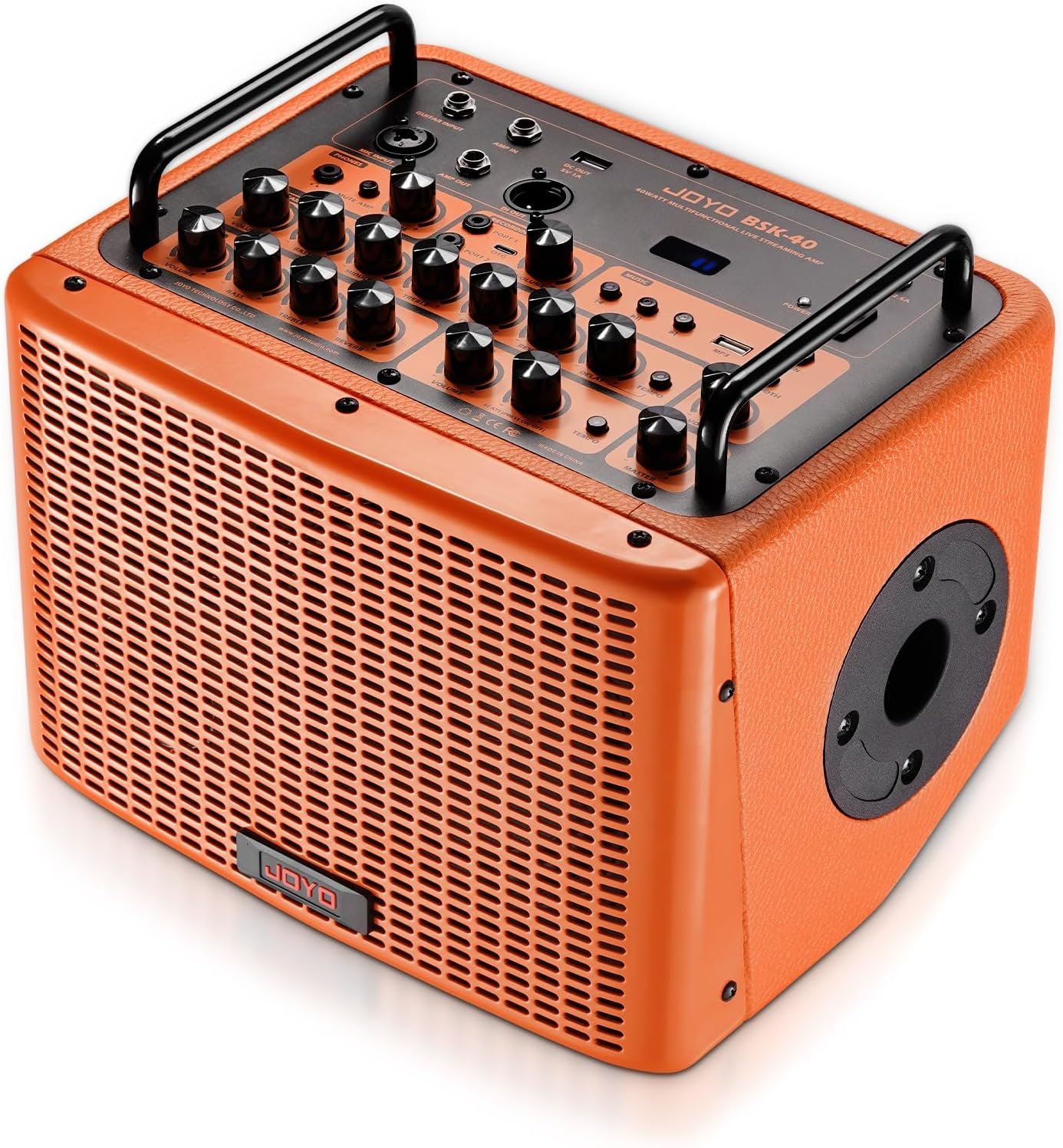
The Orange finish gives this version a distinctive appearance without looking overly decorative. Its straightforward cabinet shape, protective grille and generous selection of controls make it feel more like a working musician’s amplifier than a small Bluetooth speaker with a guitar input added.
For acoustic guitarists who also sing, the BSK-40 offers an interesting balance between portability, convenience and practical sound control.
Why it works for acoustic guitarists
The strongest feature of the JOYO BSK-40 is its ability to handle an acoustic guitar and microphone through the same amplifier.
Instead of needing separate amplification for an electro-acoustic guitar and vocals, the two signals can be connected directly to the BSK-40.
Each channel has independent controls, allowing the guitar and microphone levels to be adjusted separately.
That is particularly useful for singer-guitarists because the balance between an acoustic instrument and a voice can change considerably depending on playing style.
A softly fingerpicked guitar may need more amplification beneath a strong vocal, while energetic strumming can require the opposite adjustment.
The separate channels make it possible to find a sensible balance without constantly changing the guitar’s onboard volume or repositioning the microphone.
For solo performers, buskers and musicians playing smaller venues, that simplicity is one of the amplifier’s main attractions.
What it feels like to use
The BSK-40 is compact, but it is not an exceptionally lightweight miniature amplifier.
It measures approximately 30 cm wide, 24 cm high and 24.4 cm deep, with a weight of around 5.7 kg.
That gives it a fairly substantial cabinet for its size.
The integrated carrying handle makes it convenient to move between rooms, rehearsals and performances, although the weight is noticeable when carrying it over longer distances.
The Orange finish also makes it visually distinctive, particularly compared with the black cabinets commonly found among acoustic amplifiers.
The main controls are arranged together on the amplifier, with clearly separated sections for the guitar, microphone, drum machine and music playback.
There are quite a few knobs and buttons, but the layout is organised around the different jobs the amplifier performs.
That should appeal to musicians who prefer physical controls rather than having to connect a phone application simply to change a basic setting.
The BSK-40 is designed to be positioned on the floor or a suitable support, allowing it to serve as a compact personal amplifier during rehearsals and smaller performances.
A dedicated guitar channel
The guitar channel offers more control than a basic input and volume knob.
There are separate bass, middle and treble controls, allowing the amplified guitar sound to be adjusted to suit the instrument and playing environment.
This matters with acoustic guitars because an electro-acoustic pickup can behave quite differently through an amplifier than the guitar sounds naturally in a room.
Some instruments need a little more low-frequency warmth, while others benefit from reducing excessive bass or adjusting the middle frequencies.
The BSK-40 provides enough adjustment to shape the sound without introducing an unnecessarily complicated menu system.
It also includes chorus, reverb and delay effects for the guitar channel.
Reverb adds a sense of space, helping a dry amplified acoustic sound feel less exposed.
Chorus can introduce gentle movement and width, particularly with fingerpicked passages and slower chord arrangements.
Delay provides repeating echoes that can be used subtly or as a more noticeable creative effect.
The delay section includes a tap-tempo function, making it easier to relate the repeats to the music being played.
For guitarists who want a little atmosphere without assembling a separate pedalboard, these effects are genuinely useful additions.
A separate microphone channel
The microphone channel makes the BSK-40 particularly relevant to singer-guitarists.
JOYO provides an independent microphone input with its own volume, bass, treble and reverb controls.
That allows the vocal sound to be adjusted separately from the guitar.
For example, a singer may prefer a relatively natural guitar sound with only a small amount of reverb, while allowing more space around the voice.
Having separate reverb controls makes that possible.
The microphone channel is suitable for compatible microphones, although the amplifier does not provide phantom power.
That distinction is important for anyone using a condenser microphone that requires external power.
For musicians using a conventional compatible dynamic vocal microphone, the arrangement is considerably more straightforward.
It is particularly useful for someone who wants to arrive at a small performance with an acoustic guitar, microphone and one amplifier rather than carrying a full PA system.
Speaker design and 40W output
The JOYO BSK-40 uses a 6.5-inch bass driver and 2.75-inch high-frequency driver.
This two-driver arrangement is intended to reproduce both the body of an acoustic guitar and the clearer upper frequencies needed for strings and vocals.
The amplifier is rated at 40 watts RMS.
That provides a useful level of output for practice, rehearsals, busking and smaller performance situations.
The additional high-frequency driver is an important part of the design because acoustic guitars and vocals both contain detail that can become dull or indistinct through an unsuitable speaker.
However, amplifier power alone does not determine how loudly or clearly a system will perform in every environment.
Room acoustics, background noise, microphone positioning and the style of music all affect the result.
The BSK-40 makes most sense as a compact personal performance amplifier rather than a replacement for a substantial PA system.
Rechargeable battery for portable playing
One of the BSK-40’s most useful features is its internal rechargeable lithium battery.
This allows the amplifier to operate without being connected continuously to a mains socket.
That flexibility can be particularly valuable for busking, outdoor practice, informal performances and smaller events where access to electrical power is inconvenient.
JOYO quotes approximately three hours of continuous battery operation on a full charge, with a charging time of around four and a half hours.
Actual runtime will depend on operating conditions, including volume and the features being used.
The amplifier also has a battery-level indicator, making it easier to monitor the remaining charge.
For regular indoor use, the supplied mains adaptor provides another power option.
The important advantage is being able to choose between battery operation and mains power rather than committing to one arrangement.
Built-in drum machine
The BSK-40 also includes a drum machine with 20 rhythm patterns.
This adds another dimension to the amplifier’s usefulness, particularly for someone practising alone.
A steady rhythm can help with timing, chord changes and developing a consistent strumming pattern.
It can also make solo practice feel more musical than playing repeatedly against a metronome.
The drum machine has its own volume control, pattern selection and tempo adjustment.
That makes it possible to keep the rhythm comfortably beneath the guitar rather than allowing it to dominate.
The feature will not replace a dedicated rhythm workstation or a real drummer, but it is a practical addition for everyday practice and developing song ideas.
For an acoustic guitarist working on timing and accompaniment, having rhythm patterns available without connecting another device is convenient.
Bluetooth and music playback
Bluetooth connectivity gives the BSK-40 another useful role.
Music can be streamed wirelessly from a compatible phone or other Bluetooth device, allowing the amplifier to reproduce backing tracks or recorded music.
This is useful when practising along with songs or rehearsing arrangements before performing them live.
The amplifier also includes an auxiliary input and USB music playback facilities.
These connections make it possible to work with different audio sources rather than relying entirely on Bluetooth.
The music section has its own playback and volume controls, helping keep accompaniment separate from the guitar and microphone levels.
It is worth understanding that Bluetooth is primarily for audio playback.
It does not mean the acoustic guitar can automatically connect wirelessly without a compatible separate wireless instrument system.
Recording and live-streaming connections
The BSK-40 goes beyond conventional amplification by including connections intended for recording and live streaming.
JOYO provides a USB-C OTG connection alongside dedicated smartphone recording connections.
This allows the amplifier to form part of a recording or streaming arrangement with compatible devices.
For someone creating acoustic performance videos, practising recorded material or sharing live sessions, that adds flexibility.
The amplifier also provides a headphone connection for private listening.
Another useful feature is the balanced XLR DI output.
This allows the amplifier to connect to an external mixing desk or PA system when additional sound reinforcement is required.
That is particularly helpful for performers who occasionally move from smaller informal settings to venues with a proper sound system.
The BSK-40 can remain part of the guitar-and-vocal setup while an external PA handles the larger audience.
The drawbacks
The JOYO BSK-40 combines several useful features, but its limitations deserve just as much attention as its capabilities.
The first consideration is the available volume.
Although the amplifier produces 40 watts, that does not automatically make it suitable for every live performance.
For personal practice, busking and smaller acoustic performances, the output may be entirely appropriate.
However, a noisy pub, busy outdoor location or venue with a larger audience can demand considerably more sound reinforcement.
An acoustic guitar and vocal microphone also need enough headroom to remain clear without being pushed into unwanted distortion.
Anyone planning regular performances in louder environments should consider the BSK-40’s DI output and the possibility of using an external PA system.
The amplifier is best viewed as a compact performance solution rather than an all-purpose replacement for larger stage equipment.
Battery life is another important compromise.
The internal rechargeable battery offers freedom from mains power, but JOYO’s quoted operating time of approximately three hours is not especially generous for an extended performance schedule.
A short busking session or smaller event may fit comfortably within that period.
A long evening involving sound checks, breaks and several playing sets could be more demanding.
Battery life can also vary with operating conditions.
For performances where stopping to recharge would be inconvenient, mains power is the more dependable option when available.
The quoted charging time of around four and a half hours also means a depleted battery cannot simply be topped up in a few minutes between sets.
Anyone intending to rely heavily on battery operation should plan around that limitation.
The microphone input does not provide phantom power.
This is particularly important for performers using condenser microphones that require 48V phantom power.
Such microphones cannot simply be connected with the expectation that the BSK-40 will provide the necessary electrical supply.
An appropriate external power arrangement would be needed.
For musicians already using compatible dynamic microphones, this may not be a concern.
But someone building a vocal setup around a condenser microphone should check compatibility before purchasing.
The microphone section is also relatively straightforward.
It provides useful tone and reverb controls, but it is not a dedicated vocal-effects processor with sophisticated harmony generation, pitch correction and extensive vocal processing.
Performers wanting those facilities will need additional equipment.
The built-in guitar effects are useful but limited.
Chorus, reverb and delay cover several common acoustic-guitar requirements.
They are sensible effects to include because they can add space and interest without dramatically changing the character of the instrument.
However, there is no reason to assume they provide the same depth of control as dedicated professional effects pedals.
A guitarist who regularly uses complex delays, layered modulation, detailed compression or elaborate signal chains may find the built-in processing restrictive.
The BSK-40 prioritises convenience over extensive sound design.
For a player who only needs a little reverb and occasional chorus, that is an advantage.
For somebody who enjoys carefully constructing different effects combinations, a separate processor may still be preferable.
Portability also needs to be considered realistically.
At approximately 5.7 kg, the BSK-40 is reasonably compact but not especially light.
The carrying handle makes it practical for moving between a house, car and rehearsal room.
However, somebody travelling regularly on public transport or walking considerable distances with a guitar, microphone stand and other equipment will notice the extra weight.
Its cabinet also has fixed dimensions.
Unlike a lightweight portable speaker or compact effects unit, it cannot be folded or packed into a small compartment.
The included carrying arrangement may help protect the amplifier during transport, but it does not remove the physical bulk.
A musician who values minimum carrying weight above everything else may prefer a smaller, simpler solution.
The control panel can look busy.
There are separate sections for guitar, microphone, music, recording, effects and drum patterns.
The physical controls are convenient once their functions become familiar, but a new owner should expect to spend some time learning the layout.
Someone who only wants to plug in an acoustic guitar and adjust a single volume control may find the number of options unnecessary.
There is also the possibility of changing a setting accidentally when moving the amplifier or reaching across the controls.
This is a fairly minor concern, but the BSK-40 is undeniably more involved than a basic acoustic combo.
Bluetooth has its own limitations.
Wireless music playback is convenient, but it depends on pairing and maintaining a connection with another device.
Interference, distance and device compatibility can affect the experience.
Bluetooth playback can also introduce latency, making it less suitable for applications requiring tightly synchronised live monitoring.
For ordinary backing-track playback, that may not matter.
For critical real-time audio work, a suitable wired connection is generally the safer approach.
The recording and live-streaming connections also require some preparation.
USB-C connectivity should not be mistaken for a guarantee that every phone, tablet or computer will work in every recording application without configuration.
Device compatibility, suitable cables and software settings still need to be checked.
The USB-C OTG recording connection is also different from the amplifier’s main charging connection.
Finally, the BSK-40 is a general-purpose acoustic performance amplifier rather than a highly specialised system.
Its greatest strength is bringing guitar amplification, vocal amplification, effects, rhythms and recording connections together.
But a musician who only needs one of those functions may find a simpler product more appropriate.
A dedicated acoustic amplifier may offer a more focused control layout.
A separate vocal processor may provide more sophisticated voice effects.
A larger PA system may offer greater coverage for live performance.
The BSK-40 is most appealing when several of its features will actually be used regularly.
Buying it solely because it has a long list of functions could mean carrying more equipment than necessary.
Who it suits best
The JOYO BSK-40 makes particular sense for acoustic guitarists who also sing.
It should appeal to solo performers, buskers, singer-songwriters and musicians playing smaller venues where carrying a full PA system is unnecessary or inconvenient.
The rechargeable battery is useful for performances away from mains power, while the separate guitar and microphone channels make it easier to manage a simple live setup.
It also suits musicians who enjoy practising with backing tracks or drum patterns.
The recording connections provide additional possibilities for performers who create videos, record song ideas or experiment with live streaming.
Someone who needs considerably more volume, sophisticated vocal effects or a dedicated professional recording system may be better served by separate equipment.
Is it worth the amplifier space?
The JOYO BSK-40 Acoustic Guitar Amplifier offers a practical combination of features for musicians who want one compact unit to handle several everyday jobs.
Its 40W output, dual-channel layout, rechargeable battery and built-in effects make it particularly appealing for smaller acoustic performances.
The separate guitar and microphone controls are useful, while Bluetooth, drum patterns and recording connections add flexibility away from the stage.
There are compromises.
Battery runtime is limited, the microphone input lacks phantom power, and the amplifier is not designed to replace a large PA system.
Its effects are also more about convenient everyday sound shaping than elaborate processing.
But for a singer-guitarist who wants to keep equipment manageable while retaining control over both guitar and vocals, the BSK-40 brings several sensible features together.
It earns its place not by trying to do everything, but by making the most common requirements of a smaller acoustic performance easier to handle.
For more acoustic and electric guitar amplifiers, explore our Amplifiers guides.
As an Amazon Associate I earn from qualifying purchases.