Fender American Performer Timber Stratocaster
As an Amazon Associate I earn from qualifying purchases.
The Fender American Performer Timber Stratocaster in Honey Burst offers an interesting variation on one of the most recognisable electric guitars ever produced. Instead of the familiar alder or ash body, this limited-edition American-made Stratocaster uses solid spruce, creating an instrument that stands apart from Fender’s more conventional models.
Built in Corona, California, it combines that unusual body material with a maple neck, rosewood fingerboard, three Yosemite single-coil pickups and Fender’s distinctive Greasebucket tone circuitry.
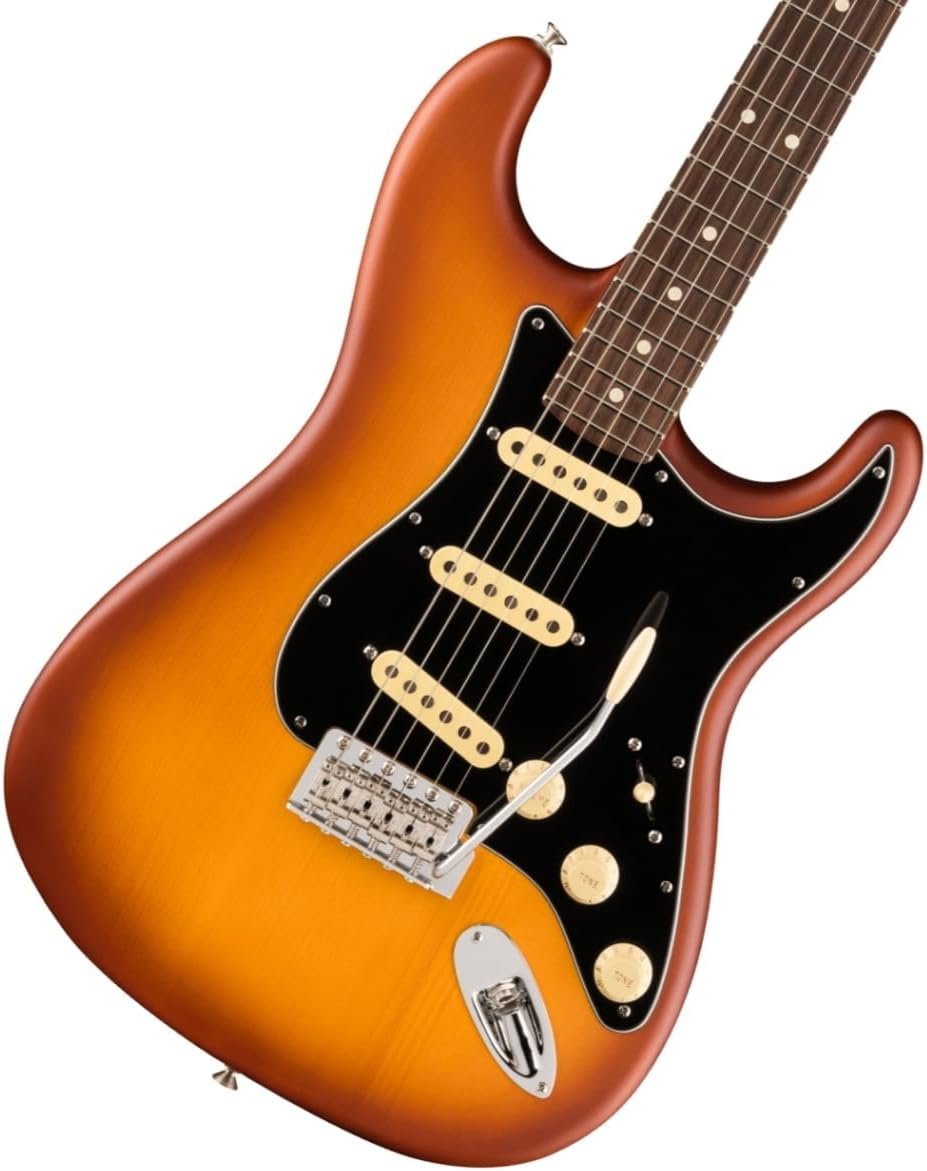
The satin Honey Burst finish gives the guitar a warm, understated appearance, while the black pickguard and aged-white pickup covers provide a particularly attractive contrast.
Underneath the distinctive finish is a familiar Stratocaster layout, but with enough thoughtful details to make this more than simply another colour variation.
For guitarists who appreciate traditional Fender playing characteristics but want something less commonly encountered, the American Performer Timber Stratocaster is an interesting instrument to consider.
Why the spruce body makes this Stratocaster different
The most unusual feature of this guitar is its solid spruce body.
Spruce is far more commonly associated with acoustic guitar soundboards than solid-body electric guitars.
Its use here gives the American Performer Timber Stratocaster an unusual identity within the Fender range.
The Honey Burst finish complements that choice particularly well. Rather than hiding the wood beneath a heavy solid colour, the satin finish provides a softer, more natural appearance.
It has a warm amber centre that moves into darker tones around the edges, creating a familiar burst effect without looking excessively glossy.
Fender also offered the Timber series with sassafras and sugar pine bodies in different finishes, making the choice of wood a defining part of this limited-edition collection.
It is worth being sensible about claims concerning tonewood.
On a solid-body electric guitar, the pickups, strings, bridge, electronics, amplifier and playing technique all contribute to the amplified sound.
The spruce body may influence the instrument’s physical resonance and feel, but it would be misleading to promise that it automatically produces a particular sound simply because spruce is used in acoustic guitars.
The more dependable attraction is the combination of an unusual material, traditional Stratocaster construction and a distinctive finish.
What it feels like to play
The American Performer Timber Stratocaster uses Fender’s familiar Modern C neck profile.
This provides a comfortable, rounded shape without becoming unusually thick or extremely flat.
For players who enjoy a conventional Stratocaster neck, the profile should feel recognisable.
The maple neck has a satin urethane finish, giving the back a smoother, less glossy surface than the polished finishes found on some traditional instruments.
That can be particularly appealing during longer playing sessions, when the fretting hand is moving repeatedly between different positions.
The rosewood fingerboard has a 9.5-inch radius, providing a useful balance between chord playing and modern lead techniques.
Fender fits 22 jumbo frets.
Their larger dimensions give the fingers plenty of contact with the strings during bends and vibrato.
This can make lead playing feel more approachable, particularly for guitarists who prefer not to press the strings heavily against the fingerboard.
The 25.5-inch scale length is another familiar Stratocaster characteristic.
It contributes to the slightly firmer string response associated with longer-scale electric guitars, although string gauge and setup will influence the actual playing feel.
The neck is attached using Fender’s conventional four-bolt arrangement, maintaining the straightforward construction that has been part of the Stratocaster design for decades.
Three Yosemite single-coil pickups
The American Performer Timber Stratocaster uses three Fender Yosemite single-coil pickups.
These pickups are designed to combine familiar single-coil character with a responsive, relatively strong output.
Fender uses flat-staggered pole pieces and a shellac coating as part of their construction.
The intention is to provide clear, expressive sounds while controlling unwanted feedback.
The neck pickup offers the rounded, expressive character that makes a traditional Stratocaster particularly attractive for blues, clean melodies and softer rhythm playing.
The middle pickup provides another tonal option, while the bridge pickup offers the brighter, more cutting response commonly associated with Stratocaster lead and rhythm sounds.
The five-way selector allows the player to access the individual pickups and two familiar combined positions.
These combinations provide a useful range of sounds without requiring complicated electronic controls.
For a guitarist moving between clean playing, blues and classic rock, this arrangement makes practical sense.
It also allows the guitar’s natural playing dynamics to remain an important part of the sound.
Changes in picking strength, amplifier settings and guitar volume can produce meaningful differences without constantly adding more effects.
Additional sounds from push-pull switching
One of the more interesting features is the push-pull control incorporated into the second tone knob.
On a conventional three-single-coil Stratocaster, the five-way selector provides five familiar pickup combinations.
The American Performer Timber Stratocaster adds another possibility.
Pulling up the second tone control activates the neck pickup alongside the selected pickups.
This is particularly useful in the first two selector positions.
With the bridge pickup selected, the push-pull function adds the neck pickup.
That creates a bridge-and-neck combination that is not normally available on a standard Stratocaster five-way selector.
With the bridge-and-middle combination selected, engaging the push-pull control activates all three pickups together.
These additional arrangements broaden the tonal possibilities without changing the guitar’s familiar appearance.
For someone who enjoys experimenting with different clean and lightly driven sounds, they offer worthwhile alternatives.
The control remains straightforward to use.
There is no additional switch cluttering the pickguard, and the standard five-way selector continues to function normally.
Greasebucket tone circuitry
Fender’s Greasebucket tone system is another feature that distinguishes the American Performer from a more basic Stratocaster.
On this model, the second tone control incorporates the Greasebucket circuit for the bridge pickup.
A conventional passive tone control reduces high frequencies as it is turned down.
Depending on the guitar and amplifier, this can sometimes make the sound feel darker or less defined than intended.
The Greasebucket circuit is designed to roll off high frequencies without adding the same sense of bass-heavy muddiness.
That can be particularly useful with a bright bridge pickup.
Instead of choosing between a sharp, cutting sound and an excessively dark one, the player has more control over the upper frequencies.
For blues and classic rock, this can be a useful feature.
It allows the bridge pickup to be softened for certain passages without losing its identity completely.
The master volume and separate tone controls retain the familiar Stratocaster layout, so the additional circuitry does not make the guitar unnecessarily difficult to operate.
Vintage-style tremolo bridge
The American Performer Timber Stratocaster uses a six-saddle vintage-style synchronised tremolo mounted with six screws.
This follows a traditional Fender approach rather than using a modern two-point tremolo system.
The tremolo allows players to introduce pitch movement using the tremolo arm.
Subtle vibrato can add expression to sustained notes and chords, while more noticeable movement is possible depending on the setup.
For players who enjoy traditional Stratocaster techniques, the bridge will feel familiar.
The individual saddles also allow string height and intonation to be adjusted during setup.
The tremolo’s behaviour depends on spring tension, bridge adjustment, string gauge and the way the player uses the arm.
A properly adjusted bridge can provide a satisfying playing experience, but it requires more attention than a conventional fixed bridge.
For guitarists who prefer traditional Fender hardware, that is an acceptable part of the instrument’s character.
ClassicGear tuning machines
Fender fits its ClassicGear tuning machines to this model.
These combine vintage-style appearance with an 18:1 gear ratio.
The finer gearing allows relatively small tuning adjustments without requiring large movements of the tuning key.
That is useful when bringing individual strings accurately into tune.
The machines also complement the guitar’s traditional appearance.
Along with the vintage-style tremolo, rosewood fingerboard and aged-white plastic components, they help preserve the character of a classic Fender instrument.
They are conventional tuning machines rather than a locking system, so correct string installation remains important.
Good tuning stability depends on the complete arrangement, including the nut, strings, tremolo setup and tuning technique.
The Honey Burst satin finish
The Honey Burst finish is one of the most appealing features of this particular version.
Its warm colouring works naturally with the unusual spruce body, giving the guitar a softer appearance than a heavily polished solid-colour instrument.
Fender uses a satin urethane finish, which produces a less reflective surface than a traditional high-gloss coating.
The result feels visually restrained.
The dark three-ply pickguard provides a strong contrast with the lighter centre of the body, while the aged-white pickup covers and controls add a traditional touch.
The rosewood fingerboard continues the warm colour scheme.
There is also a silver 1970s-style Fender logo on the headstock, providing another distinctive visual detail.
This is not a guitar covered in elaborate decorative appointments.
Its attraction comes from the combination of familiar Stratocaster lines, an unusual body material and a carefully chosen finish.
For someone who appreciates Fender’s traditional designs but wants something a little different, Honey Burst is an attractive choice.
Made in Corona, California
The American Performer Timber Stratocaster is produced at Fender’s factory in Corona, California.
That makes it part of Fender’s American-made instrument range rather than one of its overseas-produced series.
The guitar combines traditional construction methods with a more contemporary neck specification and additional switching options.
This is a sensible balance.
It retains the familiar playing experience associated with a Stratocaster while offering useful features such as the Yosemite pickups, push-pull switching and Greasebucket circuitry.
Fender supplies a deluxe gig bag as standard with this model.
That provides a convenient carrying solution for rehearsals, lessons and general transport, although buyers should confirm the contents of the specific retailer package.
For more demanding travel, a fitted hardshell case may provide additional protection.
The drawbacks
The American Performer Timber Stratocaster is an appealing instrument, but several compromises deserve careful consideration.
The first is its limited-edition availability.
Unlike a regularly manufactured Stratocaster that may remain in production for years, the Timber series was introduced as a limited-edition collection.
That means availability can become increasingly restricted as remaining stock is sold.
Someone who spends several months deciding on the exact instrument may discover that a particular finish or configuration is no longer available new.
This is especially relevant to the Honey Burst spruce version.
Buyers who are specifically attracted to the combination of spruce body, rosewood fingerboard and Honey Burst finish should not assume that another identical instrument will always be readily available.
Limited availability does not automatically make a guitar better or more desirable, but it does affect how easily an instrument can be replaced or purchased later.
The spruce body is also an unusual choice, which may not appeal to traditionalists.
Many players associate Stratocasters with alder or ash construction.
Those materials are familiar, widely used and represented across numerous Fender models.
Spruce is less commonly encountered in solid-body Stratocasters.
For someone seeking a very specific traditional construction, that difference may be enough to favour another instrument.
There is also a danger of expecting exaggerated tonal changes simply because the guitar uses a different wood.
The word spruce may suggest the resonance of an acoustic guitar, but this is a solid-body electric instrument.
Its amplified sound remains heavily influenced by the Yosemite pickups, hardware, electronics and connected equipment.
Anyone buying the guitar purely because they expect the spruce to produce a dramatic acoustic-like tone could be disappointed.
The spruce construction should be appreciated as part of the overall design rather than treated as a guarantee of a particular sound.
Weight and balance should also be checked individually.
Wood is a natural material, and density varies between pieces.
The use of spruce does not guarantee that every example will have exactly the same weight or balance.
For a guitarist who performs standing for long periods, the way an instrument hangs from the strap is important.
A guitar can feel comfortable while seated but less appealing after a lengthy rehearsal.
Anyone particularly sensitive to weight should ideally confirm the weight of the individual instrument rather than making assumptions based on the body material alone.
The three single-coil pickups introduce the familiar issue of electrical hum.
Single-coil pickups are attractive because of their clarity and expressive response.
However, individual pickup positions can also reproduce unwanted electrical interference.
This becomes more noticeable with high-gain amplification, certain lighting systems and electrically noisy environments.
Fender uses a reverse-wound, reverse-polarity middle pickup, allowing the familiar combined positions to reduce hum.
The extra switching options can also produce useful sounds, but they do not make the guitar completely noiseless in every setting.
Someone who regularly plays heavily distorted music may prefer a guitar fitted with humbuckers or dedicated noiseless pickups.
The Timber Stratocaster is better suited to players who appreciate traditional single-coil character and understand its limitations.
The Yosemite pickups may also differ from what some vintage-focused players expect.
Although they retain a familiar single-coil identity, the Yosemite pickups are designed with a relatively dynamic, expressive response.
They should not automatically be regarded as exact reproductions of early vintage Fender pickups.
Some guitarists prefer lower-output pickups with a very particular vintage character.
Others enjoy a slightly stronger response that can work across several playing styles.
The Yosemite set provides one interpretation of the Stratocaster sound rather than attempting to reproduce every historical pickup design.
For players who have spent years searching for a specific vintage tone, that distinction matters.
The six-screw tremolo is another compromise.
Traditional tremolo systems have considerable appeal, but they require careful setup.
String gauge changes, spring tension and bridge adjustments can influence how the system behaves.
Players who frequently change tunings may find a fixed-bridge guitar easier to manage.
The bridge can also require attention to maintain satisfactory tuning stability during repeated tremolo use.
Heavy-handed pitch changes may create more tuning difficulties than subtle vibrato.
A properly adjusted tremolo can perform well, but it is not a maintenance-free arrangement.
Someone who never uses a tremolo arm might reasonably prefer the simplicity of a fixed bridge.
The ClassicGear tuners are not locking tuners.
The 18:1 ratio allows precise tuning adjustments, but the machines use a conventional string-holding arrangement.
Locking tuners can make string changes faster and more convenient, particularly for guitarists who replace strings frequently.
Traditional tuning machines work perfectly well when strings are installed correctly, but they do not provide that additional convenience.
For players accustomed to locking tuners, the difference may be noticeable.
This is not necessarily a reason to replace the hardware, but it is worth understanding what Fender includes.
The 9.5-inch fingerboard radius will not suit every playing style.
For general chord work, blues and conventional lead playing, this radius provides a useful compromise.
However, players accustomed to extremely flat modern fingerboards may prefer a different feel.
Very low action combined with large string bends can also make fret condition and setup more important.
The 22 jumbo frets help with bending and fretting control, but larger frets have their own characteristics.
A player with a particularly heavy fretting technique may find that excessive finger pressure causes notes to sound slightly sharp.
Good technique and an appropriate setup help avoid that problem.
The fingerboard and fret combination will suit many guitarists, but it cannot be assumed to feel ideal for everyone.
The Modern C neck profile is another personal consideration.
It provides a familiar Fender shape without being unusually thick.
Nevertheless, neck preferences vary enormously.
Someone who enjoys a deep, rounded vintage neck may find the profile too slim.
A guitarist accustomed to an exceptionally thin modern neck may feel the opposite.
Specifications provide a useful guide, but they cannot fully describe how a neck feels in an individual player’s hand.
For a guitar intended to be played regularly, comfort matters more than the name given to the neck profile.
The satin finish also requires some care.
Satin finishes have an attractive, understated appearance, but they can show handling marks and wear differently from high-gloss finishes.
Areas regularly touched by the forearm or picking hand may gradually develop a smoother, more polished appearance.
That is a normal possibility with satin-finished instruments.
It does not necessarily indicate poor construction, but buyers expecting the surface to remain visually identical after years of playing should understand the difference.
The Honey Burst colouring also means marks may be visible against certain areas of the finish.
Cleaning should be done using suitable products and a soft cloth, avoiding abrasive polishes that could alter the satin appearance.
The included deluxe gig bag provides less protection than a rigid case.
A gig bag is convenient for carrying a guitar and normally takes up less room than a hardshell case.
However, it cannot offer the same protection against substantial impacts or crushing pressure.
Someone regularly transporting equipment in a crowded vehicle may prefer a properly fitted rigid case.
That introduces another practical consideration.
It also means the gig bag should not be treated as suitable protection for every transport situation simply because Fender supplies it with the guitar.
The correct choice depends on how the instrument will be used and carried.
Finally, the additional switching options may not be essential for every player.
The push-pull control provides bridge-and-neck and all-three-pickup combinations that are unavailable on a conventional Stratocaster selector.
Those are useful sounds to have.
However, someone who mainly uses the neck pickup or one familiar combined position may rarely need them.
Likewise, the Greasebucket circuitry provides worthwhile tonal control, but some players already achieve everything they need through conventional tone adjustments.
These additional features are attractive when they suit the guitarist’s playing style.
They should not be treated as automatic reasons to choose this model over every other Stratocaster.
The Timber Stratocaster makes the most sense when the unusual spruce body, satin finish, American-made construction and extended switching genuinely appeal to the player.
Buying it simply because it is limited edition would overlook the more important question of whether its neck, pickups and playing feel are right.
Who it suits best
The Fender American Performer Timber Stratocaster is particularly well suited to guitarists who appreciate traditional Stratocaster playing characteristics but want something less common than the usual production models.
It should appeal to blues, classic-rock, country and general-purpose electric guitar players who enjoy articulate single-coil sounds.
The Yosemite pickups and additional switching options make it attractive for musicians who like experimenting with different clean and driven tones.
The Modern C neck, rosewood fingerboard and jumbo frets provide a useful combination for everyday rhythm and lead playing.
It is also an interesting choice for Fender enthusiasts who appreciate unusual body materials and limited-edition instruments.
Players who prefer high-output humbuckers, fixed bridges or exceptionally flat modern fingerboards may find another guitar more suitable.
Is it worth the guitar space?
The Fender American Performer Timber Stratocaster in Honey Burst offers an appealing combination of familiar Fender design and unusual construction.
The spruce body gives this limited-edition instrument a distinctive identity, while the satin Honey Burst finish provides a warm, understated appearance.
The maple neck, rosewood fingerboard and 22 jumbo frets preserve a comfortable, familiar Stratocaster playing layout.
Three Yosemite pickups provide the familiar clarity and articulation of single-coil guitars, while the push-pull switching adds useful sounds beyond the conventional five-way selector.
The Greasebucket circuitry and ClassicGear tuning machines provide additional practical details.
Its limitations are worth considering.
The six-screw tremolo requires sensible setup, the single-coil pickups can produce hum, and the satin finish may develop visible handling wear over time.
Limited-edition availability also means this exact version may not be easy to find indefinitely.
But for someone who enjoys traditional Stratocaster sounds and wants an American-made Fender with distinctive materials and appearance, the Timber series offers something genuinely different.
The most important consideration remains whether the instrument suits the player’s hands, ears and musical preferences.
For a guitarist drawn to the unusual spruce construction and warm Honey Burst finish, this American Performer is certainly worth exploring.
For more Fender guitars and other quality electric instruments, explore our Electric Guitars guides.
As an Amazon Associate I earn from qualifying purchases.