BOSS VE-8 Acoustic Singer
As an Amazon Associate I earn from qualifying purchases.
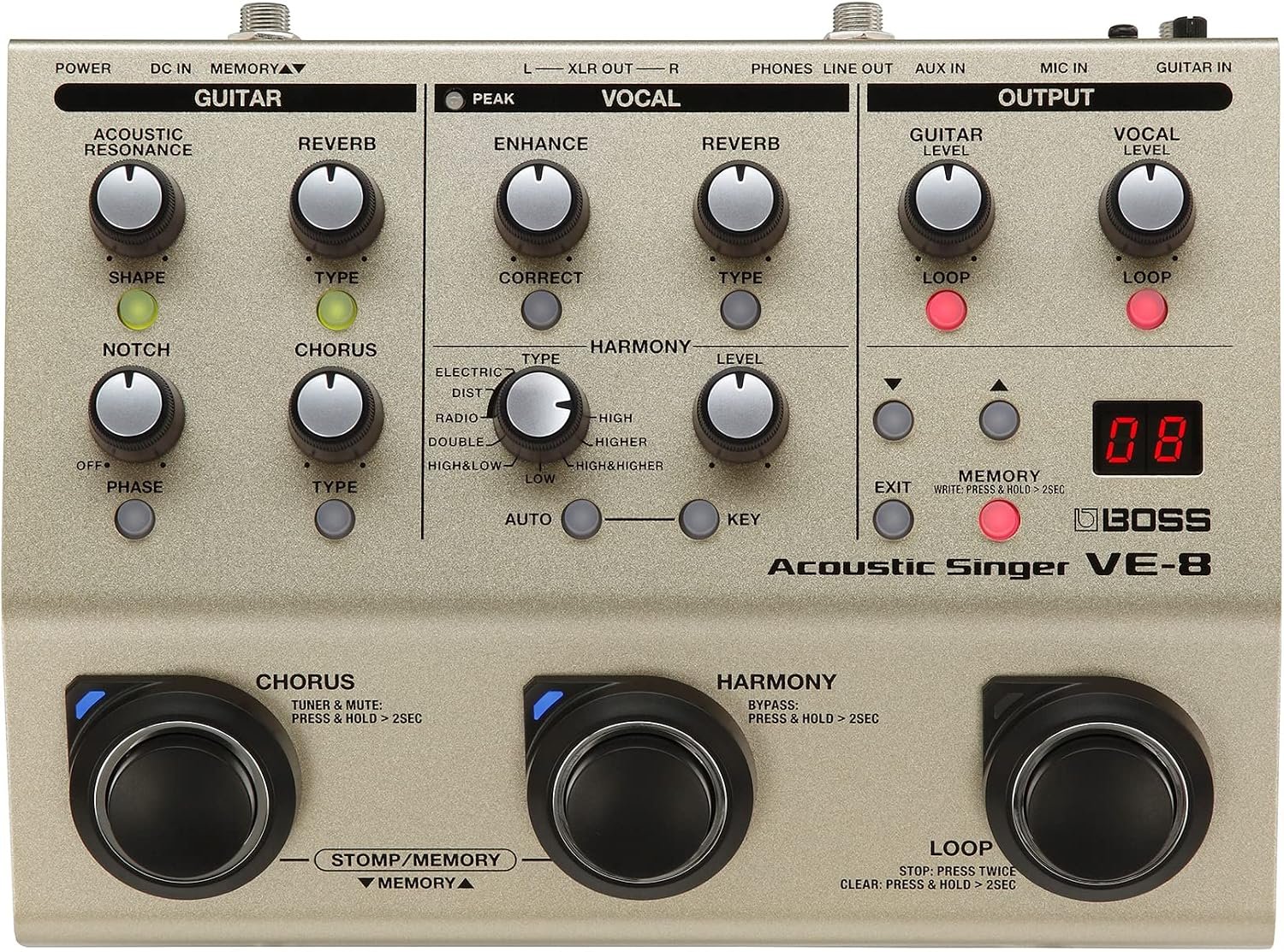
Playing acoustic guitar and singing at the same time can quickly turn a simple setup into a floor full of separate boxes. The BOSS VE-8 Acoustic Singer approaches the problem differently, combining guitar processing, vocal effects, harmony and looping in one compact floor unit designed around the needs of singer-guitarists.
Rather than treating the guitar and microphone as an afterthought to one another, the VE-8 gives each its own dedicated section. That makes it particularly interesting for solo performers who want more control over their sound without building a complicated pedalboard.
Physically, it is a substantial little unit. At roughly 217 mm wide, 161 mm deep and 65 mm high, it occupies more floor space than a single stompbox but remains compact enough to sit neatly in front of a microphone stand. With batteries fitted it weighs about 1.3 kg, giving it enough solidity that it should not feel like a lightweight plastic accessory sliding around underfoot.
Why it works for acoustic performers
The strongest part of the VE-8 is that it has been designed specifically around voice and acoustic guitar together.
The guitar side includes BOSS Acoustic Resonance processing, which is intended to give the plugged-in sound of an acoustic guitar more natural body and character. There is also reverb, chorus and a selection of additional effects including delay, tremolo, phaser, octave and modulation options.
That gives a player considerably more room to shape the guitar than simply connecting an electro-acoustic directly into a PA.
There is also a built-in tuner, which is one of those practical additions that becomes more valuable during an actual performance than it looks on a specification sheet. It means one less separate pedal or clip-on device to keep track of.
The guitar section also includes notch-filter and phase controls. These are especially relevant for amplified acoustic instruments because feedback can become a genuine nuisance in smaller venues or when stage volume begins to rise.
The VE-8 therefore does more than add decorative effects. Part of its job is helping an acoustic guitar behave more comfortably in an amplified environment.
The vocal side
The microphone section gives the singer its own set of tools rather than simply passing the vocal signal through.
Reverb can add space around a dry vocal, while the Enhance function is designed to tidy and strengthen the overall vocal sound.
The harmony feature is one of the VE-8’s more distinctive abilities.
It can create harmony parts in real time using information from the guitar input, so the harmony follows the chords being played. A key can also be set manually when required.
That can be especially useful for a solo performer who wants the impression of additional vocal parts during choruses without needing another singer on stage.
There are several harmony choices as well as vocal doubling. More obvious effects such as electronic pitch correction, distortion and radio-style processing are available for songs where a more deliberate special effect is wanted.
The useful point is that those more dramatic sounds do not have to dominate the unit. A performer can keep things relatively natural and simply use reverb, enhancement and occasional harmony.
What it feels like to use
Although the VE-8 contains quite a lot of processing, the front panel is divided logically between the guitar and vocal sections.
That physical separation matters.
A multi-effects processor with dozens of functions can become irritating when the controls needed during a performance are buried in menus. The VE-8 instead presents many of its main controls directly on the surface.
Large knobs and clearly separated sections make it easier to understand what belongs to the guitar and what belongs to the microphone.
The three footswitches provide hands-free control while performing. That is essential with a product like this because a singer with both hands on a guitar cannot realistically reach down and adjust controls in the middle of a song.
The metal-bodied floor-unit format also feels more appropriate for regular performance use than a small desktop box. It is designed to be operated with footwear, packed with other equipment and placed on stages rather than sitting permanently beside a computer.
The 80-second looper
The built-in looper gives up to 80 seconds of recording time.
More importantly, the guitar and vocal signals can be looped independently.
That opens up more possibilities than simply recording a chord progression. A performer can build guitar layers, vocal parts or combinations of both while keeping control over how the arrangement develops.
For a solo acoustic player, looping can turn a simple performance into something much fuller without requiring another separate pedal.
It is long enough for many chord sequences and performance ideas, although anyone building complex multi-minute looping arrangements may eventually find the available recording time restrictive.
The VE-8 is therefore better thought of as a practical performance looper integrated into the overall system rather than a replacement for a specialised looping workstation.
Saving sounds for different songs
The VE-8 provides 50 memory locations.
That becomes useful once you move beyond one basic guitar and vocal sound.
A performer might want a dry intimate setup for one song, more reverb and harmony for another, and a different guitar effect for something more atmospheric. Saving those combinations means they can be recalled rather than rebuilding every setting between songs.
For somebody playing a prepared live set, this could be one of the most useful features of the entire unit.
It also reduces the need to bend down and adjust several knobs while an audience waits.
Connections for stage and recording
The rear-panel connections make the VE-8 flexible enough for more than one type of setup.
There is an XLR microphone input with 48V phantom power, allowing compatible condenser microphones to be used as well as the dynamic microphones more commonly seen on stage.
The guitar has its own quarter-inch input.
For output, there are both XLR and quarter-inch line connections, giving useful options when connecting to a PA system, mixer or other amplification equipment.
A headphone output is included, along with an auxiliary input for connecting an external audio source.
There is also USB connectivity for recording to a computer. That gives the VE-8 some use away from the stage as well, particularly for musicians who want to capture guitar and vocal performances without completely rebuilding their live signal chain.
Power at home or on stage
The supplied AC adaptor is likely to be the sensible choice for regular rehearsals and performances.
However, the VE-8 can also operate from six AA batteries.
That adds useful flexibility for busking, outdoor performance, rehearsals in awkward spaces or any situation where a convenient power socket is not guaranteed.
BOSS gives an approximate continuous battery life of 4.5 hours with phantom power switched off.
With phantom power running, that estimate drops to roughly 2.5 hours.
Those figures underline why the battery facility is best viewed as a useful option rather than automatically the best way to power the unit every day.
The drawbacks
The biggest limitation of the BOSS VE-8 is also what makes it appealing: it is highly specialised.
This is not simply an acoustic-guitar effects pedal.
Its real purpose is to handle a guitar and a vocal microphone together. If you never sing while playing, a considerable part of the unit will go unused. A simpler acoustic preamp or effects pedal may make more sense and take up less room.
Likewise, a vocalist who does not play acoustic guitar would be paying for an entire guitar-processing section that offers little benefit.
The VE-8 works best when you genuinely need both halves.
Its control surface can also look intimidating at first.
There are numerous knobs, buttons, indicator lights and functions spread across the panel. The physical layout is sensible, but someone moving from a basic guitar-and-microphone setup should expect to spend some time learning what each section does.
The harmony system adds another layer to understand.
Automatic harmony can be remarkably useful, but it still requires sensible setup. Harmony levels that are too loud or effects that are too obvious can quickly make a natural acoustic performance sound processed.
The same applies to pitch correction and the more dramatic vocal effects.
Having those tools available does not necessarily mean they need to be used heavily. A little restraint will probably suit many acoustic performers better than trying to demonstrate every effect at once.
The size is another compromise.
At around 217 × 161 mm, the VE-8 is compact compared with carrying several separate processors, but it is much larger than a normal single pedal.
A guitarist with a tiny pedalboard may need to rethink the layout or carry the VE-8 separately.
At approximately 1.3 kg with batteries, it also adds noticeable weight to a gig bag. That weight contributes to the solid floor-unit feel, but musicians already carrying a guitar, microphone, stand, cables and other equipment will notice every extra kilogram.
The looper is useful, but its 80-second maximum will not satisfy every looping musician.
For straightforward verses, chord progressions and performance layers it should be perfectly workable. Players whose entire act revolves around elaborate multi-layer looping may prefer a dedicated looper with more recording capacity and deeper control.
Battery operation has limitations as well.
Six AA batteries are convenient when mains power is unavailable, but BOSS’s quoted operating time of around 4.5 hours means frequent performers could work through batteries fairly quickly.
Switching on phantom power reduces that estimate to approximately 2.5 hours.
For a full evening of music, especially with a condenser microphone, relying completely on batteries would require some planning and probably a spare set nearby.
The large range of connections is welcome, though it also means the VE-8 can become the centre of quite a cable-heavy setup.
A microphone cable, guitar lead, PA outputs, power cable and perhaps USB or auxiliary connections can all converge on one relatively small floor unit. Good cable management becomes important on a cramped performance area.
There is also no escaping the fact that putting guitar and vocal processing into the same box creates a single point of dependence.
With separate pedals, the failure of one unit does not necessarily take the entire setup with it. When one processor is handling both major parts of a solo performer’s sound, having a simple backup plan is sensible.
Finally, players who enjoy building a very particular sound from individual pedals may find the all-in-one approach less appealing.
The VE-8 is designed around convenience and integration. It gives you a broad collection of useful tools in a coherent package, but it does not offer the same freedom as choosing a favourite individual acoustic preamp, vocal processor, harmony pedal and dedicated looper separately.
For many performers that simplicity will be precisely the attraction. For inveterate pedalboard builders, it may feel more restrictive.
Who it suits best
The BOSS VE-8 makes the most sense for the solo singer-guitarist.
A musician performing acoustic sets in pubs, restaurants, small venues, churches, open-mic nights or similar environments can potentially replace several separate pieces of equipment with this one floor unit.
It is particularly attractive for players who want vocal harmony and guitar processing without making the live setup unnecessarily complicated.
It should also suit performers who move regularly between venues and value being able to save their favourite sounds in memory rather than setting everything from scratch each time.
For guitarists who do not sing, or singers who do not play guitar, there are more focused products available.
Is it worth the pedalboard space?
For a musician who genuinely needs both acoustic-guitar and vocal processing, the BOSS VE-8 Acoustic Singer earns its floor space by bringing several useful jobs together.
The guitar section provides more than basic effects, with Acoustic Resonance and feedback-control tools aimed specifically at amplified acoustic instruments.
The vocal section adds reverb, enhancement and real-time harmony without requiring a separate vocal processor.
Then there is the looper, 50 memories, flexible outputs, USB connection and battery option.
It is not the smallest or simplest box a singer-guitarist could put on the floor, and its depth means there is a learning curve.
But that complexity has a purpose.
Instead of assembling a collection of unrelated pedals and processors, the VE-8 provides one integrated control centre for the two things at the heart of an acoustic singer’s performance: the guitar and the voice.
For more pedals and processors designed to shape your sound, explore our Pedals & Effects guides.
As an Amazon Associate I earn from qualifying purchases.