CAHAYA Electric Guitar Hard Shell Case
As an Amazon Associate I earn from qualifying purchases.
The CAHAYA Electric Guitar Hard Shell Case is designed for players who want something more substantial than a soft gig bag without moving into a bulky flight-case style enclosure.
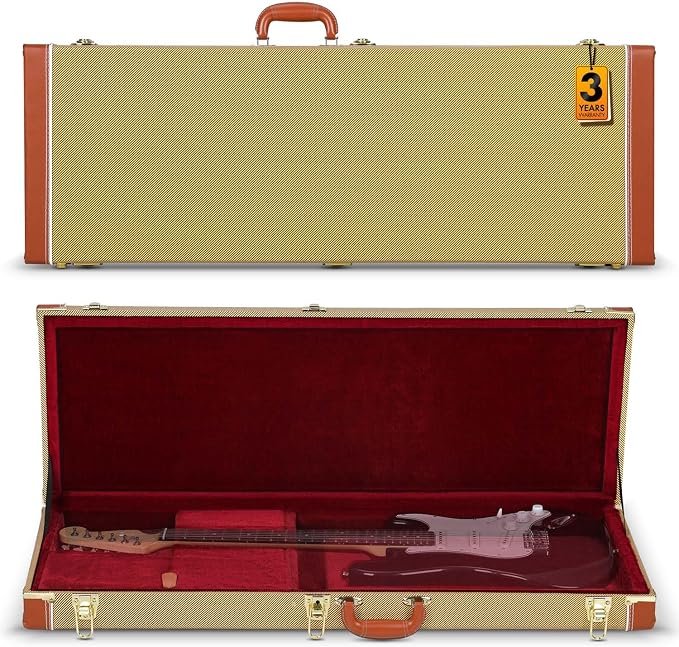
Its rigid wooden shell is wrapped in a vintage-looking tweed-style finish, while the inside is lined with deep red plush. Reinforced corners, metal hardware and a structured handle give it the reassuringly solid feel you expect from a proper guitar case rather than a padded fabric cover.
The most important question with any hard case, however, is not how attractive it looks. It is whether your particular guitar actually fits properly. That is especially important here, because electric guitars vary enormously in body shape.
Why a hard case makes sense
A good gig bag is perfectly adequate for many players.
For carrying a guitar to a local lesson or putting it carefully into the back of a car, thick padding may be all that is needed.
A hard case serves a different purpose.
Its rigid outer structure is designed to resist pressure and knocks rather than simply cushioning them. If other equipment gets pushed against the case, the shell provides a physical barrier between the outside world and the instrument inside.
That matters when guitars are being transported alongside amplifiers, pedalboards, microphone stands and other equipment.
It also provides more reassurance around the parts of a guitar that are particularly vulnerable, including the headstock, neck and controls.
The CAHAYA case feels much more like something intended to surround and support the instrument than simply wrap around it.
What it feels like to use
The exterior has a traditional luggage-like appearance rather than the black moulded-plastic finish found on many modern guitar cases.
The tweed-style surface feels textured and slightly warmer visually, while the contrasting brown trim, reinforced corners and carrying handle give it a more furniture-like character.
Open the case and the feel changes completely.
The deep red plush lining is soft against the guitar finish, while padded areas around the neck and body help hold the instrument away from the hard shell underneath.
That softness matters.
A rigid case needs structure on the outside, but the guitar itself should sit against padded surfaces rather than hard timber or metal fittings.
The case also has a proper hinged lid rather than the flexible opening of a gig bag. Once opened on the floor or a table, it stays open and gives clear access to the guitar.
That makes putting the instrument away feel more deliberate.
Internal support for the guitar
The neck area is one of the most important parts of any guitar case.
A guitar should not simply lie flat inside an oversized box with the neck unsupported.
The CAHAYA design includes additional padding around the neck and bridge areas, helping to support the instrument and reduce movement inside the case.
There is also a dedicated neck rest.
This raises the neck away from the bottom of the case and helps distribute the guitar’s weight more sensibly.
For normal transport, that is much more reassuring than a loose soft bag where the entire instrument can flex slightly as it is carried.
The plush lining also keeps harder components such as bridge saddles, knobs and strap buttons away from abrasive surfaces.
Storage for the small things
There is an internal accessory compartment for the items that always seem to travel with a guitar.
Picks, spare strings, a tuner, short cables, a strap and other smaller accessories can stay inside the case rather than being carried separately.
That sounds like a minor feature until you start using a guitar regularly outside the house.
Keeping spare strings and a tuner permanently in the case means they are much less likely to be forgotten before a rehearsal.
The compartment also keeps these objects away from the guitar itself.
A loose metal tuner, jack adapter or string cutter rattling around beside a finished instrument is exactly the sort of thing a proper case should prevent.
Suitable for regular transport
The reinforced hardware and rigid construction make the CAHAYA more appropriate for repeated car journeys than a very lightweight bag.
Metal latches hold the case closed, while reinforced corners protect areas most likely to meet doorways, floors and the inside of a vehicle.
The carrying handle has a more traditional suitcase feel than the soft webbing handle on many gig bags.
That does make the case feel heavier and more substantial in the hand, but there is something reassuring about carrying a guitar in a rigid rectangular shell.
You can feel immediately that there is structure around the instrument.
For a guitarist travelling between home, rehearsals and lessons, that added protection can be worth the extra weight.
Check the dimensions before buying
This is the part I would pay most attention to.
The listing gives an external case size of approximately 105 × 36.5 × 13 cm, with an internal length of roughly 100 cmand width around 31 cm.
Those numbers matter far more than the phrase “standard electric guitar”.
A Stratocaster-shaped guitar and a Les Paul may both be standard six-string electric guitars, but their bodies are very different.
Then there are Telecasters, SGs, Jazzmasters, Jaguars, semi-hollow guitars and more unusual shapes.
A hard case cannot stretch around an instrument in the same way a gig bag can.
Before ordering, measure:
- Overall guitar length
- Widest part of the body
- Body thickness
- Headstock width
- Position of the neck and body relative to the internal support
A few minutes with a tape measure is much better than discovering that a beautiful hard case is two centimetres too narrow.
The vintage-style appearance
There is no practical reason a guitar case needs to look attractive.
But this one does have more visual personality than a plain black rectangular case.
The cream and tan exterior has a vintage amplifier or old luggage feel, while the red lining gives the inside a traditional instrument-case appearance.
That can work particularly well with classic-looking guitars.
A sunburst Stratocaster, Telecaster or similar instrument looks quite at home against the dark red plush.
It is a small pleasure, but opening a nice case and seeing the guitar sitting properly inside it does make ownership feel a little more considered.
The design is less likely to disappear visually than a black case, though, which will be either an advantage or a drawback depending on your taste.
Hard case or gig bag?
Neither option is automatically better.
A gig bag wins for portability.
It is lighter, easier to carry on public transport and often has shoulder straps. Many padded bags also include large exterior pockets for sheet music, cables and other accessories.
The CAHAYA hard case wins in a different area.
Its rigid construction provides a more substantial barrier against pressure and impact.
If your guitar travels mainly in a car, sits among other equipment or spends time stored in cupboards where things could be placed against it, that additional structure becomes useful.
The trade-off is weight and bulk.
You cannot fold a wooden guitar case and put it in a drawer when it is empty.
The drawbacks
The first and most important drawback is compatibility.
The words “standard electric guitar” should not be treated as meaning “fits every normal electric guitar”.
There is no truly universal rectangular hard case.
Electric guitar bodies differ too much in length, width and geometry.
A Strat-style instrument may sit comfortably while an offset guitar could be too wide in one area. A Les Paul-style guitar may have very different body depth and neck angle. Some extended headstocks may also create problems even when the body fits.
This is why I would not buy the case without measuring the guitar first.
The rigid shell provides protection precisely because it does not stretch. That becomes a disadvantage when the dimensions are wrong.
The second drawback is weight.
A wooden case with plush lining, metal hardware and reinforced corners is naturally heavier than a fabric gig bag.
That difference becomes noticeable when walking any distance.
Carry the guitar from the house to a car and it is unlikely to matter much. Carry it through a railway station, across a city or several streets to a rehearsal and the extra weight becomes far more obvious.
There are also no backpack straps.
A gig bag can leave both hands free, which is particularly useful when you are also carrying a pedalboard or amplifier.
With this style of hard case, one hand is occupied by the handle.
The rectangular shape adds bulk too.
It may slide nicely into the boot of a car, but it occupies more volume than a fitted moulded case or soft bag.
Storage at home deserves consideration for the same reason.
A gig bag can often be folded slightly or hung behind a door when not in use. A rigid case still occupies its full footprint even when the guitar is on a stand.
That can become irritating in a small flat or bedroom.
The tweed-style exterior has its own practical compromise.
It looks attractive, but a pale textured surface will probably show dirt and scuffs more readily than a plain black moulded case.
A guitar case used regularly eventually gets knocked against doors, car interiors and rehearsal-room floors.
That wear may actually improve the vintage character for some owners, but anyone wanting the case to remain immaculate may find themselves cleaning it more often than expected.
The plush interior also requires a little care.
It is soft and attractive, but fibres can collect dust, broken string ends and small bits of debris.
Before putting a valuable guitar inside, it is worth occasionally running a hand gently through the lining to make sure nothing sharp has become lodged there.
The internal storage compartment is useful, but it is not enormous.
Picks, tuners, strings and a small cable are sensible contents.
Large straps, full-length instrument leads, power supplies and multiple tools can quickly fill it.
Trying to cram too much into the compartment defeats the point of protecting the guitar.
Loose objects should never be forced into the main guitar area simply because the storage box is full.
The metal latches are another difference from a zipped gig bag.
They feel satisfyingly positive when closed, but they should always be checked before lifting the case.
It sounds obvious, yet lifting a hard case with one latch accidentally left open is the sort of mistake that only has to happen once.
Hard cases can also encourage a false sense of security.
This is considerably more protective than a soft bag for normal transport, but it should not automatically be treated as an airline flight case or professional touring road case.
A rigid wooden shell can protect against everyday bumps and pressure without being designed for baggage handlers, heavy stacking or serious drops.
If the guitar is going into an aircraft hold or touring equipment truck, I would want something specifically built and rated for that environment.
The rectangular construction can also allow some guitars to move more than expected if their body shape does not match the internal support closely.
A guitar should not rattle around inside the case.
If you can noticeably shift the instrument from side to side once it is inside, the fit is not ideal even if the lid closes.
The neck support deserves the same attention.
The guitar should rest naturally without the neck being forced upward or the headstock pressing against the end of the case.
A case that technically closes is not necessarily a case that fits correctly.
There is also the matter of neck angle.
Many electric guitars have relatively straight neck-to-body geometry, while others have an angled neck and headstock arrangement.
That can affect how the instrument sits against the internal support.
This is another reason measurements and shape matter more than simply seeing the words “electric guitar case” in the title.
The carrying handle is comfortable enough for normal transport, but one central handle means all the load hangs from one arm.
A heavier guitar inside a wooden case can become tiring after several minutes.
Finally, this is not the case I would choose for someone whose priority is the lightest possible setup.
Its appeal is almost the opposite.
You accept additional bulk and weight because you want a hard shell around the instrument.
That trade-off should be intentional.
Who it suits best
The CAHAYA hard shell case makes most sense for a guitarist who regularly transports a compatible electric guitar by car and wants more protection than a soft gig bag provides.
It also suits someone who stores a guitar in a cupboard, under furniture or around other equipment where a rigid shell provides additional reassurance.
The vintage-style exterior may particularly appeal to players with traditional-looking instruments who find ordinary black cases rather dull.
It is less suitable for someone who walks long distances with their guitar, relies on public transport or needs backpack straps.
And anyone with an unusual guitar shape should treat the internal dimensions as essential rather than optional information.
Is it worth the guitar-case space?
The CAHAYA Electric Guitar Hard Shell Case offers something fairly simple: a rigid wooden enclosure, soft plush interior, padded neck support, internal accessory storage and reinforced hardware around the outside.
It feels more substantial than a gig bag because it is more substantial.
That extra protection comes with predictable compromises. The case is heavier, bulkier and far less forgiving when it comes to guitar dimensions.
The most important advice is therefore also the least exciting: measure your guitar carefully before ordering.
If the instrument fits correctly and most of your transport is by car rather than on foot, the CAHAYA case provides a reassuring middle ground between a soft gig bag and a much heavier professional flight case.
For more cases, cables, tuners and other practical equipment, explore our Aceessories guides on Techstore1.
As an Amazon Associate I earn from qualifying purchases.