Squier Classic Vibe ’60s Jazz Bass
As an Amazon Associate I earn from qualifying purchases.
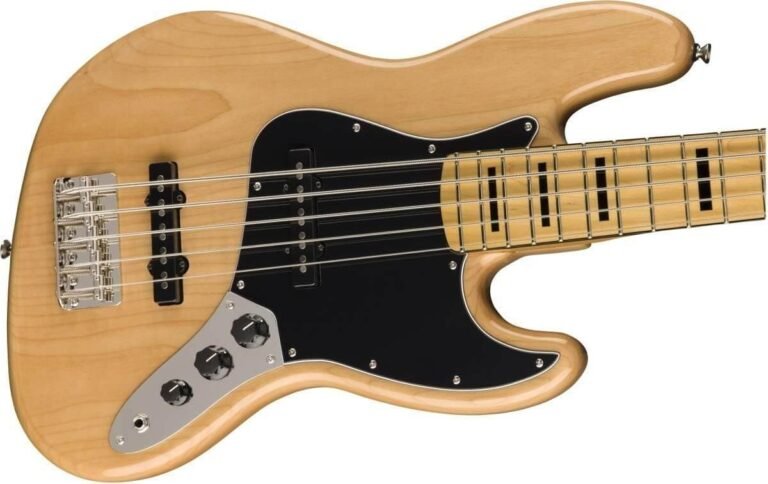
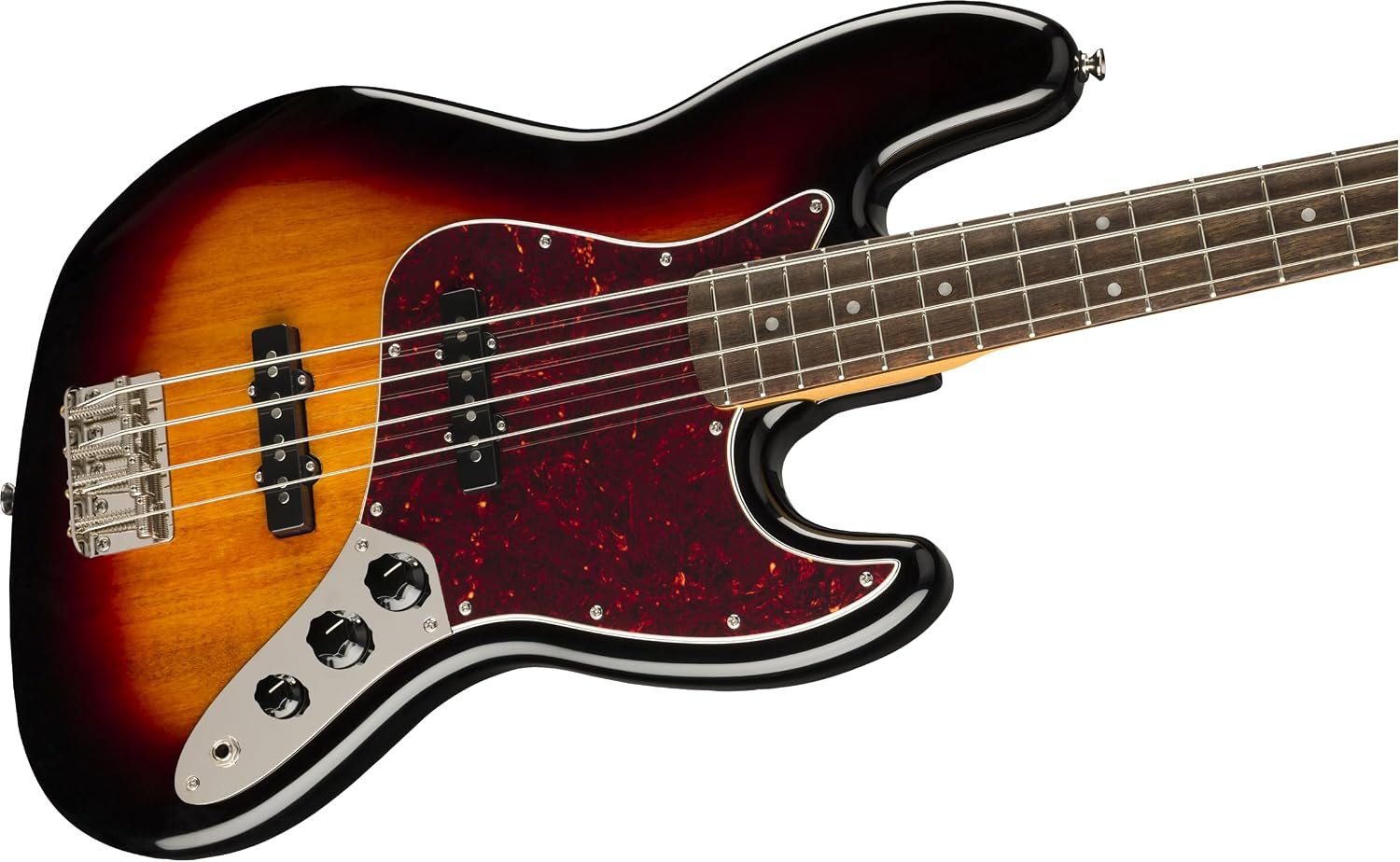
The Squier Classic Vibe ’60s Jazz Bass takes one of Fender’s most recognisable bass designs and gives it a deliberately vintage character without making it feel awkward or overly specialised. The 3-Colour Sunburst finish, tortoiseshell pickguard and offset Jazz Bass body give it a familiar 1960s look, while the hardware and controls remain simple enough for everyday playing.
Fender currently specifies this model with a poplar body, maple neck, Indian laurel fingerboard, 34-inch scale length and two Fender-Designed Alnico single-coil pickups. It also uses the traditional Jazz Bass control layout: one volume for each pickup and a shared master tone.
Why the Jazz Bass design still works
The offset Jazz Bass body is one of those shapes that has stayed useful because it balances character with practicality.
It has more visual movement than a very plain slab-bodied bass, but it still sits naturally against the player when seated or standing. The contours help soften the contact points around the forearm and body, while the longer top horn helps balance the instrument on a strap.
The 3-Colour Sunburst finish also suits this design particularly well. Against the tortoiseshell pickguard and dark laurel fingerboard, it has a warm, slightly aged appearance without relying on artificial distressing.
Fender describes the Classic Vibe version as being inspired by 1960s Jazz Bass models, and details such as nickel-plated hardware, vintage-style tuners and the tinted gloss neck finish reinforce that direction.
What it feels like to play
The Classic Vibe ’60s Jazz Bass uses a 34-inch scale length, which is the familiar full-size Jazz Bass format. Fender pairs that with a slim C-shaped maple neck, a 9.5-inch fingerboard radius and 20 narrow-tall frets.
One particularly important measurement is the nut width: Fender lists it at 1.5 inches / 38.1 mm. That relatively narrow nut is part of what gives a Jazz Bass neck its distinctive feel.
Physically, that means the strings sit a little closer together at the first few frets than on some broader-necked bass designs. Players with smaller hands, guitarists moving onto bass, or anyone who simply prefers a slimmer neck may find that appealing.
The back of the neck has a tinted gloss urethane finish. It looks convincingly vintage, but it also feels different from a dry satin finish. Some players like that smooth, polished surface, while others prefer a neck that feels less glossy under the palm.
Two single-coil pickups, three simple controls
The electronics are refreshingly straightforward.
There are two Fender-Designed Alnico single-coil pickups, one at the neck and one at the bridge. Each pickup has its own volume control, followed by a master tone. There is no pickup selector switch.
That arrangement gives the player control over how much of each pickup is present in the final sound.
Run the neck pickup more prominently and the response becomes fuller and rounder. Bring the bridge pickup forward and the sound tends to become more focused and defined. Blend both together and you get the classic Jazz Bass idea of combining the character of the two pickup positions rather than simply switching from one to the other.
The lack of complicated switching is one of the nicer aspects of the design. You can hear the effect of each control almost immediately, which makes the instrument easy to understand even if you are relatively new to bass.
Vintage-style bridge and hardware
Fender fits a four-saddle vintage-style bridge with threaded steel saddles. The threaded saddle design also allows some adjustment in string spacing, which is a small but useful detail.
The bass also uses vintage-style tuning machines and nickel-plated hardware.
There is nothing especially exotic here, and that is part of the appeal. The hardware has a substantial, mechanical feel without trying to look modern or technical.
The instrument is supplied with nickel-plated steel strings in .045–.105 gauges, which is a very familiar starting point for a four-string bass.
A bass that suits several styles
A Jazz Bass is rarely locked into one musical direction, and the Classic Vibe ’60s version follows that tradition.
The neck pickup can suit warmer accompaniment, while the bridge pickup can bring more attack and definition. Blending the two gives a useful middle ground.
That flexibility makes the instrument suitable for rock, pop, funk, soul, blues and plenty of other styles without needing active electronics or complicated onboard controls.
It also makes sense as a first serious bass because the player can learn how pickup position changes the sound without being overwhelmed by switches and preamp settings.
For an experienced bassist, the appeal is different: this is a simple, familiar passive platform that can be played directly into an amplifier or used with pedals without having to work around active electronics.
The drawbacks
The first drawback is the gloss neck finish.
Fender deliberately uses a tinted gloss urethane finish to reinforce the vintage look, and visually it works very well. But a glossy neck has a different physical feel from satin. When your hand gets warm, some players feel a little more drag on a polished surface. Others do not notice it at all. It is very much a preference issue, but it is worth knowing because the back of the neck is something you feel constantly.
The passive electronics are similarly a strength and a limitation.
Two volume controls and one tone control are easy to understand, but there is no active EQ, no boost and no onboard preamp. Players who want to shape bass, middle and treble directly from the instrument will need to do that at the amplifier or with external equipment.
The two single-coil pickups can also behave differently from humbuckers in noisy electrical environments. Traditional single-coils may reveal more hum or interference depending on the venue, lighting and equipment around you. That is part of the classic design rather than a defect in this particular bass, but players who need the quietest possible setup may prefer hum-cancelling alternatives.
The 34-inch scale is standard, but it still feels like a full-size bass.
Someone moving from a short-scale instrument, or from guitar, may initially notice the longer reach between the lower frets and the greater overall length of the instrument. The slim 1.5-inch nut helps, but it does not change the fact that this is a full-scale bass.
The instrument also uses 20 frets. That is entirely traditional for this style, but players who regularly use very high-register notes may prefer a modern bass with 22 or 24 frets.
The vintage-style bridge is another area where tradition wins over modernity. It is straightforward, adjustable and visually appropriate, but players looking for large modern bridge hardware with heavy mass and contemporary styling may prefer something else.
The poplar body is practical and appropriate at this level, but buyers specifically seeking ash, alder or another traditional Fender body wood should be aware of the actual specification. Fender clearly lists this Classic Vibe model as poplar.
There is also no case or gig bag included according to Fender’s current specification. Fender lists compatible cases and bags as optional accessories, so some protection will need to be arranged separately if the bass is going to rehearsals or gigs.
Finally, the deliberately vintage styling will not suit everyone. The sunburst finish, tortoiseshell guard, tinted neck and nickel hardware all lean strongly into a 1960s look. Someone wanting a very modern, minimal or aggressive-looking bass may find the Classic Vibe design too traditional.
Those limitations are not accidental shortcomings. They come directly from what the instrument is trying to be: a straightforward passive Jazz Bass with a strong vintage flavour.
Who it suits best
The Squier Classic Vibe ’60s Jazz Bass makes sense for a player who likes the classic Jazz Bass shape and wants familiar passive controls without moving immediately into active electronics or complicated switching.
It should also suit guitarists moving onto bass because the slim C-shaped neck and 1.5-inch nut width give the left hand a relatively approachable starting point.
More experienced players may appreciate it as a second bass with a traditional personality, especially if their main instrument is more modern or uses active electronics.
It is less suited to someone who specifically wants a short-scale bass, a very broad neck, active EQ or an ultra-modern visual style.
Is it worth the bass space?
The Squier Classic Vibe ’60s Jazz Bass has a very clear identity.
The 34-inch scale, slim C-shaped maple neck, Indian laurel fingerboard, dual Alnico single-coils and passive volume-volume-tone layout give it the familiar ingredients of a classic Jazz Bass without loading it with features that complicate the experience.
The drawbacks are just as clear: the gloss neck will divide opinion, there is no active EQ, the full-scale body needs more reach than a short-scale instrument, and the vintage styling is deliberately traditional.
For a player who wants that classic feel and straightforward control layout, though, the Squier Classic Vibe ’60s Jazz Bass has a convincing combination of familiar ergonomics, useful tonal range and proper old-school character.
For more four-string options, explore our Bass Guitars guides on Techstore1.
As an Amazon Associate I earn from qualifying purchases.