Ibanez TMB100 Talman Bass Guitar
As an Amazon Associate I earn from qualifying purchases.
The Ibanez TMB100 Talman Bass Guitar takes a slightly different approach from the slim, modern shapes usually associated with Ibanez basses.
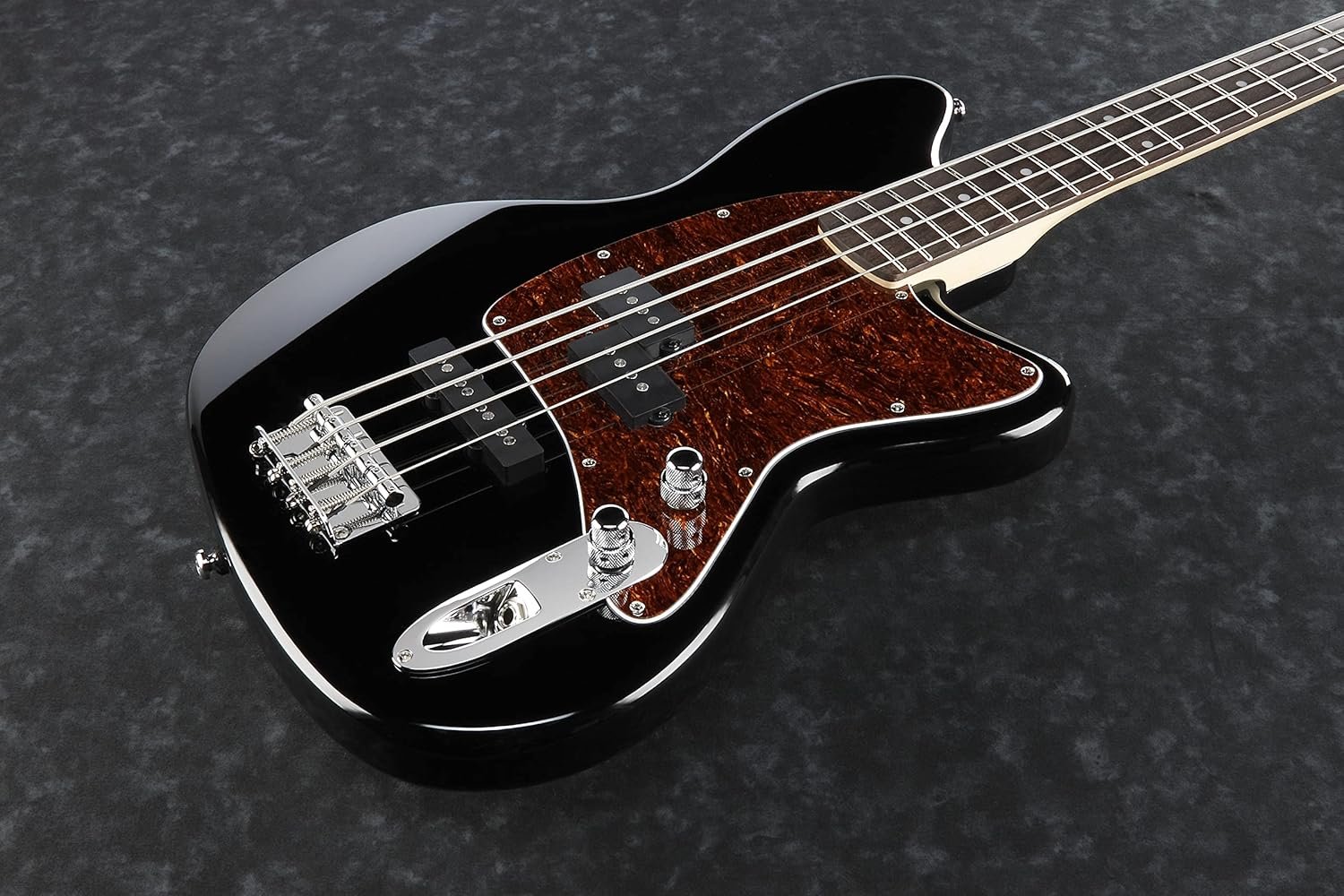
Its rounded Talman body has a more retro appearance, while underneath it is a practical full-scale bass with a P/J pickup combination and active tone controls. That combination gives the TMB100 enough flexibility for somebody who wants one straightforward bass for practice, recording, rehearsals and live playing.
This Black version keeps the appearance relatively understated, with chrome hardware and a dark jatoba fingerboard contrasting against the body.
Why the Talman design works
The TMB100 uses Ibanez’s distinctive Talman body shape rather than the narrow, sculpted profile of the company’s SR basses.
The body is made from poplar, a relatively lightweight wood commonly used in electric instruments.
In the hands, the Talman shape feels broad enough to sit securely against the player without becoming excessively bulky.
The offset curves give the bass a vintage flavour without simply copying one of the classic bass shapes that have been around for decades.
That makes the TMB100 interesting for someone who likes traditional-looking instruments but wants something that has its own identity.
It is also a design that looks equally at home in a practice room, studio or on stage.
A full 34-inch scale
The TMB100 is a full-scale bass, with a scale length of 864 mm / 34 inches.
That is important because the Talman’s rounded shape can make the instrument look more compact than it actually is.
This is not a short-scale bass.
The 34-inch scale gives the strings the familiar tension and fret spacing used on countless traditional electric basses.
For a player moving from another full-scale bass, the transition should therefore feel natural.
For somebody buying their first bass, it also means learning on dimensions that translate easily to many other instruments later.
The neck measures approximately 41 mm wide at the nut, widening to 62 mm at the 20th fret. Ibanez specifies a 240 mm fingerboard radius and neck thickness of 21.5 mm at the first fret.
Those dimensions help give the neck a comfortable, manageable feel without making it excessively narrow.
What it feels like to play
The TMB100 uses a maple neck with a jatoba fingerboard and 20 medium frets.
Ibanez describes the maple neck as contributing stability and a bright tonal character, while the jatoba fingerboard brings a darker reddish-brown appearance and a clear midrange response.
Physically, the neck feels substantial enough to remind you that this is a bass, but it avoids the oversized club-like feeling that can make some older bass designs tiring.
The medium frets also keep the instrument conventional.
There is no attempt to make this feel like an ultra-modern technical bass with 24 frets, an extremely flat fingerboard or a radically thin neck.
Instead, the TMB100 sits closer to a traditional playing experience while still benefiting from Ibanez’s understanding of comfortable neck design.
P and J pickups in one bass
One of the most useful parts of the TMB100 is the pickup configuration.
Ibanez fits a Dynamix P pickup at the neck and a Dynamix J pickup at the bridge. Both pickups themselves are passive.
The P-style pickup provides the thicker and more rounded side of the bass.
Used on its own or favoured strongly with the blend control, it works naturally for rock, blues, soul and many traditional bass sounds where weight and punch are more important than extreme brightness.
Move towards the J-style bridge pickup and the sound becomes tighter and more defined.
That can help individual notes cut through more clearly and can be useful for funkier lines, recording or parts where extra attack is useful.
Blending the two gives access to sounds between those extremes.
This is one of the reasons a P/J arrangement makes sense on a general-purpose bass.
You are not locked into one basic pickup character.
Active two-band EQ adds another layer
Although the pickups are passive, the TMB100 includes an active Ibanez Custom Electronics 2-band EQ.
The controls are arranged as two stacked knobs.
The stack nearest the neck carries the master volume and pickup balance controls.
The second stack provides bass and treble boost/cut.
That layout keeps the control area tidy while still giving you four separate functions.
The EQ gives the bass considerably more flexibility than a completely passive P/J setup.
If the room or amplifier sounds slightly thin, you can bring up the lower frequencies.
If the sound becomes too dark, the treble control can restore definition.
The controls can also be used creatively rather than purely as correction tools.
Boosting lows and reducing treble can produce a rounder, softer sound.
Reducing bass and adding treble moves the instrument towards a tighter, more articulate response.
The important thing is that the EQ is there when you need it without forcing you to use extreme settings.
A wide range without complicated switching
Some modern basses use multiple switches, coil options and elaborate preamps.
The TMB100 keeps things much simpler.
You have volume, pickup balance, bass and treble.
That is enough to provide a broad range of practical sounds without turning basic adjustments into a menu of decisions.
For a newer bass player, that simplicity can be valuable.
You can hear clearly what each control does and gradually learn how pickup balance and EQ affect the way the bass sits in a mix.
For experienced players, it means adjustments can be made quickly between songs or during a recording session without looking down at a complicated control panel.
The B10 bridge
At the other end of the strings is Ibanez’s B10 bridge.
Ibanez specifies 19 mm string spacing, with individual saddle adjustment for intonation and string position.
The 19 mm spacing is fairly traditional for a four-string bass.
It gives the picking hand enough room between the strings whether you play with fingers or a pick, without spreading them unusually far apart.
The bridge also provides normal intonation adjustment, which matters whenever string gauges or setup height are changed.
A bass that cannot be adjusted properly can feel frustrating no matter how good the pickups are.
The TMB100 uses conventional, serviceable hardware rather than anything exotic.
Useful for different styles of music
The TMB100 does not have one narrow musical identity.
The P-style pickup can provide the strong fundamental needed for rock, blues and soul.
The J-style bridge pickup adds sharper definition for funkier or more modern bass lines.
Blending them works well for general-purpose playing where you want warmth without losing clarity.
The active EQ then expands those basic pickup sounds.
That makes this an easy bass to imagine in a home studio.
Rather than needing several instruments for different tracks, you can adjust the balance and EQ until the bass sits more naturally with the guitars, drums and vocals already in the mix.
For practice, the same flexibility lets you experiment and learn how different bass sounds work with different music.
A good platform for learning bass tone
One advantage of having both pickup blending and active EQ is that it teaches you what actually changes a bass sound.
Turn towards the neck pickup and the sound thickens.
Move towards the bridge and you hear more attack and upper-mid definition.
Adjust the bass control and you can hear how low frequencies affect fullness.
Change the treble and you hear how string attack and brightness come forward or disappear.
That is useful knowledge regardless of which bass you eventually play.
The TMB100 therefore offers more than simply a number of controls.
It provides an easy way to understand the relationship between pickups, EQ and playing style.
The drawbacks
The TMB100 is versatile, but there are several compromises worth understanding.
The first is that the 34-inch scale is full size.
That gives the bass familiar tension and traditional proportions, but it will not suit everybody.
Players with smaller hands, younger beginners or guitarists specifically looking for something physically compact may prefer a short-scale bass such as the 30-inch TMB30.
A full-scale bass also requires slightly more reach between the lower frets.
For many players that quickly becomes normal, but it is worth knowing before assuming the Talman body automatically means a compact instrument.
The active EQ requires battery power.
The pickups themselves are passive, but the onboard preamp cannot operate indefinitely without a battery.
That means keeping a spare battery available is sensible, particularly before a rehearsal or performance.
It also adds a maintenance item that a fully passive bass does not have.
The stacked controls can take a little time to get used to as well.
Each physical knob actually controls two functions.
That saves space and keeps the bass looking tidy, but it is easier to grab the wrong part of a stacked knob than it is with four completely separate controls.
After some use this becomes second nature, but the layout is not quite as immediately obvious as a simple volume-and-tone arrangement.
The active EQ can also make it easy to overdo things.
A large bass boost may sound impressive when playing alone, but too much low end can make a bass muddy once drums and guitars are added.
Likewise, excessive treble can exaggerate finger and string noise.
The EQ is most useful when treated as a shaping tool rather than something that always needs to be boosted.
The 20-fret neck is another limitation for players who regularly use very high notes.
Many modern basses provide 22 or 24 frets.
For most conventional bass lines, 20 frets are more than enough.
But players using the upper register for solos or chordal work may prefer an instrument with a longer fingerboard.
The Talman body shape will not appeal to everybody either.
Its rounded, retro-influenced appearance is a major part of the instrument’s character.
Players who prefer the sharp, sleek appearance of a modern Ibanez SR bass may find the TMB100 visually heavy by comparison.
That is purely personal preference, but body shape is part of why people choose one instrument over another.
The poplar body is practical, but players specifically looking for more traditional body woods such as alder or ash will need to look elsewhere.
Likewise, the jatoba fingerboard will not appeal to someone determined to have rosewood or maple.
Those material choices are not faults, but they are part of what defines the TMB100.
The finish and chrome hardware can also show fingerprints and handling marks.
A black bass tends to reveal dust and smears more readily than lighter finishes, so somebody who likes an instrument to remain pristine may find themselves wiping it down regularly.
The P/J pickup combination is versatile, but it is still a conventional pickup arrangement.
Players looking for aggressive modern humbuckers, multiscale construction or highly detailed three-band preamps will find more specialised basses elsewhere.
There is also no active/passive bypass switch.
The TMB100 is built around its active 2-band EQ system rather than offering a simple way to switch the preamp completely out of the circuit.
For most users that is not a problem, but some players like having a passive fallback if the battery becomes weak.
The factory string gauges are .045, .065, .080 and .100.
That is a sensible general-purpose set, but changing to significantly heavier or lighter strings may require adjustments to the truss rod, intonation or action.
That is true of most basses, but it is worth remembering if you plan to experiment with very different tunings.
Finally, no amount of active EQ can replace a good setup.
If the action is too high, the neck relief is wrong or the intonation is out, the bass may feel difficult to play regardless of how flexible the electronics are.
A proper setup matched to your preferred strings and playing style can make just as much difference as the pickup and EQ controls.
Who it suits best
The Ibanez TMB100 makes particularly good sense for someone who wants one versatile full-scale bass rather than a specialised instrument.
A newer bassist can benefit from the familiar 34-inch scale, straightforward P/J pickup layout and active EQ.
A guitarist adding bass to a home studio may appreciate being able to produce several useful tones without buying multiple instruments.
More experienced players could equally use it as a backup bass or as a different flavour from a modern active instrument.
The retro Talman body should especially appeal to players who want something visually distinctive without moving into a radical or awkward design.
Is it worth the bass space?
The Ibanez TMB100 succeeds because it combines familiar bass fundamentals with just enough extra flexibility.
The 34-inch scale, maple neck, jatoba fingerboard, P/J pickups and traditional 19 mm string spacing make the instrument easy to understand. The active 2-band EQ and pickup balance control then give those basic ingredients considerably more range.
It does not have 24 frets, elaborate switching or modern multiscale construction.
It also requires battery power for the active electronics, and the full-size scale will not suit someone specifically looking for a compact bass.
But those limitations are part of what keeps the TMB100 straightforward.
For somebody who wants a bass that can move from warm P-style tones to brighter J-style definition while retaining a distinctive retro appearance, the TMB100 offers a useful amount of flexibility without becoming unnecessarily complicated.
Explore more bass guitars in our Bass Guitars section.
As an Amazon Associate I earn from qualifying purchases.