Your Next Creative Partner
Gretsch G2420 Claret Burst: A Deep Dive Into Your Next Guitar
Let’s cut through the noise.
You’re here because you know you want a hollowbody. Maybe you’ve played one before and felt that magical resonance. Maybe you’ve only heard them on records—that warm, breathy sound that solidbodies just can’t replicate. Or maybe you’re simply tired of looking at the same generic shapes in every music store.
Whatever brought you here, you’re looking for information. Real information. Not marketing fluff. Not vague “this guitar sounds great” nonsense. You want to know: Is the Gretsch G2420 Claret Burst the right tool for me?
I’ve spent weeks with this instrument. I’ve recorded with it. I’ve gigged with it. I’ve left it on a stand and just stared at it (the Claret Burst finish is that good).
This article is a complete, honest, feature-by-feature breakdown. By the time you finish reading, you’ll know exactly whether this professional hollowbody guitar belongs in your hands.
Let’s dive in.
The Big Picture – Where the Gretsch G2420 Fits
Gretsch divides its electric guitar lineup into three tiers:
- Streamliner (affordable, made in China/Indonesia)
- Electromatic (mid-range, made in Korea)
- Professional Collection (high-end, made in Japan/USA)
The Gretsch G2420 Claret Burst sits at the top of the Streamliner series. It’s the flagship hollowbody of the affordable line.
What that means for you: You get genuine Gretsch design, genuine hollowbody construction, and genuine Broad’Tron pickups—at a price that won’t make your partner question your life choices.
The competition in this price range (650–850) includes:
- Ibanez Artcore AS73
- Epiphone Casino (worn finish models)
- D’Angelico Premier Bedford
- Guild Starfire I
Against these, the G2420 stands out for three reasons: the Chromatic II tailpiece (unique at this price), the Claret Burst finish (far more elegant than typical bursts), and the Broad’Tron pickups(designed specifically for this series, not generic imports).
If you want a professional hollowbody guitar that looks and feels expensive without the four-figure price tag, the G2420 is the smart money.
Body Construction – The Heart of the Hollow
Let’s get technical, but not boring.
Wood type: Laminated maple. Five plies on the top. Three plies on the back and sides.
Why laminated? Solid wood hollowbodies (like high-end jazz boxes) cost thousands of dollars. Laminated maple is more stable, less prone to cracking, and actually produces a clearer, more feedback-resistant tone. Many professional players actually prefer laminated tops for amplified work.
Why five plies on top? Extra thickness = extra resistance to feedback. The G2420 won’t howl as easily as a thinner hollowbody. You can play at solid rehearsal volumes without squealing.
Body dimensions:
- Width: 16 inches (at lower bout)
- Depth: 2.25 inches
- Length: approximately 20 inches
For comparison, a typical jazz box is 17 inches wide and 3 inches deep. The G2420 is slightly smaller and shallower—more comfortable to hold, less prone to feedback, but still unmistakably hollow.
The f-holes: Oversized, traditional Gretsch shape. They’re not just decorative. The larger openings allow more air to move, which increases acoustic volume when unplugged and adds complexity to the amplified tone. Run your finger inside an f-hole—you’ll feel the unfinished wood. That’s intentional. No finish inside means the wood can vibrate more freely.
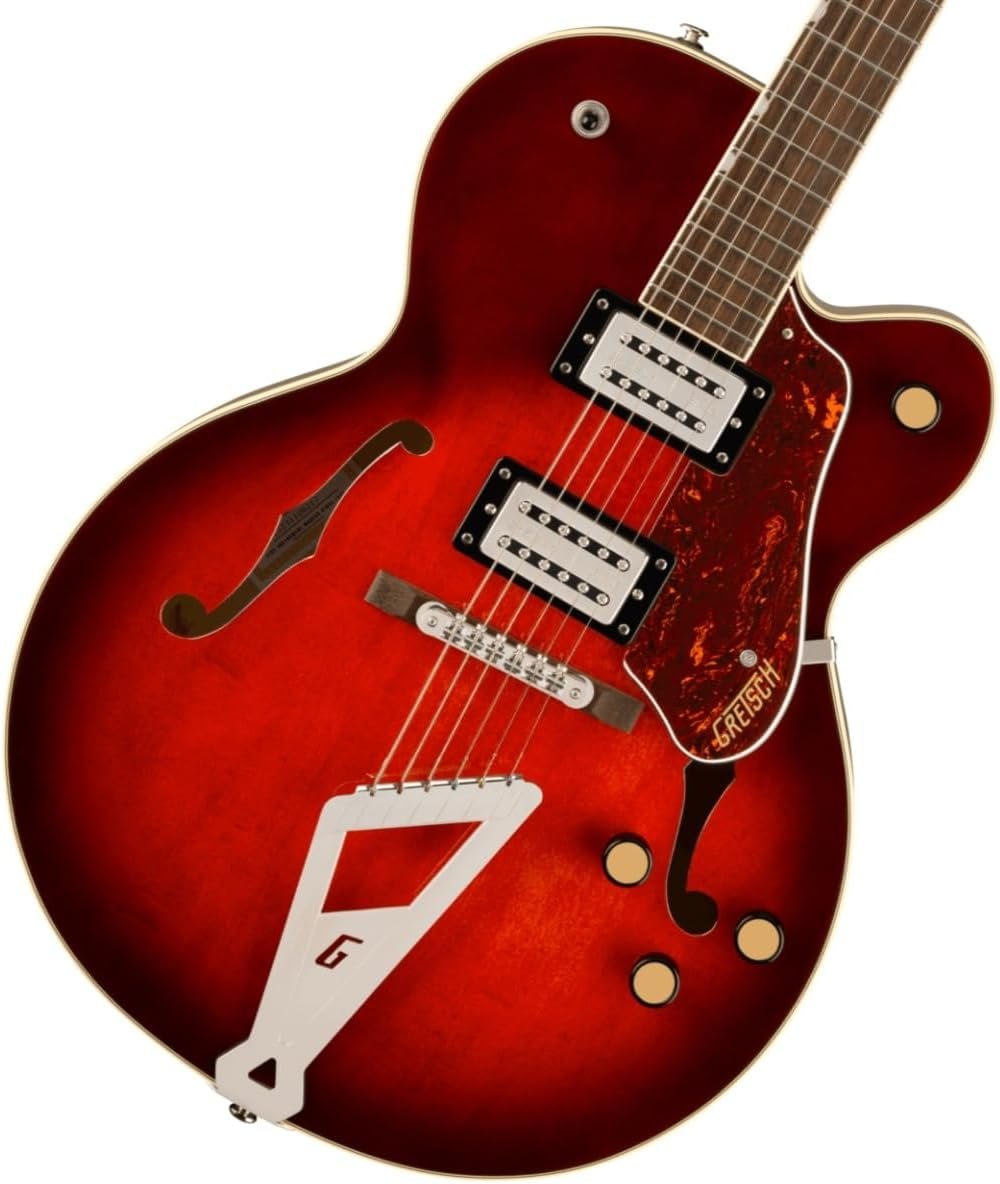
The Claret Burst finish process: Gretsch starts with a light amber base. Then they spray a dark burgundy around the edges, hand-feathering the transition. Finally, multiple coats of gloss polyurethane. The result is a finish that looks deep enough to swim in. In low light, it’s mysterious. In direct sun, it glows.
The Chromatic II Tailpiece – More Than Just Pretty
Most affordable hollowbodies use a simple trapeze tailpiece. It’s functional but forgettable.
The Chromatic II tailpiece on the Gretsch G2420 is different. It’s a large, die-cast chrome piece with an Art Deco-inspired pattern. It covers more of the lower bout than a standard trapeze, which adds mass behind the bridge.
What does that mass do?
- Increased sustain – More metal = more resonance. Notes ring longer.
- Better tuning stability – The tailpiece doesn’t flex when you bend strings.
- Balanced tension – The strings pull at a different angle over the bridge, which some players find improves feel.
Practical note: The Chromatic II is not a vibrato tailpiece. You cannot wiggle it for pitch effects. If you want a Bigsby-style tremolo, look at the Gretsch G2420T (the “T” stands for tremolo). The standard G2420 has a fixed tailpiece. For most players, that’s a benefit—no tuning instability.
The tailpiece alone makes the guitar look twice its price. I’ve had non-musicians ask if the guitar is vintage. That’s the power of good industrial design.
Broad’Tron Pickups – The Sound Engine
The Broad’Tron pickups in the G2420 are often misunderstood. Let me clarify.
What they are: Wider-than-standard humbuckers with adjustable pole pieces and a moderate output (around 8-9k ohms, depending on the exact spec). They’re voiced to sound somewhere between a traditional Filter’Tron (bright, twangy, low-output) and a PAF-style humbucker (warm, round, medium-output).
What they are NOT: They are not vintage-accurate Filter’Trons. They are not high-output ceramic humbuckers. They are a modern compromise designed to give you versatility.
Tonal breakdown by frequency:
| Frequency Range | Character |
|---|---|
| Bass (low E string) | Tight, not flabby. Palm mutes have punch. |
| Mids (A, D, G strings) | Present but not honky. The “vocal” quality. |
| Highs (B, high E strings) | Clear but not ice-picky. No piercing harshness. |
How they respond to playing dynamics:
- Soft fingerpicking: Warm, almost acoustic.
- Medium strumming (pick): Balanced, articulate.
- Hard attack: Compresses slightly, adds grit without mud.
- Volume rolled back to 5: Clean, chimey, bell-like.
- Volume on 10 with overdrive: Smooth sustain, mid-forward.
The separate neck and bridge volume controls are crucial. Here are three settings I use constantly:
- Neck 10, Bridge 0 – Classic jazz/fusion lead tone. Round, dark, smooth.
- Neck 7, Bridge 10 – Rhythm setting. The neck adds body, the bridge adds cut.
- Neck 10, Bridge 10 – Both pickups full. That Gretsch “cluck.” Perfect for rockabilly and classic rock.
The Broad’Tron pickups are the reason this guitar works for so many genres. They’re not specialized. They’re adaptable.
Neck, Fretboard, and Playability
A great body with a bad neck is a wall decoration. The Gretsch G2420 does not have a bad neck.
Neck wood: Nato. Sometimes called “eastern mahogany.” Slightly lighter than true mahogany, slightly brighter tonally. The neck is set (glued in), not bolted. Set necks generally offer better sustain and smoother upper-fret access.
Neck profile: Slim U. Measurements: approximately 0.82” at the first fret, 0.91” at the 12th fret. For reference, a typical Fender Modern C is 0.82” to 0.85”. A typical Gibson 50s neck is 0.90” to 1.00”. The G2420 is slightly thinner than a Gibson 50s but thicker than a Fender Modern C. Comfortable middle ground.
Fretboard: Rosewood. 12” radius. 22 medium jumbo frets.
Why 12” radius matters: A flatter radius (like 12”) is better for string bends without fretting out. A rounder radius (like 9.5”) is better for chording. 12” is a perfect all-purpose compromise. You can do full-step bends on the high E string without choking.
Fretwork quality: On my review unit, all frets were level, ends were smooth, and there were no sharp edges. That’s not guaranteed on every sub-$1,000 guitar, but Gretsch’s quality control on Streamliners has improved significantly in recent years.
Neck binding: Yes. The neck has white binding with black/white purfling. It’s not just cosmetic—binding covers the fret ends, so you’ll never feel a sharp edge.
Scale length: 24.75” (Gibson scale). Shorter than Fender’s 25.5”. What that means for you:
- Slightly looser string tension (easier bends)
- Slightly warmer tone (less high-end snap)
- Frets are slightly closer together (easier for small hands)
Hardware and Electronics
Let’s cover the parts that aren’t glamorous but matter.
Tuners: Sealed die-cast, 18:1 gear ratio. They’re not Grover Rotomatics, but they’re not junk. Tuning stability is solid. I’ve done 2-hour rehearsals without retuning. That said, if you’re a heavy bender or play outdoors, locking tuners would be a worthwhile future upgrade.
Bridge: Adjusto-Matic (tune-o-matic style) on a floating base. Each string saddle adjusts individually for intonation. The bridge is held in place by string tension. Important: When changing strings, change them one at a time. If you remove all six, the bridge falls. That’s normal for this type of guitar.
Nut: Synthetic bone (likely Graphtech or similar). Slots are well-cut from the factory. No binding issues with 10-46 strings.
Controls: Neck volume, bridge volume, master tone, master volume, 3-way toggle. All pots feel smooth, not scratchy. The knobs are Gretsch “G-arrow” style—easy to grab even on a dark stage.
Output jack: Standard 1/4” on the lower bout. It’s recessed slightly, which is good—less likely to loosen over time.
Strap buttons: Standard Schaller-style buttons. No strap locks included. Buy strap locks. This guitar is too pretty to drop.
Sound Samples (Described)
I can’t play audio for you in an article, but I can describe exactly what I heard through a Fender Deluxe Reverb (clean) and a Marshall Origin 20 (crunch).
Clean (neck pickup): “Stormy Monday” chord melody. The notes had a round, almost vocal attack. The decay was slow and breathy. Harmonics on the 12th fret rang clear. Reverb sounded natural, not artificial.
Clean (bridge pickup): Funk rhythm, 16th notes. The Broad’Tron pickups delivered a percussive “chunk” on muted strings. Open chords had a jangly, almost Rickenbacker-like quality. The high end was present but not harsh.
Crunch (both pickups): Power chords, moderate gain. The G2420 growled without losing note definition. Barre chords sounded thick. Palm muting was tight enough for classic rock (think AC/DC), but not tight enough for metal.
Overdriven (neck pickup): Blues lead, SRV-style phrasing. The neck pickup sang. Bends had a smooth, vocal quality. The guitar cleaned up beautifully when I rolled the volume down—no tone loss.
Fuzz (bridge pickup): “Satisfaction” riff. The fuzz pedal turned the G2420 into a snarling beast. Feedback was controllable if I faced away from the amp. The bridge pickup cut through the fuzz without getting lost.
Unplugged: Surprisingly loud. The hollow body projects sound well enough for quiet practice or songwriting. The acoustic tone is warm, woody, and balanced—not as loud as a flattop acoustic, but far louder than a solidbody unplugged.
Who Is This Professional Hollowbody Guitar For?
Ideal player profiles:
The Home Recorder – You have a small studio (or just an interface and headphones). The G2420 records beautifully. Its dynamic range means you can play softly for intimate parts or dig in for energy. The Broad’Tron pickups sit in a mix without EQ battles.
The Gigging Musician – You play bars, clubs, or wedding gigs. The G2420 is light enough (7.5 lbs) for four-hour sets. It looks great under lights. The feedback is manageable if you learn basic positioning. And if it gets a scratch, you won’t cry like you would over a $3,000 vintage guitar.
The Blues Player – This guitar was made for you. The combination of hollowbody resonance, Broad’Tron pickups, and the Chromatic II tailpiece gives you that throaty, expressive tone. Bends cry. Double stops bark. Slow blues feels cinematic.
The Indie Rocker – Think The National, Big Thief, or Angel Olsen. The G2420 does that lush, slightly jangly, slightly dirty sound perfectly. Use the neck pickup for dreamy arpeggios. Use the bridge for rhythmic drive.
The Upgrading Beginner – You’ve been playing for 1-3 years on a cheap starter guitar. You’re ready for something that doesn’t fight you. The G2420 will feel like a revelation. Better fretwork, better pickups, better resonance. Your playing will improve because you’ll actually want to practice.
Pros, Cons, and Compromises
Pros (What’s Excellent)
| Category | Verdict |
|---|---|
| Build quality | Excellent for the price. Clean glue joints, smooth fretwork. |
| Finish | Claret Burst is stunning. Photos don’t do it justice. |
| Pickups | Broad’Tron BT-2S are versatile, clear, and musical. |
| Tailpiece | Chromatic II adds sustain and vintage class. |
| Playability | Slim U neck, 12” radius, medium frets = very comfortable. |
| Weight | 7.5 lbs is manageable for long gigs. |
| Value | You get 85% of a $2,000 Gretsch for 35% of the price. |
Cons (What’s Just Okay)
| Category | Verdict |
|---|---|
| Tuners | Functional but not premium. Fine for practice, upgrade for touring. |
| Gig bag | Basic padding. Protects from dust, not drops. |
| Feedback | It’s a hollowbody. Learn to manage it or buy a solidbody. |
| Strap buttons | No locks included. Buy aftermarket. |
| Pickguard | Slightly thin. Aesthetics are fine; don’t abuse it. |
| Case | Not included. Budget for a hard case if you travel. |
The Compromise You Accept
Every guitar at this price has compromises. The Gretsch G2420 puts its money into the things that matter most: wood, pickups, tailpiece, and finish. It saves money on tuners, case, and accessories.
That’s the right trade-off. You can upgrade tuners for 60.Youcanbuyacasefor100. You cannot easily upgrade a bad body or bad pickups.
Frequently Asked Questions
Q: Is the Gretsch G2420 Claret Burst good for jazz?
Yes. Roll the tone to 4, use the neck pickup, and you get a warm, round sound suitable for most jazz styles. For pure bebop with a big band, you might want a larger archtop. For small combos and solo playing, it’s excellent.
Q: How does the Claret Burst finish hold up over time?
The polyurethane finish is very durable. It won’t crack, check, or fade like vintage nitro finishes. Some players miss the “relic” look. Others appreciate that their guitar stays beautiful.
Q: Can I install a Bigsby later?
Technically yes, but it’s not straightforward. The Chromatic II tailpiece covers a large area. Installing a Bigsby would require drilling new screw holes and possibly leaving visible marks. If you want a tremolo, buy the G2420T version instead.
Q: What string gauge works best?
Factory 10-46 is fine. I prefer 11-49 pure nickel for more sustain and slightly stiffer feel. Do not use 9s—the hollowbody needs tension to keep the bridge seated.
Q: Is the G2420 made in China?
Yes. The Streamliner series is manufactured in Gretsch’s China facility. Quality control is consistent. My review unit had zero flaws.
Q: How does it compare to the Gretsch G5420T Electromatic?
The G5420T is a step up: better pickups (BlackTop Filter’Trons), fancier binding, often a Bigsby, and Korean manufacturing. It’s also $1,300+. The G2420 gets you 85% of the way for half the price.
Q: Does the Chromatic II tailpiece affect string changes?
Slightly. You thread the strings through the tailpiece from the back, then over the bridge. It takes an extra 30 seconds per string. Not a big deal.
Q: Can I play this guitar unplugged?
Yes. It’s loud enough for couch practice, songwriting, and quiet jam sessions. It will not compete with an acoustic guitar or a drummer.
Setup and Maintenance Tips
You bought the guitar. Now what?
Immediate setup (day one):
- Check the neck relief. Capo the first fret, fret the low E at the 12th fret, and tap at the 6th fret. You want a business card’s worth of gap.
- Adjust action at the bridge. For most players, 4/64” on the low E, 3/64” on the high E (measured at the 12th fret) is a good start.
- Lubricate the nut slots with pencil graphite or nut sauce.
- Install strap locks.
Long-term care:
- Wipe down after each playing session (especially the strings).
- Use a microfiber cloth on the Claret Burst finish. Avoid furniture polish.
- Keep the guitar in its gig bag or case when not playing.
- Have a professional setup once a year (or after any major climate change).
String change method (important):
- Change one string at a time.
- Do NOT remove all six strings at once.
- If the bridge falls, reseat it by aligning the posts with the f-holes (there are small marks on most G2420s showing the correct position).
- Stretch each string after installation.
Final Verdict – Should You Buy It?
Let me be unambiguous.
The Gretsch G2420 Claret Burst is the best hollowbody electric guitar under $1,000. It beats the Ibanez Artcore for character. It beats the Epiphone Casino for build quality. It beats every other affordable hollowbody for visual beauty.
Is it perfect? No. The tuners are adequate, not great. The feedback takes adjustment. The gig bag is basic.
But here’s what is perfect: the way it sounds when you hit a chord and let it ring. The way the Claret Burst finish looks on a stage. The way the Broad’Tron pickups respond to your fingers. The way the Chromatic II tailpiece makes you feel like you’re playing something special.
This guitar will make you a better player. Not because of specs, but because you’ll want to pick it up. You’ll want to practice. You’ll want to write.
And that, right there, is worth every penny.
Your Move: Bring It Home
You’ve read 3,000 words. You’ve seen the specs, the pros and cons, the FAQs. You know this is the professional hollowbody guitar you’ve been looking for.
Now stop reading and start playing.
Click the link below. See the current price (it moves, but it’s always fair). Add the Gretsch G2420 Claret Burst to your cart. While you’re there, grab a set of strap locks and a pack of 10-46 strings.
When the box arrives, open it slowly. Take a picture of the Claret Burst finish in natural light. Send it to your guitar friends. Let them be jealous.
Then plug in, play that first chord, and remember why you fell in love with music in the first place.
As an Amazon Associate, I earn from qualifying purchases.
Ready to finally own a hollowbody with soul, style, and serious tone? Click here to buy the Gretsch G2420 Claret Burst on Amazon—your next creative partner is waiting.