EART NK-VS60 Electric Guitar
As an Amazon Associate I earn from qualifying purchases.
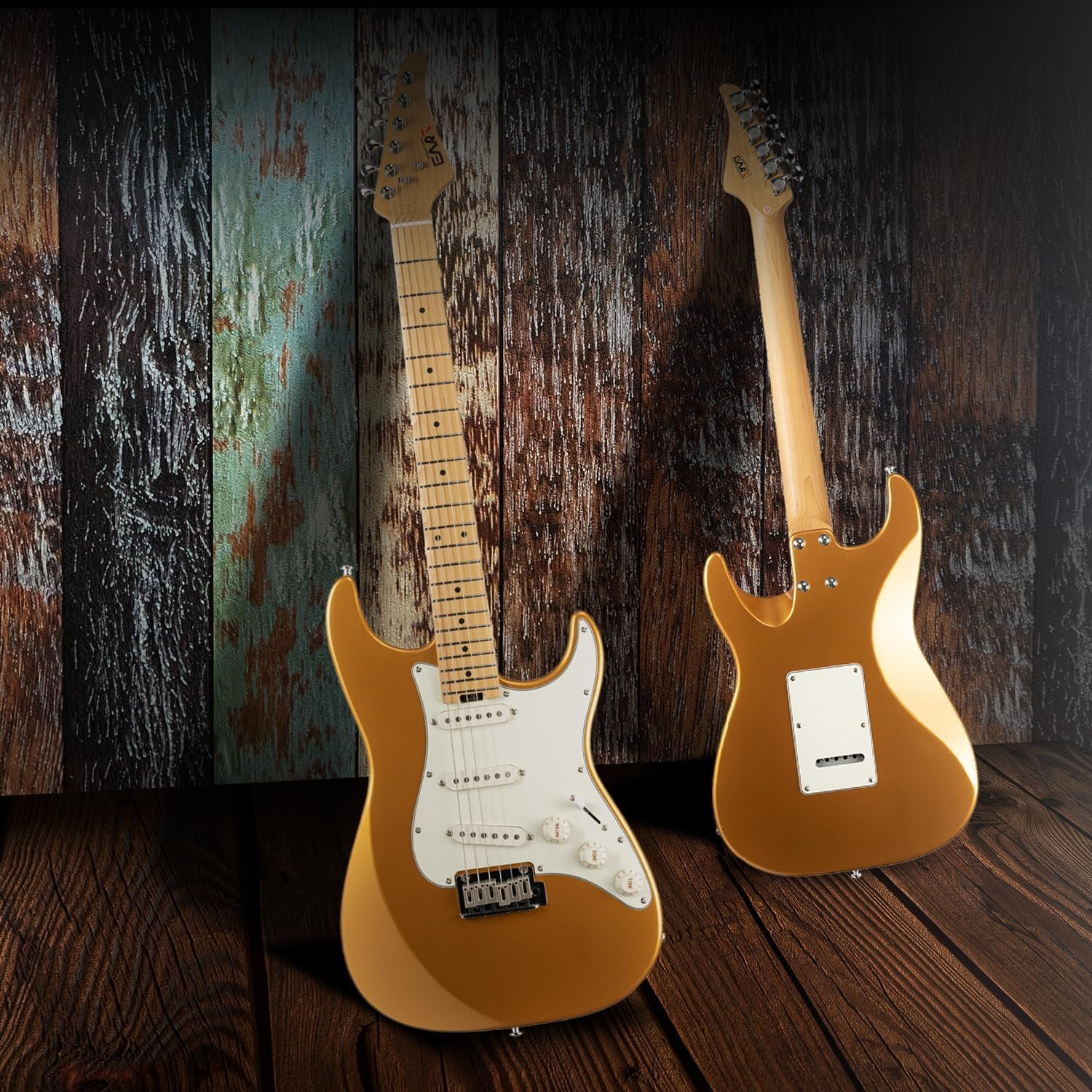
The EART NK-VS60 Electric Guitar in Gold combines vintage-inspired styling with a collection of modern construction features that deserve a closer look.
Its roasted mahogany body, roasted Canadian maple neck, 22 stainless steel frets and Alnico V single-coil pickups create an interesting alternative to more familiar electric guitars.
There is also a 7.25-inch to 9.5-inch compound-radius fingerboard, a two-point tremolo bridge and a traditional five-way pickup selector.
These features suggest that EART has paid attention to the parts of a guitar that influence everyday playing comfort and practicality, rather than concentrating entirely on appearance.
The Gold finish gives the instrument a distinctive character, particularly when combined with the natural colouring of the roasted maple neck and traditional pickguard.
However, specifications alone cannot guarantee excellent playability. Factory setup, fret finishing, hardware adjustment and the individual instrument’s condition remain important.
For guitarists who enjoy the familiar feel and sounds of a three-single-coil electric guitar but are interested in alternatives to established manufacturers, the EART NK-VS60 is worth examining.
Why the EART NK-VS60 Stands Out
The NK-VS60 follows a familiar double-cutaway electric guitar design, but several construction details distinguish it from a basic traditional instrument.
EART uses a roasted, bookmatched mahogany body rather than the alder or ash commonly associated with vintage-style guitars of this shape.
The neck and fingerboard are also made from roasted maple.
Roasting is a heat-treatment process that reduces moisture content in the wood. Manufacturers use it partly to improve dimensional stability, although it does not make a wooden instrument immune to changes in humidity or temperature.
This is a useful feature on a guitar intended for regular playing.
More unusual is the inclusion of stainless steel frets.
Stainless steel offers greater resistance to wear than conventional nickel-silver fretwire. That can be attractive to players who spend many hours practising bends, vibrato and lead passages.
The compound-radius fingerboard provides another point of interest.
Together, these features suggest an instrument that combines traditional styling with some thoughtful modern touches.
The result is not a radical reinvention of the electric guitar. It is a familiar design with specifications that may appeal to players who care about the neck, fretwork and hardware as much as the appearance.
What It Feels Like to Play
Playing comfort is one of the most important considerations when choosing an electric guitar.
A guitar may look attractive and feature good-quality components, but if its neck does not suit the player’s hands, it may never become a favourite instrument.
The NK-VS60 uses a roasted Canadian maple neck with a satin natural finish.
Unlike a heavily glossed neck, a satin surface can provide a less sticky sensation when moving the fretting hand along the fingerboard.
This may be particularly welcome during longer practice sessions or when playing in warm conditions.
A Compound U-to-C Neck Profile
EART describes the neck profile as a compound U-to-C design.
This means the shape changes along the neck rather than maintaining precisely the same contour from one end to the other.
The intention is to provide a comfortable shape for different playing positions.
However, neck preference is highly personal.
Some guitarists enjoy a substantial rounded profile, while others prefer something noticeably slimmer.
Anyone with a strong preference for a particular neck shape should consider this specification carefully rather than assuming that a compound profile will automatically feel better.
A 7.25-Inch to 9.5-Inch Compound Radius
The fingerboard begins with a more rounded 7.25-inch radius and gradually becomes flatter towards the higher frets.
The rounded lower section is associated with traditional electric guitar designs and can provide a comfortable surface for chord playing.
The flatter upper section offers additional space for lead playing and string bends.
However, the upper radius is still 9.5 inches, so this is not an exceptionally flat modern shred-guitar fingerboard.
The design is best understood as a blend of vintage playing characteristics and modest modern flexibility.
Stainless Steel Frets
The NK-VS60 has 22 medium-jumbo stainless steel frets.
This is one of its more appealing specifications.
Stainless steel is highly resistant to the wear that gradually develops on conventional fretwire.
For guitarists who regularly practise bends and vibrato, reduced fret wear may prove valuable over time.
Well-finished stainless steel frets can also provide a smooth contact surface during bends.
However, fret material alone does not establish the quality of the final instrument.
The levelling, crowning and polishing work remain important.
A poorly finished stainless steel fret is not automatically better than a carefully finished conventional fret.
Roasted Mahogany Body and Gold Finish
EART specifies a roasted, bookmatched mahogany body for the NK-VS60.
Mahogany is widely used in electric guitar construction and is associated with a substantial, traditional feel.
However, it would be misleading to suggest that the body wood alone determines the amplified sound.
Pickups, strings, electronics, hardware, amplifier settings and playing technique all contribute to the final result.
The roasted construction is therefore best appreciated as a material choice rather than a guarantee of a particular tone.
The Gold Finish
The Gold version gives the NK-VS60 a distinctive appearance without relying on elaborate decoration.
The glossy body finish contrasts with the satin roasted maple neck.
A three-ply parchment pickguard, chrome hardware and traditional pickup layout complete the design.
There is a pleasing balance between familiar electric guitar styling and the warmer colour of the neck.
For guitarists who prefer understated finishes, Gold may be more visually assertive than black, natural wood or traditional sunburst.
Others may appreciate having an instrument that looks a little different without abandoning a classic design.
Weight and Balance
EART lists a nominal instrument weight of approximately 3.05kg.
That suggests a manageable solid-body electric guitar, although the weight of individual wooden instruments can vary.
Balance is equally important.
The relationship between the body, neck and strap-button positions affects how comfortable a guitar feels when standing.
Anyone particularly sensitive to instrument weight should confirm the specification of the individual guitar rather than relying entirely on the published figure.
EART NK-VS60 Pickups and Tone
The NK-VS60 uses three EART Custom VS60 Alnico V single-coil pickups.
These follow a familiar arrangement, with individual pickups positioned at the bridge, middle and neck.
A five-way selector allows players to choose between individual pickups and the conventional combined positions.
There is one master volume control and two tone controls.
This is a straightforward configuration that many electric guitarists will already understand.
Neck Pickup
The neck pickup is typically the position guitarists choose when seeking a fuller, rounder clean sound.
It can be useful for blues phrases, melodic lead playing, jazz-influenced passages and softer rhythm parts.
The exact response will depend on pickup construction, height, amplifier settings and playing technique.
Middle Pickup
The middle position provides another single-coil voice.
It can be useful for clean rhythm playing and passages where a balanced sound is desirable.
Combined pickup selections provide additional options for funk, pop and blues.
These positions can produce a distinctive character that differs from using an individual pickup alone.
Bridge Pickup
The bridge pickup is positioned closer to the bridge, where string movement is more restricted.
This commonly produces a brighter, more cutting sound.
It can be useful for country-style picking, articulate rhythm playing and lead passages that need definition.
However, players who rely on thick, high-output humbucker sounds may find a conventional single-coil bridge pickup less suitable.
How Versatile Is the Pickup Arrangement?
Three single-coil pickups and five-way switching provide useful flexibility for many guitar styles.
Blues, country, funk, pop, indie and classic rock are natural areas to explore.
Overdrive pedals and suitable amplifier settings can extend the range further.
Nevertheless, three traditional single-coil pickups do not automatically offer the same character as a guitar with humbuckers.
Players wanting a broader contrast between single-coil clarity and a thicker bridge sound could also consider the Yamaha Pacifica 112VM Electric Guitar, which uses an HSS pickup arrangement.
The EART is most attractive to guitarists who specifically appreciate the traditional three-single-coil format.
Two-Point Tremolo Bridge
The NK-VS60 uses an EART two-point synchronized tremolo bridge.
This allows the guitarist to introduce pitch movement using the tremolo arm.
Gentle vibrato can add expression to sustained notes, while more noticeable movement can create dramatic musical effects.
A two-point system uses two pivot points rather than the traditional six-screw arrangement found on many vintage-style guitars.
This can provide smooth bridge movement when the hardware is correctly installed and adjusted.
However, a two-point tremolo is not automatically a guarantee of perfect tuning stability.
String installation, nut friction, spring tension and the bridge setup all influence how accurately the guitar returns to pitch.
Players who use the tremolo regularly should pay particular attention to these details.
Tuning Machines and Nut
EART specifies modern die-cast tuning machines with a 21:1 ratio.
This relatively fine gearing is intended to make small tuning adjustments easier.
The guitar also features a bone nut.
Bone is a traditional material used for guitar nuts, but the accuracy of the slot cutting is more important than simply having the material listed in the specifications.
A poorly cut nut can contribute to tuning problems, particularly when using a tremolo.
The hardware specification is promising, but the quality of the finished setup should always take priority.
Playing Different Musical Styles
The EART NK-VS60 is most naturally associated with musical styles that benefit from the clarity and articulation of single-coil pickups.
Blues players may appreciate the variety of clean and moderately driven tones.
Funk guitarists can make use of the crisp rhythmic character associated with combined pickup positions.
Country players may prefer the brighter response of the bridge pickup.
For pop and indie music, the three-pickup arrangement offers several tonal choices without introducing complicated electronics.
The tremolo adds another expressive option.
However, the NK-VS60 is less obviously suited to guitarists who want exceptionally high-output pickups, extended-range playing or aggressive dive-bomb tremolo techniques.
Its strongest appeal is a familiar and versatile electric guitar layout with some worthwhile improvements to the neck and fret construction.
The Drawbacks
The EART NK-VS60 has several attractive specifications, but guitar selection involves much more than examining a manufacturer’s feature list.
The following considerations are especially important for buyers comparing this model with more established alternatives.
1. EART Is Less Established Than Major Guitar Brands
EART does not have the same long-standing global recognition as Fender, Yamaha or Ibanez.
That does not automatically mean its instruments are inferior.
Smaller manufacturers can produce worthwhile guitars, and the NK-VS60 includes several appealing construction details.
However, buyers may have less independent information about long-term ownership, resale demand and consistency between production batches.
A guitarist choosing an instrument primarily for predictable resale value or a widely established dealer network may prefer a better-known manufacturer.
2. Factory Setup May Need Attention
A guitar can arrive with good components but still require adjustment.
Action height, neck relief, intonation, pickup height and tremolo balance all influence the playing experience.
The NK-VS60’s stainless steel frets and compound-radius fingerboard are interesting features, but they cannot compensate for an unsuitable factory setup.
Some buyers may be happy making minor adjustments themselves.
Others may prefer a professional guitar technician to inspect and set up the instrument.
This possibility should be considered when comparing guitars, particularly if the player expects an instrument to be perfectly adjusted straight from the box.
3. Stainless Steel Frets Are Not a Guarantee of Excellent Fretwork
Stainless steel frets offer excellent resistance to wear.
However, the material is only one part of good fret construction.
The frets must still be properly seated, levelled, crowned and polished.
Sharp fret ends or uneven fret heights can make an otherwise attractive guitar uncomfortable to play.
Correcting problems with stainless steel fretwire can also require more effort and specialist tools than working with softer conventional fret material.
For that reason, the finishing quality of the individual guitar remains more important than the material specification alone.
4. The Compound Radius Will Not Suit Everyone
The 7.25-inch to 9.5-inch fingerboard radius provides a combination of traditional and slightly more modern playing characteristics.
However, some players prefer a consistently flat fingerboard.
Guitarists accustomed to 12-inch, 14-inch or 16-inch radii may find the NK-VS60 comparatively rounded.
Large bends can also be influenced by string action and fret levelling.
The compound radius offers potential advantages, but it should not be treated as a universal improvement over every conventional fingerboard.
5. Traditional Single-Coil Pickups Can Produce Hum
Single-coil pickups are attractive for their clarity and distinctive response.
However, traditional single-coil construction can also pick up unwanted electrical interference.
Hum may become more noticeable when using high-gain distortion, certain lighting systems or electrically noisy rehearsal environments.
Pickup combinations can sometimes reduce unwanted noise, depending on the wiring arrangement, but buyers should not assume that every switch position will be noiseless.
Guitarists who routinely use heavy distortion may prefer humbuckers or specially designed noiseless pickups.
6. The Bridge Pickup May Lack the Weight Some Players Want
A traditional single-coil bridge pickup typically offers a brighter and more focused character than a full-size humbucker.
That is useful for many playing styles.
However, guitarists who want a thick, powerful bridge sound for heavier rock or metal may find this arrangement less suitable.
Pedals and amplifier settings can help shape the sound, but they do not turn the pickup into a conventional humbucker.
Players who value modern versatility may wish to compare the NK-VS60 with an alternative such as the Fender Aerodyne Special Stratocaster, which takes a different approach to construction and hardware while retaining three single-coil pickups.
7. Tremolo Systems Require Maintenance
A two-point tremolo offers useful expressive possibilities.
However, moving bridges require more careful setup than many fixed-bridge arrangements.
Changing string gauge can affect the relationship between string tension and tremolo springs.
That may alter the bridge position and require readjustment.
Players who regularly change tunings may also find a floating tremolo less convenient.
For guitarists who rarely use vibrato effects, a fixed bridge can be simpler to maintain.
The NK-VS60’s tremolo is an advantage only when the player genuinely wants that feature.
8. Tuning Stability Depends on More Than the Tuners
The 21:1 tuning machines and bone nut are encouraging specifications, but they do not guarantee that the instrument will stay in tune under every condition.
Nut slots, string installation, bridge movement and temperature changes all affect tuning.
This is especially relevant when using the tremolo.
A guitar that does not return accurately to pitch may require adjustment rather than replacement hardware.
Buyers should therefore judge the complete tuning system rather than relying on the manufacturer’s hardware descriptions.
9. The Roasted Wood Claims Need Perspective
Roasted maple and roasted mahogany are interesting material choices.
Heat treatment can reduce moisture content and influence how the wood responds to environmental changes.
However, roasting does not eliminate seasonal movement or make a guitar immune to humidity.
Nor does it guarantee greater sustain or a superior amplified sound.
Much of an electric guitar’s character comes from the interaction of its strings, pickups, electronics and amplifier.
Players should appreciate the roasted construction without expecting it to transform the sound on its own.
10. The Gold Finish May Not Be for Everyone
The Gold finish gives the NK-VS60 an individual appearance.
However, finish preferences are subjective.
Some guitarists prefer traditional sunburst colours, natural wood or understated black finishes.
A glossy surface can also show fingerprints, fine scratches and ordinary handling marks.
The appearance may initially attract attention, but it should not outweigh neck comfort, hardware quality and suitability for the player’s preferred music.
A guitar needs to remain enjoyable after the novelty of its finish has worn off.
11. Limited Opportunities to Try Before Buying
One advantage of widely distributed guitar brands is that many models can be tried in physical music shops.
EART instruments may not be as readily available for hands-on comparison.
That makes it more difficult to assess the neck shape, instrument balance and fret finishing before purchase.
Online photographs and specifications can provide useful information, but they cannot fully communicate how a neck feels in the hand.
Buyers should examine seller information and return arrangements carefully, particularly when ordering an unfamiliar instrument.
12. Modifications May Reduce the Original Appeal
Some guitarists enjoy replacing pickups, tuners or tremolo components.
However, modifying a less-familiar guitar requires checking compatibility carefully.
Replacement pickguards, bridge assemblies and other components should not be assumed to fit simply because the instrument resembles a traditional double-cutaway design.
Mounting dimensions and hardware spacing may differ.
The NK-VS60 makes the most sense when its existing specification already suits the player.
Buying it with the expectation of immediately replacing numerous components could undermine much of its attraction.
Who the EART NK-VS60 Suits Best
The EART NK-VS60 is particularly interesting for guitarists who enjoy traditional single-coil electric guitars but want modern construction features.
The roasted maple neck, stainless steel frets and compound-radius fingerboard may appeal to players who spend substantial time practising and appreciate thoughtful neck specifications.
Its three Alnico V pickups and five-way switching make it suitable for exploring blues, funk, country, pop, indie and classic rock.
The two-point tremolo offers an additional means of expression.
It may also appeal to guitarists who are comfortable considering less-established manufacturers when the specifications and overall design are appropriate.
However, someone seeking high-output humbuckers, a completely fixed bridge or exceptionally flat modern fingerboard may prefer another instrument.
Beginners should also remember that a comfortable factory setup matters more than an impressive list of components.
Is the EART NK-VS60 Worth Considering?
The EART NK-VS60 Electric Guitar in Gold combines a familiar three-single-coil design with several features that deserve attention.
Its roasted mahogany body, roasted maple neck, stainless steel frets and compound-radius fingerboard create an interesting construction specification.
The Alnico V pickups provide a traditional switching arrangement, while the two-point tremolo adds expressive flexibility.
However, this is not a guitar that should be chosen purely because its feature list looks impressive.
The quality of the individual instrument, factory setup, fret finishing and suitability of the neck remain crucial.
EART’s more limited recognition compared with established manufacturers is another consideration, particularly for guitarists concerned about long-term resale or dealer support.
For someone who appreciates vintage-inspired styling, traditional single-coil sounds and modern fret and neck features, the NK-VS60 is an instrument worth investigating.
Its appeal comes from the combination of practical specifications and distinctive Gold styling rather than unnecessary complexity.
Explore more carefully selected instruments in our Electric Guitars collection.
As an Amazon Associate I earn from qualifying purchases.