G7th Performance 3 Gold Guitar Capo
As an Amazon Associate I earn from qualifying purchases.
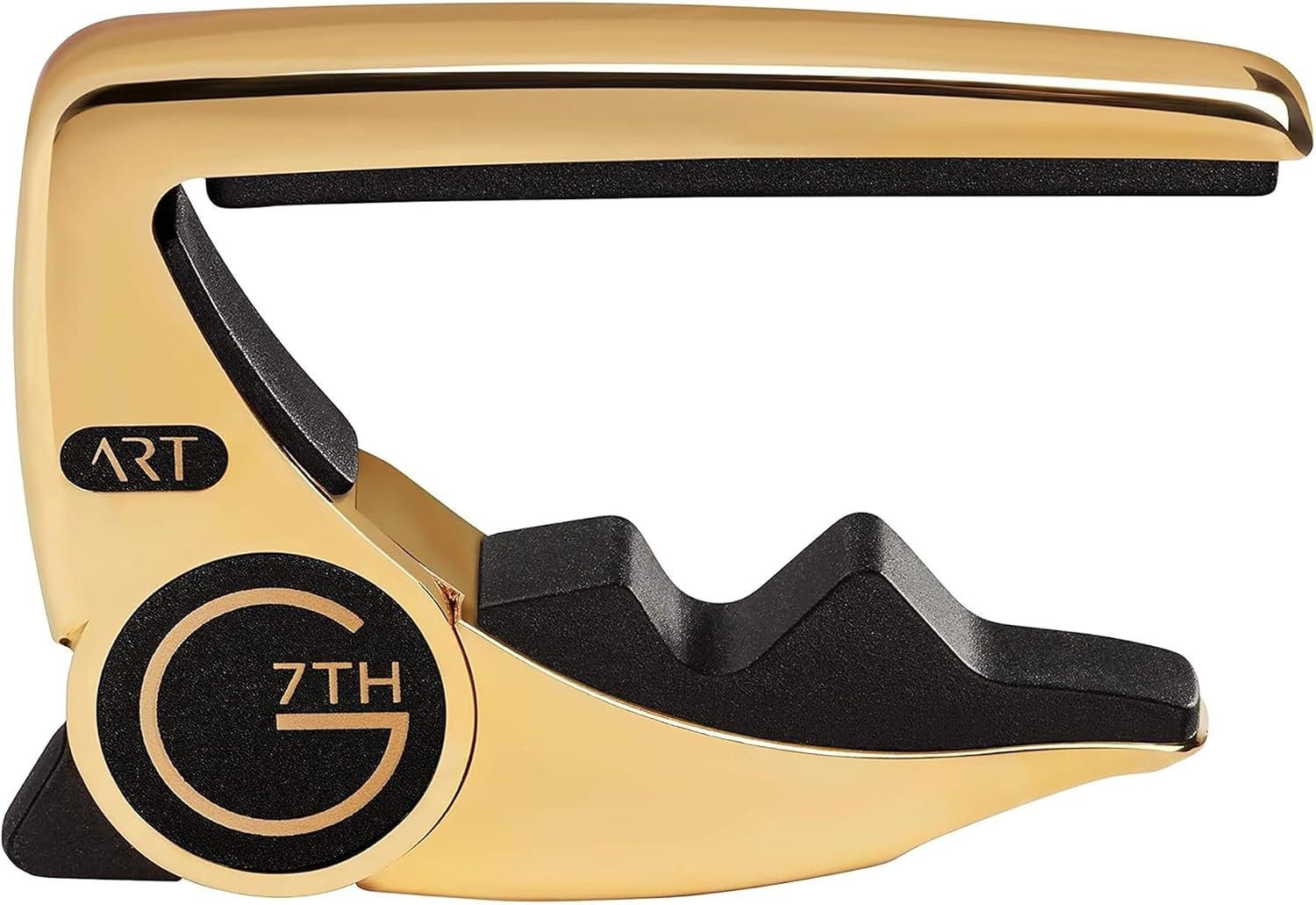
The G7th Performance 3 Gold Guitar Capo combines thoughtful engineering, precise tension control and an elegant 18kt gold-plated finish in a compact accessory designed for serious guitar players.
A capo may appear to be one of the simplest pieces of guitar equipment, but its design can have a noticeable influence on tuning stability, playing comfort and the clarity of individual strings.
Applying too much pressure can pull notes sharp, while uneven contact may leave some strings buzzing or poorly defined.
The G7th Performance 3 addresses these problems through two distinctive features: Adaptive Radius Technology (ART)and the company’s patented Unique Tension Control system.
Together, they allow the capo to adapt to the curvature of the strings and give the guitarist direct control over the amount of clamping pressure.
The gold-plated version adds an attractive finish that looks particularly appropriate alongside guitars with gold hardware and traditional decorative appointments.
However, the Performance 3 is more than a decorative accessory.
Its primary attraction is the way it approaches an everyday guitar-playing problem.
For acoustic and electric guitarists who regularly change keys, accompany singers or experiment with different chord voicings, it offers an interesting alternative to conventional spring-operated capos.
There are compromises, though. The mechanism requires a little familiarity, the gold finish provides no additional musical advantage, and the standard six-string model is not suitable for every instrument.
Understanding these points will help determine whether this carefully designed capo deserves a place in your guitar case.
Why it works for acoustic and electric guitarists
A capo changes the effective length of a guitar’s strings by holding them against a selected fret.
This raises the pitch of the open strings while allowing the player to continue using familiar chord shapes.
For example, placing a capo at the second fret raises the pitch of each open string by two semitones.
A guitarist can then use ordinary open chord shapes while playing in a higher key.
This is particularly useful when accompanying a singer.
Rather than learning an entirely different set of chord shapes, the guitarist can reposition the capo to find a more comfortable key for the vocalist.
Capos are also useful for creating different tonal textures.
Two guitarists can play the same chord progression using different voicings, with one instrument capoed higher on the neck.
The resulting arrangement can sound fuller without requiring complicated playing.
For acoustic music, folk, country and singer-songwriter performances, this versatility is especially valuable.
However, a capo must hold the strings securely without applying excessive force.
A conventional spring capo generally produces a predetermined amount of clamping pressure.
That may be suitable for one instrument but excessive for another.
The G7th Performance 3 allows the player to determine how firmly the strings are held.
This gives it a practical advantage when moving between guitars with different neck shapes, string gauges and fret heights.
Its purpose is not to create an artificial tone or replace good playing technique.
It is to make the ordinary task of changing a guitar’s effective tuning more controlled and convenient.
Adaptive Radius Technology explained
The most distinctive feature of the Performance 3 is Adaptive Radius Technology, usually shortened to ART.
A guitar fingerboard is not always perfectly flat.
Many electric guitars have curved fingerboards, while acoustic guitars can use different degrees of curvature.
This curvature is described by the fingerboard radius.
The strings also sit at different heights relative to one another, influenced by the bridge, nut, string gauge and the instrument’s setup.
A conventional capo generally uses a fixed-shape string pad.
That pad may work well on certain necks but distribute pressure less evenly on others.
When the pressure is uneven, some strings may be pressed harder than necessary while others receive insufficient contact.
The result can be unwanted pitch changes, fret buzz or muted notes.
G7th developed ART to address this problem.
Inside the Performance 3’s upper bar is a mechanical system that allows the string-contacting pad to adapt to the curvature of the strings.
Rather than relying on one fixed radius, the pad changes its shape in response to the instrument.
The intention is to provide more evenly distributed pressure across all six strings.
This is particularly useful when the same capo is used on several guitars.
An acoustic instrument may have a different fingerboard profile from an electric guitar.
Even one guitar can present slightly different relationships between the strings and the fingerboard at different fret positions.
The ART system is designed to accommodate these variations automatically.
This does not mean the capo can correct every instrument setup problem.
Uneven frets, excessive string action and damaged strings can still affect the sound.
Nevertheless, addressing string-pressure distribution is a meaningful improvement over a capo that simply clamps every neck with an unchanging contact shape.
Unique Tension Control
The other important feature is G7th’s Unique Tension Control mechanism.
Instead of relying on an ordinary spring to determine clamping force, the Performance 3 uses a patented clutch arrangement.
The guitarist positions the capo over the neck and gently squeezes it closed.
The mechanism holds the selected position once the required pressure has been applied.
To remove it, the player operates the release mechanism, allowing the arms to open.
This arrangement gives the guitarist direct control over the pressure applied to the strings.
That matters because different instruments require different amounts of clamping force.
A guitar with low action and relatively light strings may need only gentle pressure.
Another instrument with heavier strings or higher action may require slightly more.
With the Performance 3, the user can adjust the pressure by feel rather than accepting one predetermined spring force.
The aim is to use only enough tension to make every string sound cleanly.
Applying more force than necessary serves little musical purpose and can increase the risk of pulling the strings sharp.
The system therefore encourages a more deliberate approach.
Position the capo carefully, apply gentle pressure and check that every string sounds properly.
If a string buzzes, the position or clamping pressure may need a small adjustment.
Once familiar with the mechanism, this becomes a straightforward routine.
It is particularly useful for guitarists who move between acoustic and electric instruments during a rehearsal or performance.
Why capo pressure affects tuning
One common frustration with capos is that a guitar can sound correctly tuned before the capo is fitted but noticeably sharp afterwards.
This is not necessarily caused by poor-quality strings or inaccurate tuning machines.
It can be a consequence of the pressure applied by the capo.
When a string is pushed down against a fret, its tension changes slightly.
The amount of change depends on several factors, including string height, string gauge and the force applied.
If a capo squeezes much harder than necessary, the strings may be stretched more than they need to be.
This can produce an unwanted rise in pitch.
The effect may differ between strings, leaving the guitar sounding less balanced.
Adjustable clamping pressure helps reduce this problem.
The guitarist can apply enough force to establish a clean contact with the fret without unnecessarily compressing the strings.
G7th’s ART system adds another advantage by adapting the string pad to the instrument’s curvature.
Together, these features are intended to improve tuning consistency.
However, it is important not to promise that the Performance 3 will completely eliminate tuning adjustments.
A guitar with high string action, poor intonation or uneven frets may still require attention.
String condition and capo positioning also matter.
Even with a carefully designed capo, it is sensible to check the instrument’s tuning after fitting or repositioning it.
The G7th makes controlling pressure easier, but it cannot override the physical characteristics of the guitar.
What it feels like to use
The Performance 3 has a compact shape with a smooth, curved design.
The gold finish gives it a more decorative appearance than the familiar black or silver capos found in many guitar cases.
Its operating method is slightly different from that of a conventional spring capo.
With a spring-operated design, the guitarist squeezes the handles to open the clamp and releases them to apply pressure.
The G7th uses a controlled squeezing action to close and secure the capo.
The release mechanism is then operated when the player wants to remove it.
This takes a little getting used to.
Someone who has used spring capos for years may initially reach for the controls in the wrong way.
However, the arrangement becomes more intuitive with practice.
One of its practical advantages is the absence of a large protruding spring handle.
The compact profile helps keep the capo from appearing unnecessarily bulky on the guitar neck.
The Performance 3 can also be operated with one hand.
That is useful when the other hand is supporting the guitar or preparing for the next musical passage.
For ordinary practice, the process is simple enough.
Place the capo close to the selected fret, apply the minimum effective pressure and listen for clean notes.
For performance use, it is worth practising the movement between different fret positions.
The mechanism is designed for convenient operation, but achieving smooth changes during a song still requires familiarity.
One-handed capo changes
For performing guitarists, changing the capo’s position quickly can be important.
A singer may need to move into a different key between songs.
A guitarist may also want to change voicings during a rehearsal without interrupting everyone else.
The Performance 3 is designed for one-handed use.
With practice, the player can release the capo, reposition it and apply the required pressure using one hand.
This is especially useful for musicians who regularly move the capo rather than leaving it in one position.
However, it would be misleading to claim that it is automatically faster than every spring-operated alternative.
A familiar spring capo can be moved very quickly because its mechanism is straightforward.
The G7th offers greater control over the pressure, but that control introduces an additional consideration during positioning.
The guitarist needs to squeeze the capo firmly enough to hold the strings cleanly without applying excessive force.
Someone who has developed a comfortable technique may find the process nearly as quick as using a conventional spring capo.
Others may need more time.
The important benefit is not simply speed.
It is the opportunity to reposition the capo while applying an appropriate amount of tension for the new fret location.
Suitable for different fingerboard radii
One of the strengths of the Performance 3 is its compatibility with different fingerboard curvatures.
Many electric guitars have noticeably curved fingerboards.
Traditional Fender-style instruments, for example, can use a relatively rounded playing surface.
Other electric guitars use flatter fingerboards, while acoustic designs vary considerably.
A capo with a fixed string-pad shape may suit one radius particularly well but be less effective on another.
G7th’s adaptive string pad is intended to accommodate these differences.
This makes the Performance 3 especially appealing to musicians who own several guitars.
Someone might use the same capo on a steel-string acoustic during a folk performance and on an electric guitar during practice.
The capo’s pressure can be adjusted, while its string pad adapts to the different string curvature.
This reduces the need to maintain separate conventional capos for instruments with different fingerboard radii.
However, fingerboard radius is not the same as neck width.
The standard Performance 3 Gold is designed principally for six-string steel-string guitars.
A very wide classical neck or a twelve-string guitar presents different physical requirements.
Those instruments may need a dedicated model.
The ART mechanism makes the Performance 3 adaptable within its intended application, not universally suitable for every string instrument.
Protecting the guitar neck
A capo comes into direct contact with the guitar neck, so the materials used at those contact points matter.
The Performance 3 includes protective silicone pads.
These are designed to prevent the metal parts of the capo from contacting the guitar’s finish directly.
The rear of the neck is particularly important because the clamping mechanism must apply pressure against it.
A poorly designed or damaged capo may create unwanted marks if hard components touch the finished surface.
G7th uses silicone cushioning to reduce that risk during normal operation.
The string-contacting pad also provides a controlled surface for pressing the strings.
However, protection depends on correct use.
The capo should be clean before being placed on the guitar.
Dust, grit or other debris trapped between the pad and the neck may create marks.
The user should also avoid sliding a tightly clamped capo along the neck.
It is better to release the pressure before repositioning it.
Guitars with delicate or ageing finishes deserve particular care.
G7th states that its silicone materials are intended to be compatible with guitar finishes, including nitrocellulose, but recommends not leaving a capo attached when it is not being used.
That is sensible advice for any valuable instrument.
The protective materials are a worthwhile design feature, but they should be supported by careful handling.
The 18kt gold-plated finish
The gold finish gives this version of the Performance 3 its distinctive appearance.
G7th describes it as an 18kt gold-plated finish.
That means the capo has a decorative gold plating rather than being made from solid gold.
The distinction is important because the plating is primarily an aesthetic feature.
It does not change the fundamental way the ART system or tension mechanism operates.
However, appearance can still matter to musicians who appreciate carefully chosen accessories.
The gold-plated version works particularly well with guitars fitted with gold tuning machines, bridges or other decorative hardware.
It can also complement instruments with darker finishes.
Against black, deep red or natural wood, the polished gold creates a noticeable contrast.
For a player with a high-quality acoustic or electric guitar, this may be more appealing than an ordinary utility-style accessory.
The gold finish also gives the capo a traditional, understated sense of luxury rather than relying on bright plastic or elaborate decoration.
However, it will not improve the guitar’s tone compared with the silver or black versions of the same Performance 3 design.
The musical benefits come from the mechanism and string pad.
The choice of gold is therefore best understood as a design preference.
For someone who enjoys matching guitar accessories to the instrument, that may be a worthwhile consideration.
For a player concerned only with function, another finish may provide the same essential performance.
Acoustic guitar applications
Acoustic guitarists are among the musicians most likely to benefit from a well-designed capo.
Singer-songwriters regularly use capos to adjust the key of familiar chord progressions.
Folk musicians may use them to create open-string voicings that would be difficult to achieve through ordinary chord shapes.
Fingerstyle guitarists can also use a capo to explore different registers while retaining their preferred arrangements.
The Performance 3 is designed for six-string steel-string acoustic guitars.
Its adjustable pressure is useful because acoustic instruments can vary considerably in neck dimensions, string gauges and action.
A guitar fitted with heavier strings may respond differently from one using a lighter set.
The same capo may also need different pressure at the second fret compared with the seventh.
The squeeze-operated mechanism allows these adjustments to be made directly.
For acoustic playing, clear individual strings are particularly important.
An imperfectly positioned capo can make a picked note buzz or lose its natural sustain.
That becomes obvious during fingerpicking passages.
The ART system is intended to help distribute contact evenly so that the strings can sound cleanly.
As always, correct placement remains essential.
The Performance 3 can make capo use more controlled, but the player must still ensure that the guitar itself is properly adjusted.
Electric guitar applications
Although capos are commonly associated with acoustic guitars, they can also be useful on electric instruments.
An electric guitarist may use a capo to play familiar chord shapes in a different key or create contrasting rhythm parts.
For example, a guitarist accompanying a singer could position the capo higher on the neck and play open-style chords while another musician performs lower voicings.
The combination can create an interesting layered arrangement.
Capos are also useful for certain indie, alternative, country and pop guitar techniques.
However, electric guitars can be especially sensitive to excessive capo pressure.
Many instruments have relatively light strings and low action.
A strong spring clamp may apply more pressure than necessary, increasing the possibility of sharp notes.
The Performance 3 allows the guitarist to control the tension more carefully.
That is particularly appealing when using lighter strings.
The ART system also helps accommodate different electric-guitar fingerboard profiles.
This makes the capo suitable for moving between various conventional six-string instruments.
However, an electric guitar with unusually large frets, very low action or a specialised neck design may still need careful positioning.
No capo can guarantee perfect results on every instrument without adjustment.
The importance of correct positioning
Even a sophisticated capo can cause problems when positioned incorrectly.
The most reliable starting point is to place it immediately behind the selected fret, rather than halfway between two frets.
The capo should be close enough to provide clean contact without sitting directly on top of the fret crown.
Once positioned, the player should apply gentle clamping pressure.
Each string can then be checked individually.
If a note buzzes, the capo may need to be moved slightly or given a little more pressure.
If the guitar sounds noticeably sharp, excessive pressure may be part of the problem.
A small adjustment can often improve the result.
It is also worth checking the capo’s alignment.
If it is placed at an awkward angle, the contact between the pad and strings may be less consistent.
The Performance 3’s ART mechanism helps accommodate string curvature, but correct positioning remains the player’s responsibility.
For live musicians, developing a consistent placement technique is valuable.
It reduces interruptions and makes key changes more predictable.
A good capo works best when the player understands how to use it rather than relying entirely on the mechanism to compensate for careless placement.
Replaceable string pad and long-term care
The Performance 3 uses a replaceable ART string pad.
This is a practical feature because the string-contacting material is one of the parts most likely to experience regular wear.
Over time, repeated contact with guitar strings can leave marks or grooves.
If a pad becomes worn or damaged, its ability to apply pressure evenly may be affected.
G7th provides replacement pads for the Performance 3.
This allows the relevant part to be renewed without automatically replacing the entire capo.
For someone who uses a capo frequently, that is an attractive long-term ownership detail.
The replacement should be carried out according to G7th’s instructions.
Routine care is straightforward.
The capo should be kept free from dirt and abrasive particles, particularly around the silicone contact surfaces.
A soft, dry cloth can be used for ordinary cleaning.
The gold-plated surfaces should be handled gently, avoiding abrasive polishing methods that could affect the decorative finish.
It is also sensible to keep the capo in a suitable compartment when travelling.
Although the metal construction is substantial, the mechanism and plating should not be subjected to unnecessary impacts.
A G7th protective case is available separately, but buyers should not assume one is included with this model.
With appropriate care and occasional inspection of the string pad, the Performance 3 is designed to provide long-term use.
G7th’s lifetime warranty
G7th provides a lifetime warranty for its capos, subject to the company’s conditions.
The manufacturer explains that the warranty covers manufacturing faults and failures of the mechanism during normal use.
It is not insurance against accidental damage, misuse or every form of cosmetic wear.
G7th provides an online registration process and instructions for contacting the company if a manufacturing problem develops.
This is reassuring for a product with a distinctive clutch mechanism.
A conventional spring capo has relatively few moving components.
The Performance 3 uses a more specialised system, so dependable manufacturing and support are particularly relevant.
The availability of replacement string pads adds another practical benefit.
However, a lifetime warranty should not be interpreted as a guarantee that the gold plating will remain visually perfect forever.
Normal handling, storage and wear can affect the appearance of decorative finishes.
The warranty’s principal attraction is the manufacturer’s commitment to the product’s construction and mechanism.
For a guitarist who prefers buying well-designed accessories intended for repeated use, that is a positive consideration.
The drawbacks
The G7th Performance 3 Gold Guitar Capo has several attractive features, but it is important to understand where its design introduces compromises.
A capo is a relatively simple accessory, and additional engineering is only worthwhile when it produces benefits the guitarist genuinely needs.
The first drawback is that the mechanism requires some practice.
Most guitarists are familiar with spring-operated capos.
The user squeezes the handles to open the clamp, positions it on the neck and releases the handles to secure it.
The Performance 3 works differently.
It uses a controlled squeezing action to apply pressure, with a separate release movement when the capo needs to be removed.
This is straightforward once familiar, but it can feel unusual initially.
Someone who has used a conventional spring capo for many years may need to develop a different technique.
During a performance, that unfamiliarity could make a quick key change less convenient.
The best approach is to practise applying, releasing and repositioning the capo before relying on it during a live set.
Its one-handed operation is useful, but it should not be assumed that every player will find it immediately easier than a familiar spring design.
The gold plating provides no additional musical benefit.
This is perhaps the clearest limitation of the gold version.
The distinctive appearance is attractive, particularly alongside guitars with gold hardware.
However, the plating does not change the fundamental operation of the capo.
The ART mechanism and Unique Tension Control are also available on other Performance 3 finishes.
A guitarist choosing the gold version is therefore making an aesthetic decision as well as a functional one.
That may be entirely reasonable for someone who values the appearance of their equipment.
Nevertheless, it would be misleading to suggest that gold plating improves tuning accuracy, sustain or tonal response.
Someone interested solely in the mechanical benefits may be equally satisfied with a different finish.
The main reasons to choose the Performance 3 are its adaptive string pad and controlled clamping system, not the decorative metal surface.
The polished finish requires careful handling.
Gold plating can look particularly attractive when the capo is new.
However, decorative finishes are vulnerable to ordinary wear.
Repeated handling, contact with other metal objects and unsuitable cleaning methods may eventually affect the surface.
A capo is an accessory that is frequently picked up, moved and stored.
It may spend time in a guitar case alongside tuners, cables and other equipment.
If carried loose among hard objects, the finish could become scratched.
Abrasive polishing compounds may also be unsuitable for plated surfaces.
The sensible approach is to clean the capo gently and store it separately from objects that could damage the finish.
For musicians who prefer equipment that develops visible wear without concern, the gold version may be less practical than a more understated finish.
The standard six-string model is not suitable for every guitar.
The Performance 3 Gold considered here is designed primarily for steel-string acoustic and electric guitars with six strings.
It is also listed by G7th as suitable for certain hybrid nylon-string instruments.
However, it should not automatically be regarded as suitable for all classical guitars.
Traditional classical guitars generally have wider, flatter fingerboards.
G7th produces a dedicated classical capo for these instruments.
The company also recommends specialised capo designs for most twelve-string guitars.
These instruments have paired strings that can require different pressure relationships.
A standard six-string capo may not provide the most satisfactory result.
Anyone buying the Performance 3 for a twelve-string or wide-neck classical guitar should check the appropriate G7th model rather than assuming the standard version will work.
The adaptable ART mechanism does not remove every physical compatibility limitation.
A capo cannot correct poor guitar setup.
The Performance 3 is designed to reduce problems caused by excessive or uneven string pressure.
However, it cannot compensate for every fault in the instrument.
If the guitar has uneven frets, excessively high action or a poorly adjusted neck, fitting a capo may still produce unwanted buzzing or pitch changes.
Likewise, a guitar with incorrect intonation can sound out of tune at certain positions even when its open strings are accurately tuned.
The ART system adjusts to the string curvature.
It does not alter the guitar’s frets, bridge or neck geometry.
For someone experiencing persistent tuning problems, the instrument may need professional attention.
A well-designed capo can improve the consistency of clamping, but it should not be treated as a substitute for proper guitar maintenance.
Correct tension still depends on the player.
Unique Tension Control gives the guitarist the freedom to choose how much pressure is applied.
That is one of the product’s strongest advantages.
However, the freedom also introduces responsibility.
If the capo is squeezed excessively, it may still pull strings sharp.
If the pressure is insufficient, some notes may buzz or fail to sound clearly.
The mechanism does not automatically determine the ideal force in every circumstance.
The user needs to develop a feel for the correct amount.
This can vary between instruments and fret positions.
A player who wants a capo that applies the same preset pressure every time may find a conventional spring design more convenient.
The Performance 3 rewards careful adjustment, but it cannot remove the need for judgement.
It may not be the fastest option for every live performer.
G7th designed the Performance 3 for convenient one-handed operation.
With practice, it can be repositioned quickly.
However, a conventional spring capo can also be moved extremely rapidly.
The Performance 3 requires the player to release the mechanism, place the capo correctly and apply suitable pressure.
For a musician changing capo position between songs, this is unlikely to be troublesome.
For someone making very rapid capo changes during a performance, the extra attention to tension may become noticeable.
The better choice depends on whether the guitarist prioritises maximum speed or greater control over clamping force.
The Performance 3 provides a useful balance, but it is not necessarily the fastest capo for every individual.
Its compact design can still interfere with certain playing positions.
The Performance 3 has a relatively restrained profile.
Nevertheless, it remains a physical object attached to the guitar neck.
Players who wrap their thumb around the neck or use unusual hand positions may occasionally notice the capo near the fretting hand.
This can be more apparent when playing close to the capo itself.
The exact experience depends on the neck shape, playing technique and chosen fret position.
Although the G7th avoids the large protruding handles found on some conventional spring capos, it cannot completely remove the physical presence of the accessory.
A guitarist with a highly individual fretting technique may need to experiment with the capo’s orientation and placement.
A protective pad does not guarantee that every guitar finish is immune to marking.
G7th uses non-reactive silicone cushioning to protect the instrument.
This is a thoughtful and important feature.
However, guitar finishes vary considerably.
Some vintage or delicate finishes can be affected by pressure, prolonged contact and environmental conditions.
Nitrocellulose finishes in particular deserve sensible care.
G7th recommends not leaving its capos attached to the instrument when they are not being used.
That is good advice.
The capo should also be kept clean, because dirt trapped against the finish can create unwanted marks.
Sliding it along the neck while tightly clamped is another practice worth avoiding.
The protective pads reduce the risk of metal-to-wood contact, but the guitarist remains responsible for careful handling.
The string pad will eventually show wear.
The replaceable ART pad is a useful design feature.
However, replacement may become necessary after prolonged use.
Guitar strings place repeated pressure on the same contact surface.
Over time, wear can affect the pad’s condition.
If the material develops grooves or other damage, the capo may no longer distribute pressure as effectively.
The advantage is that G7th offers replacement parts.
The drawback is that the user must inspect the pad and replace it when appropriate.
This introduces a small maintenance requirement that should be recognised.
A capo is not necessarily a completely permanent, maintenance-free accessory simply because it is made from metal.
The clutch mechanism is more specialised than an ordinary spring.
The Performance 3 uses G7th’s patented wrap-spring clutch design.
This provides the controlled pressure adjustment that makes the capo distinctive.
However, it is also a more specialised mechanical arrangement than a basic spring clamp.
If the mechanism develops a fault, it is not something the average guitarist should attempt to repair through improvised methods.
The manufacturer’s warranty provides reassurance for qualifying defects, but an unexpected failure could still leave the player without their preferred capo until the issue is resolved.
For musicians who perform regularly, keeping a simple spare capo is sensible regardless of the main model used.
The Performance 3 is designed for dependable operation, but no mechanical device is completely immune to wear or damage.
The warranty does not cover every possible problem.
G7th’s lifetime warranty is an attractive feature.
However, it is intended to cover manufacturing faults and mechanism failures during normal use.
It does not automatically provide protection against accidental damage, misuse or every cosmetic change.
A scratched gold finish should not automatically be assumed to qualify for replacement.
The manufacturer also provides instructions for registering the product and making a claim.
Buyers should familiarise themselves with these conditions.
A warranty is a valuable form of support, but it does not mean the owner can use or store the capo carelessly without consequences.
It is not a partial capo.
The standard Performance 3 Gold is designed to hold down all six strings across the selected fret.
That is ideal for ordinary capo applications.
However, some guitarists use partial capos to fret only selected strings.
These can create unusual open-string arrangements and different chord possibilities.
The Performance 3 is not designed around that specialised technique.
Someone who wants to leave certain strings open while fretting others with a capo will need a purpose-built partial capo.
The G7th range includes other models for different applications.
The standard Performance 3 should be chosen for conventional full-width capo use rather than experimental partial-string arrangements.
It will not suit every player’s approach to guitar tone.
Some guitarists rarely use a capo.
They may prefer playing barre chords, changing chord shapes or transposing songs without attaching anything to the neck.
Others rely heavily on alternate tunings rather than using a capo to change pitch.
For those musicians, even a carefully designed capo may see little use.
The Performance 3 provides useful improvements for people who already depend on capos.
It does not create an essential requirement for every guitarist to own one.
Someone who uses a capo once or twice a year may be perfectly satisfied with a simpler alternative.
The additional engineering is most valuable when capo use forms a regular part of playing.
Finally, the extra sophistication may be unnecessary for straightforward practice.
A conventional capo can perform its basic function effectively when matched to the guitar.
For a beginner practising with one instrument and using only a few capo positions, an ordinary spring model may provide everything required.
The G7th Performance 3 introduces more deliberate tension control, adaptive string pressure and a specialised clutch mechanism.
These features are meaningful when tuning consistency and instrument compatibility are important.
However, they are not automatically essential for every situation.
A guitarist who already owns a well-fitting capo that performs reliably may notice only a modest improvement.
The sensible reason to choose the Performance 3 is that its particular features address a genuine need.
For regular performers, multi-guitar owners and players sensitive to capo-related tuning problems, that need may be considerable.
For occasional users, simplicity may matter more.
Who it suits best
The G7th Performance 3 Gold Guitar Capo is particularly suited to acoustic and electric guitarists who use capos regularly and value accurate, controlled string pressure.
Singer-songwriters may appreciate the ability to move between keys while keeping familiar chord shapes.
Fingerstyle guitarists can benefit from the design’s attention to even string contact, particularly where clean individual notes are important.
It is also an attractive option for musicians who own several guitars with different fingerboard radii.
The ART mechanism and adjustable tension allow the same capo to accommodate a range of conventional six-string instruments.
Players who appreciate well-designed accessories may also enjoy the gold-plated finish, especially when it complements the hardware on their guitars.
However, the standard model is less suitable for traditional wide-neck classical guitars, twelve-string instruments and specialised partial-capo applications.
It may also be more elaborate than necessary for someone who only occasionally uses a capo.
The strongest audience is the guitarist who considers tuning stability, careful instrument handling and dependable performance important parts of everyday playing.
Is it worth the guitar case space?
The G7th Performance 3 Gold Guitar Capo brings useful engineering to an accessory that is often treated as little more than a spring-operated clamp.
Its Adaptive Radius Technology is designed to distribute pressure evenly across the strings, while the Unique Tension Control mechanism lets the player choose how firmly the capo grips the neck.
These features address two familiar capo problems: unwanted tuning changes and inconsistent string contact.
The protective silicone pads, replaceable ART string pad and lifetime warranty add further appeal.
The 18kt gold-plated finish gives the capo an elegant appearance, particularly alongside guitars with matching hardware.
There are limitations.
The mechanism takes some practice, the gold finish requires sensible care, and the standard six-string version is not suitable for every instrument.
The musician must also apply the correct pressure and position the capo carefully.
For someone who rarely uses a capo, a simpler design may be sufficient.
However, for acoustic and electric guitarists who regularly change keys, move between instruments and want more control over their tuning, the Performance 3 offers a thoughtful combination of function and design.
Its greatest attraction is not the decorative finish, attractive though that may be.
It is the attention G7th has given to making an everyday guitar accessory more precise and adaptable.
For the right guitarist, that makes the G7th Performance 3 Gold a worthwhile addition to a carefully chosen collection of guitar accessories.
For more quality guitar capos, tuners, cases and practical equipment for musicians, explore our Accessories guides.
As an Amazon Associate I earn from qualifying purchases.