Line 6 POD Express Guitar
As an Amazon Associate I earn from qualifying purchases.
The Line 6 POD Express Guitar takes a different approach to the modern multi-effects processor. Instead of surrounding the guitarist with a large display, menus and rows of switches, it puts the essentials into a small pedal that can be adjusted largely by turning physical controls.
Inside are seven guitar amp models, seven matching cabinet models and 17 effects derived from Line 6’s HX family of processors. There is also a looper, tuner, 21 preset locations, headphone output and USB connectivity, giving this compact unit considerably more flexibility than its simple appearance suggests.
For guitarists who want amp sounds and effects without carrying a large processor, it occupies an interesting middle ground between a conventional stompbox and a full modelling floorboard.
Why it works for guitar
The strongest part of the POD Express Guitar is its straightforward layout.
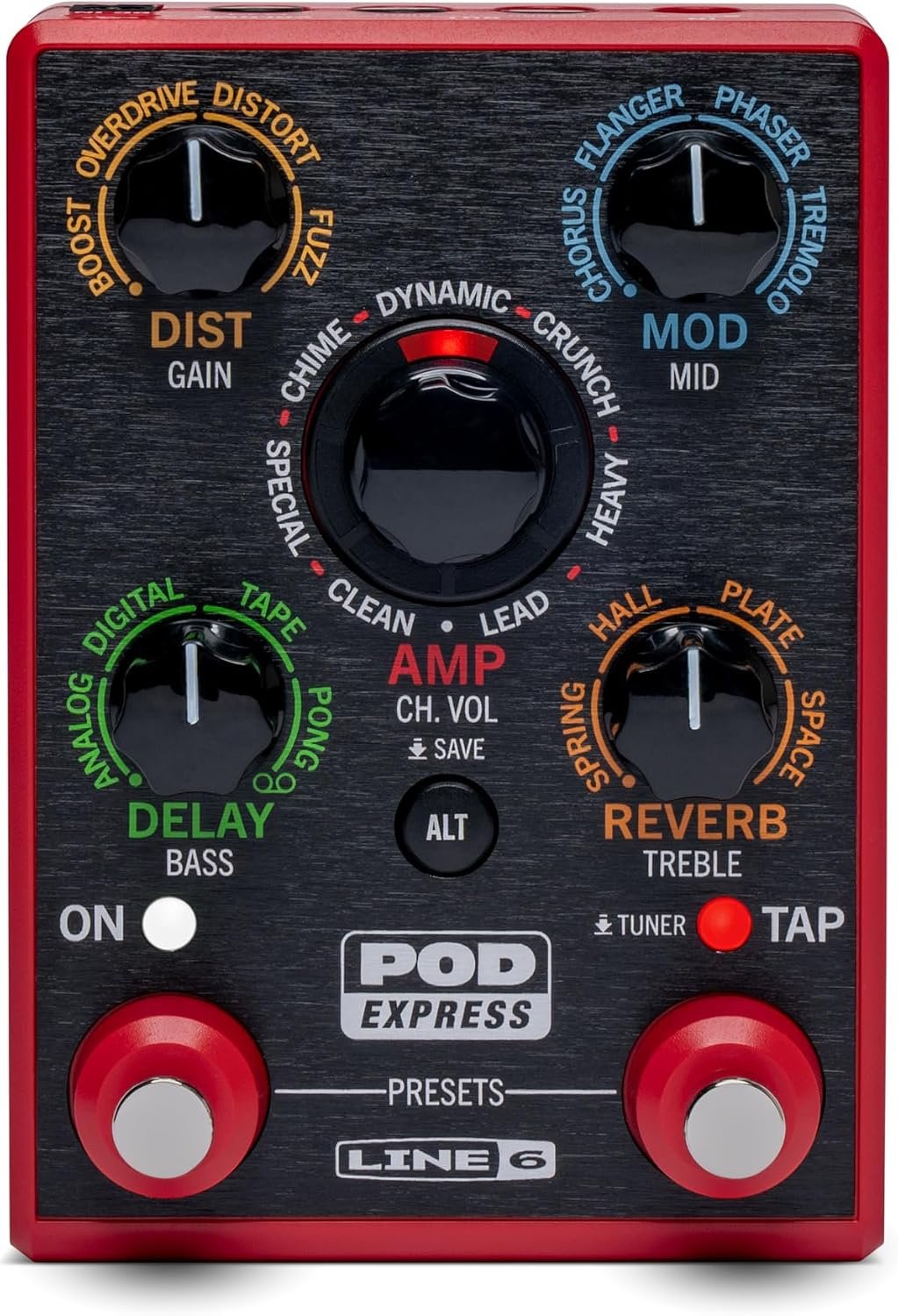
The central amp control selects the amplifier model, while dedicated controls cover distortion, modulation, delay and reverb. Secondary controls provide access to gain, EQ and other useful adjustments without requiring a large screen.
That makes it possible to build a sound in much the same way you would approach a small pedalboard: choose an amp, add the effects you want and adjust them by ear.
Line 6 has included seven amp and cabinet models, covering a useful spread of guitar tones rather than trying to squeeze hundreds of choices onto the front panel. The effects section adds distortion, modulation, delay and reverb choices, with the looper providing another useful practice tool.
There are 21 preset locations, and all of them can be overwritten with your own settings. That means a handful of favourite clean, crunch, lead and ambient sounds can be stored rather than recreated every time the unit is switched on.
Two footswitches handle functions including bypass, preset changes, tap tempo and the onboard tuner.
What it feels like to use
The POD Express Guitar is deliberately compact and uncluttered.
Rather than feeling like a small computer on the floor, the top panel resembles a collection of familiar pedal controls. Turning the amp control changes the basic amplifier character, while the four effects knobs let you bring different effects into the sound.
A multicolour LED ring provides visual feedback without dominating the pedal with a large display.
That physical approach should appeal to guitarists who like modelling technology but do not particularly enjoy navigating pages of menus before they can play.
It is also very flexible about where it can be used.
Stereo left and right outputs allow connection to suitable amplification, powered speakers, recording equipment or another pedal setup. There is also a 3.5mm headphone connection, which makes the POD Express useful for quiet practice.
Connect it to a computer or compatible mobile device through USB and it can operate as an audio interface, so a separate interface is not necessarily required for straightforward guitar recording.
Power is equally flexible. Three AA batteries are included, or the pedal can be powered using a compatible 9-volt supply purchased separately. Line 6 says alkaline batteries typically provide at least six hours of operation, although actual running time depends on how the unit is being used.
That makes it particularly useful as a small practice setup. Guitar, POD Express and headphones can be enough for a session without setting up an amplifier and pedalboard.
The drawbacks
The simplicity of the POD Express Guitar is also where its limitations begin.
There is no large display. That helps keep the pedal compact and immediate, but guitarists accustomed to modern processors with detailed screens, named signal blocks and graphical editing may initially find the LED-based interface less informative.
Seven amplifier models are enough to cover several useful styles, but this is not the product for somebody who wants to scroll through dozens or hundreds of individual amplifier recreations. The same applies to the effects. Line 6 has provided a carefully reduced selection rather than turning the unit into an enormous effects library.
That restriction can actually make practising easier, but it is still a restriction.
The pedal also provides only two onboard footswitches. They handle a surprising number of duties, including preset navigation, tap tempo and tuner access, but a guitarist wanting individual footswitches for several effects during a performance may find the layout limiting. Additional control is possible through the external control connection, but that means adding more hardware.
Battery operation is convenient rather than completely effortless. Three AA batteries remove the need for a nearby mains supply, but they eventually need replacing. Anyone using the POD Express regularly at home or on a pedalboard will probably prefer a compatible 9-volt power supply, which is not included.
Headphone practice is another strength with a small qualification. The experience will depend heavily on the headphones being used. A comfortable, reasonably balanced pair can make the modelling enjoyable for long practice sessions; poor headphones can make even good amp modelling sound thin or tiring.
The compact controls also mean there is less physical space between knobs than on a large floor processor. That is perfectly manageable at a desk or while practising, but making careful adjustments with your foot while standing is not what the knobs are designed for.
There is also an important question of who actually needs the amp modelling.
If you already have an amplifier you love and simply want one specific delay, chorus or overdrive sound, an individual effects pedal may be the cleaner choice. The POD Express earns its place when its combination of amps, effects, presets, headphones and USB recording will genuinely be used.
Likewise, a guitarist building a complex live rig with extensive MIDI control, numerous simultaneous effect blocks and detailed routing will probably outgrow it. A larger HX-family processor is designed more directly for that type of setup.
Its strength is not maximum complexity. It is getting a useful collection of guitar sounds into a small, approachable box.
Who it suits best
The Line 6 POD Express Guitar makes particular sense for players who want to practise in more than one place.
It can sit on a desk with headphones, travel in a guitar bag, connect to recording software through USB or become part of a compact pedal setup.
Beginners may appreciate having several types of amp and effect available without immediately building a collection of individual pedals. More experienced guitarists may see it differently: as a small practice processor or convenient backup that avoids carrying a larger rig.
It also suits players who prefer turning physical controls to spending their practice time moving through menus.
The 21 writable presets provide enough storage for several carefully prepared sounds without making preset management feel like a separate hobby.
Is it worth the pedalboard space?
The Line 6 POD Express Guitar works because it does not try to behave like the largest modelling processors.
It provides a focused collection of HX-derived amp, cabinet and effect models in a small format, then adds practical features such as presets, tuner, looper, stereo outputs, headphones and USB recording.
There are more powerful processors for complicated live setups, and traditional individual pedals remain attractive when only one particular effect is required.
But for a guitarist wanting a compact unit that can move easily between practice, recording and a small pedal setup, the POD Express Guitar offers a useful amount of flexibility without surrounding the player with unnecessary complexity.
Explore more pedals and tone-shaping gear in our Pedals & Effects section.
As an Amazon Associate I earn from qualifying purchases.