BOSS RC-1 Loop Station Pedal
As an Amazon Associate I earn from qualifying purchases.
The BOSS RC-1 Loop Station is made for guitarists who want to start looping without turning the pedalboard into a technical exercise. It keeps the idea simple: record a phrase, play it back, add another layer and build from there using a single compact pedal.
That simplicity is a big part of the appeal. Whether you are working on timing, building rhythm parts under a lead line, experimenting with song ideas or creating fuller solo arrangements, the RC-1 gives you a practical way to hear how different parts sit together. The clear loop-status display also makes it easier to keep track of recording, playback and overdubbing while you are actually playing.
How Easy Is the BOSS RC-1 to Use?
The RC-1 is deliberately uncomplicated. One footswitch handles the main looping functions, so there is very little standing between plugging in and creating your first loop. That makes it particularly approachable for players who have never used a looper before.
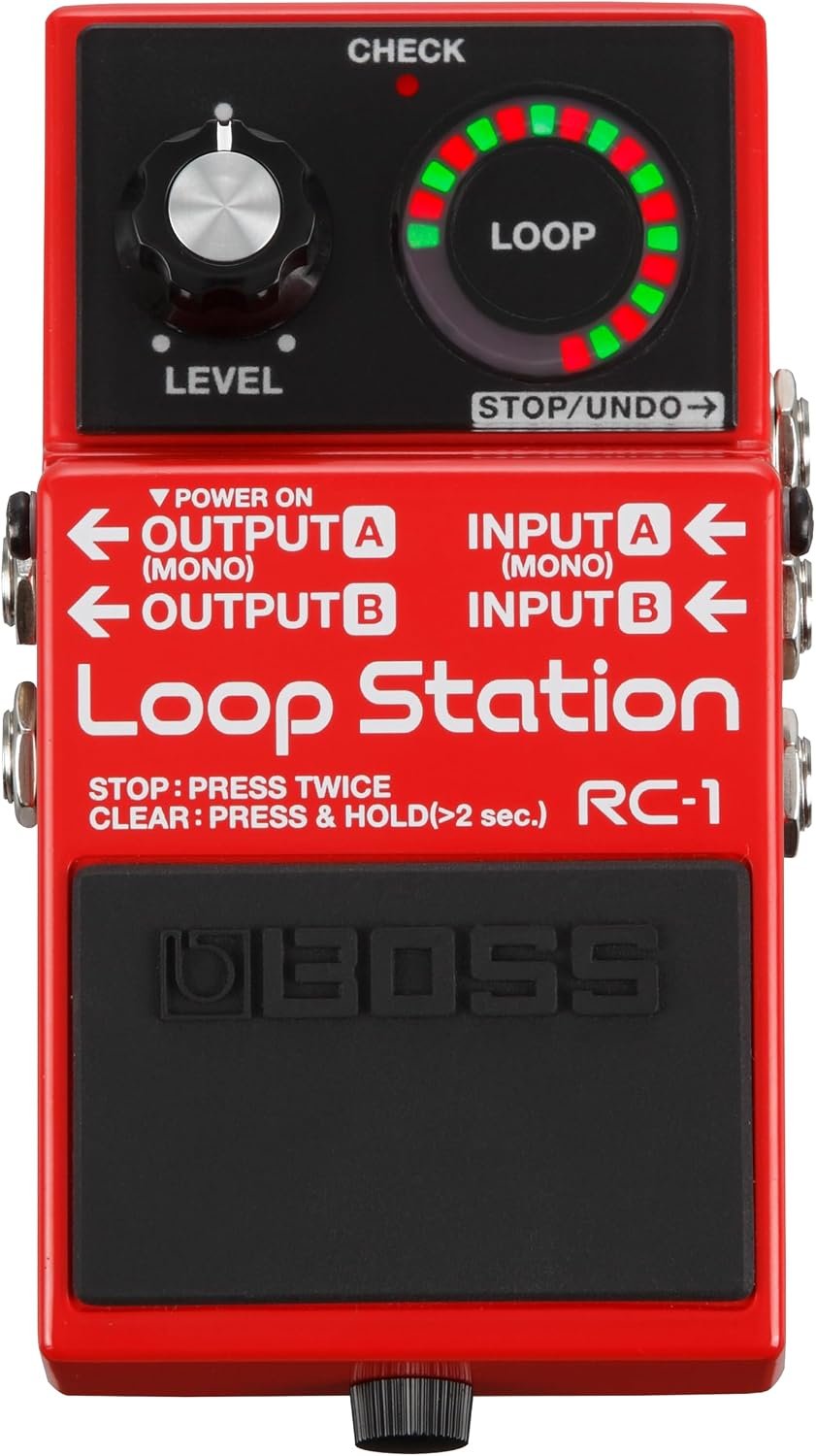
The circular indicator is especially useful because it gives you a visual reference for what the pedal is doing. You can see when you are recording, playing back or overdubbing without having to guess from the sound alone, which helps when you are trying to keep your timing tight.
There is still a short learning curve because single-switch loopers depend on different taps and presses for different commands. After a little practice, though, the process becomes much more natural and the pedal starts to feel like part of the playing rather than something you have to constantly think about.
What Can You Do With the RC-1?
The RC-1 is useful for far more than simply repeating a riff. You can record a rhythm part, let it play back and then add lead lines over the top, which makes solo practice feel much more like playing with another guitarist.
It is also handy for songwriting. Instead of trying to remember how two parts might work together, you can record one idea, layer another over it and immediately hear whether the arrangement has potential. That makes the pedal useful for developing chord progressions, melodies and simple harmonies without opening recording software.
For timing practice, looping can be particularly revealing. If the first phrase is not played cleanly or in time, every repeat makes the mistake obvious. That can be frustrating at first, but it is also one of the reasons a looper can become such a useful practice tool.
How Much Recording Time Does the BOSS RC-1 Offer?
The RC-1 gives you up to 12 minutes of stereo recording time, which is more than enough for most practice loops, song ideas and layered guitar parts. For everyday use, that means you can build longer progressions without constantly worrying about running out of space.
It records a single loop track, so the workflow stays simple rather than turning into a multi-track arrangement system. You can keep overdubbing parts onto that loop, but everything remains part of the same overall phrase.
The RC-1 also retains the recorded phrase when the pedal is switched off, which is useful if you want to come back to an idea later rather than rebuilding it from scratch each time.
Can You Use the RC-1 in Stereo?
Yes. The RC-1 has stereo inputs and stereo outputs, so it can sit comfortably in a more involved pedalboard or stereo rig as well as a simple mono guitar setup. If you are using stereo modulation, delay or other effects before the looper, the RC-1 can preserve that stereo image rather than collapsing everything to mono.
For a straightforward guitar rig, you can simply use the mono input and output and ignore the second pair of sockets. That keeps the pedal just as easy to use for a basic amp-and-guitar setup.
There is also a separate STOP/UNDO connection for optional external footswitch control, which can make stopping or undoing loops more convenient if you eventually want a little more control without moving to a larger looper.
What the RC-1 Feels Like on a Pedalboard
The RC-1 uses the familiar compact BOSS pedal format, so it feels reassuringly solid underfoot without taking up excessive space. The footswitch has the firm, dependable action players expect from this style of enclosure, and the pedal sits securely enough for repeated tapping during practice or performance.
The circular display is one of the most useful physical details. Instead of relying on a tiny screen, it gives you an immediate visual sense of where you are in the loop and whether the pedal is recording, overdubbing or playing back.
It is a simple piece of hardware, but that is really the point. There are no deep menus to navigate and no large control surface to learn, so the RC-1 tends to disappear into the setup once you are comfortable with the footswitch commands.
The Drawbacks
The RC-1’s greatest strength — its simplicity — is also its biggest limitation. Everything revolves around a single main footswitch, so recording, overdubbing, stopping and clearing loops depend on different taps and presses. Once the sequence becomes familiar it works well, but during the first few sessions it can feel less intuitive than a looper with separate record and stop switches.
It is also a single-track looper. You can build multiple overdubs, but they all become part of the same loop rather than separate tracks that can be muted or edited independently. That is perfectly adequate for practice and straightforward layering, but players wanting to construct more elaborate arrangements may eventually want a more advanced multi-track looper.
There are no built-in drum patterns or rhythm accompaniments either. The RC-1 focuses purely on looping, which keeps the controls clean but means it offers less help for structured practice than pedals that combine looping with percussion or backing features.
Its simplicity also means there is no screen for naming loops, browsing stored performances or managing a large library of ideas. The RC-1 is much better suited to capturing and working with the loop in front of you than acting as a storage system for lots of songs.
Finally, stopping a loop with the onboard switch requires the correct foot action, which can feel slightly awkward in a live situation until it becomes second nature. An optional external footswitch can make stopping and undoing more convenient, but that adds another pedal and cable to a product whose appeal is partly its compact simplicity.
These limitations are worth understanding because the RC-1 is not trying to be a miniature recording workstation. It works best for players who want simple, dependable looping without paying for layers of features they may never use.
Who the BOSS RC-1 Suits Best
The RC-1 is a particularly good fit for guitarists who want to learn looping without buying a complicated multi-function unit. It suits home players, songwriters and anyone who wants to practise rhythm and lead parts together in a simple, repeatable way.
It also works well for players who already have a pedalboard and want to add looping without giving up much space. The stereo connections make it flexible enough for more involved rigs, while the basic mono setup remains completely straightforward.
If you want drum patterns, multiple independent loop tracks or deep editing, a more advanced looper will suit you better. But if you want a solid, dependable pedal that keeps looping simple, the RC-1 fits that job very well.
Is the BOSS RC-1 Worth Adding to Your Pedalboard?
The RC-1 earns its place by doing one job clearly rather than trying to become an entire workstation. It lets you capture a phrase, build layers over it and immediately hear how different guitar parts work together, all from a compact pedal that does not demand much pedalboard space.
For practice, it can make playing alone considerably more useful. Rhythm parts become backing tracks, chord progressions become something to improvise over, and timing mistakes become much easier to hear. For songwriting, it provides a quick way to test ideas without setting up a recording session.
More advanced loopers offer additional tracks, rhythm features and deeper control, but that extra capability also brings more controls and complexity. The RC-1 is better suited to the guitarist who wants to plug in, understand what is happening and start looping.
If straightforward operation, solid construction and dependable everyday looping matter more than an enormous feature list, the BOSS RC-1 remains a very sensible pedal to have within reach.
Explore more pedals and tone-shaping gear in our Pedals & Effects section.
As an Amazon Associate I earn from qualifying purchases.