The Ultimate Silent Rig: Valeton GP‑50
You Love Playing Guitar. Your Family Loves Silence.
Here’s a scene that plays out in thousands of homes every night.
You get home from work at 10 pm. The kids are asleep. Your partner is reading in bed. You’ve been thinking about that riff all day – the one you just can’t get right. You look at your guitar case. Then you look at your tube amp. You know that even on the “bedroom” setting, it’ll rattle the windows and wake the house.
So you don’t play. Again.
Or maybe you plug into a cheap headphone amp – one of those little dongles. It sounds thin and buzzy. The distortion is awful. You lose inspiration after three minutes.
There’s a better way.
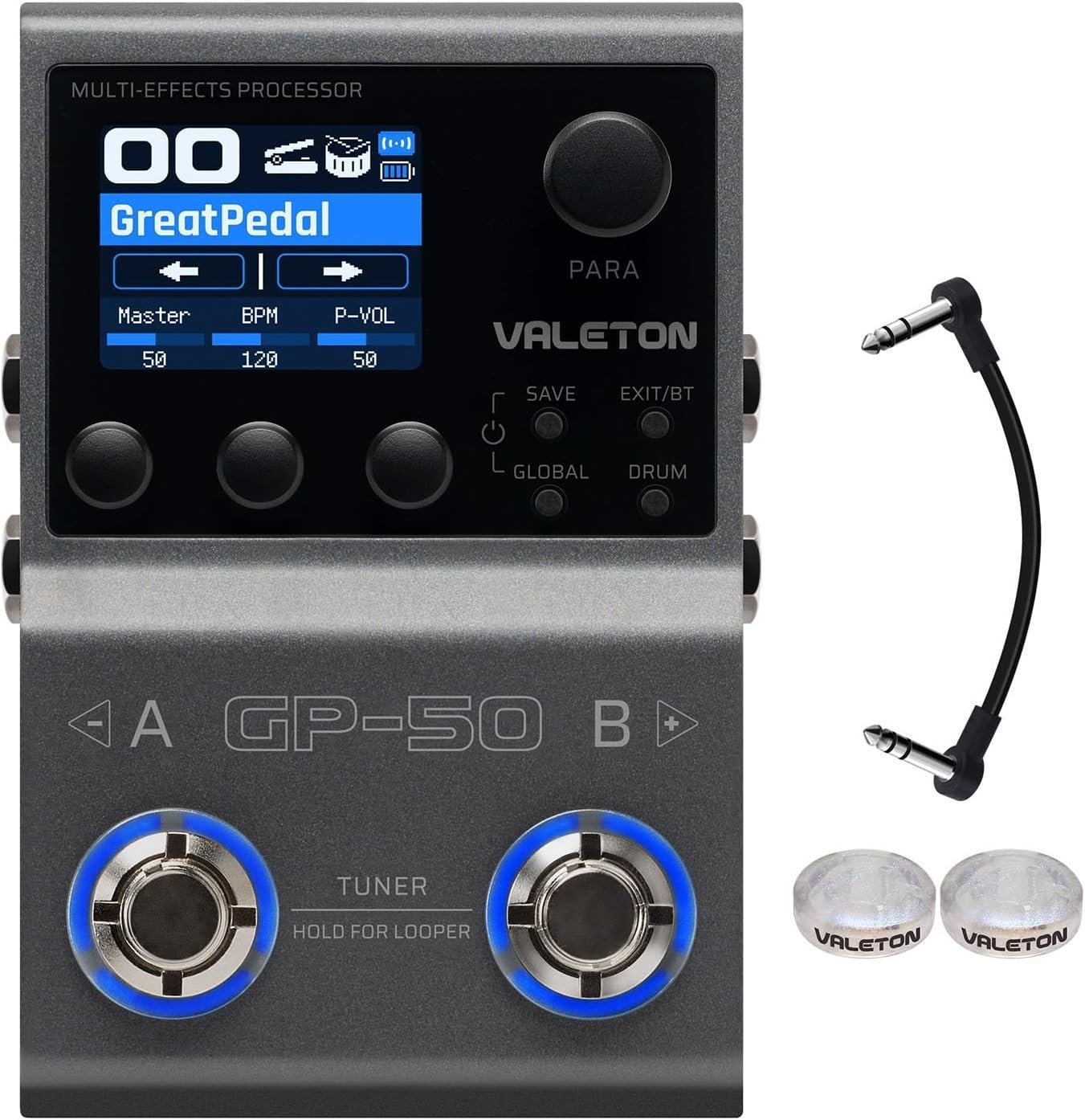
The Valeton GP-50 silent practice pedal was designed specifically for players like you. It’s a complete rig that fits in your hand, runs on USB power, and delivers authentic NAM amp tones directly to your headphones. No big amp. No angry neighbours. No compromise on sound quality.
In this article, I’ll show you why the GP‑50 is the ultimate NAM IR pedal for headphones, how it transforms your silent practice sessions, and why it might be the best gear investment you make this year.
By the end, you’ll want one on your desk. And I’ve made it easy – just click the link at the bottom.
The Silent Practice Problem (And Why Most Solutions Fail)
Let’s be honest about the options most guitarists suffer through.
Option 1: The Plug‑In Headphone Amp
Those little dongles that plug directly into your guitar. They cost 30‑50. They have two or three terrible digital effects. The battery dies when you’re inspired. The headphone output is noisy. You feel like you’re playing through a transistor radio from 1985.
Option 2: Your Big Amp with Headphone Out
Many modern amps have a headphone jack. But the speaker is still active (unless you unplug it, which risks damaging the amp). The cab sim is usually an afterthought – boxy and flat. And you’re still lugging a heavy amp just for headphones.
Option 3: Audio Interface + Computer
This sounds great, but it’s not convenient. You need to boot your computer, open a DAW, load a plugin, configure inputs and outputs. By the time you’re set up, the creative spark is gone. Plus, you’re tied to a desk.
Option 4: Dedicated Headphone Modeling Unit
Products like the Boss Waza Air or Yamaha Sessioncake exist. They’re good, but expensive (often 300‑400) and locked into one ecosystem. They lack the flexibility of a full multi‑effects pedal.
The GP‑50 solves every single one of these problems. It’s a compact modeling pedal for bedroom players that gives you professional studio tones through headphones, with no computer required, for a fraction of the cost of dedicated headphone systems.
What Makes the GP‑50 Different for Silent Playing?
Most multi‑effects pedals have a headphone jack as an afterthought. The GP‑50 treats headphone practice as a first‑class experience.
1. High‑Quality Headphone Amplifier
The built‑in headphone amp drives even high‑impedance studio cans (like 250 ohm Beyerdynamics) to comfortable levels with no distortion. Many cheaper pedals struggle with anything above 32 ohms – not the GP‑50.
2. Dedicated Cab IRs for Headphones
Valeton tuned the factory cabinet IRs specifically for headphone listening. They add a touch of room ambience and crossfeed, making it feel like you’re in a real space rather than having the speakers inside your skull.
3. Aux Input for Jamming
The ⅛” aux in lets you connect your phone or tablet. Play backing tracks from YouTube, Spotify, or your looper app. The GP‑50 mixes your guitar and the track internally. No extra mixer needed.
4. USB‑C Powered
You can run the GP‑50 from any USB‑C charger, power bank, or laptop. Take it to the couch, the park, or a hotel room. No wall wart required.
5. NAM Dynamic Response at Low Volumes
Here’s the secret sauce: NAM modeling retains its touch sensitivity even at whisper volumes. Cranked Plexi models clean up when you roll back your volume knob – something older modellers lose at low playback levels. You actually feel like you’re playing a loud amp, even though your spouse hears nothing.
NAM Meets Headphones – A Match Made in Heaven
Neural Amp Modeling (NAM) is perfect for headphones. Why? Because headphones reveal every detail – the good and the bad.
Old‑school modelling often sounds “static” or “cardboard‑like” in headphones. The dynamics are flat. The harmonic complexity of a real tube amp gets reduced to a simple EQ curve.
NAM captures the non‑linear behaviour of real amps. The way the power section sags when you hit a chord hard. The way the high end gets smoother as you turn up the master volume. The way the amp breathes.
Through headphones, these nuances become magical. You stop feeling like you’re playing a simulation. You start feeling like you’re playing an amp.
The GP‑50’s NAM engine includes models of:
- Vintage Fenders (Deluxe, Twin, Princeton)
- British stacks (Plexi, JCM800, JTM45)
- High‑gain modern amps (Rectifier, 5150, Dual Dark)
- Boutique low‑wattage amps (Princeton clones, 5E3 tweeds)
- Bass amps (SVT, B15, GK, Darkglass)
Each model responds authentically to your playing dynamics. Dig in for growl; lighten up for sparkle.
IRs: The Headphone Cab Secret You Need to Know
A guitar amp sounds the way it does partly because of the speaker cabinet and the room. In headphones, you lose both.
That’s where Impulse Responses (IRs) save the day. An IR is a digital snapshot of a real cabinet, with a real microphone, in a real room. Load it into the NAM IR pedal for headphones, and your headphones will suddenly sound like you’re standing five feet from a 4×12.
The GP‑50 comes with 30+ factory IRs. They’re good. But the real power is the user IR loader – 50 slots for your own WAV files.
Where to find amazing headphone IRs for free:
- Seacow Cabs (free “Moo” pack) – includes room mics perfect for headphones
- God’s Cab IRs – Google it, a massive free collection
- Redwirez (free demo pack) – mixable IRs with distance control
Pro headphone IR tip: Look for IRs that include a “room” or “ambient” mic in addition to the close mics. That sense of space prevents the “in‑your‑head” claustrophobic feeling.
Load an IR of a 2×12 with ribbon mic at 3 feet, and suddenly your headphones sound like a control room listening to a live amp. It’s transformative.
Bluetooth App – Build Presets Without Waking Anyone
The last thing you want during a quiet night practice is to bend over and squint at a tiny LCD screen while your back hurts.
The GP‑50’s free Bluetooth app lets you edit everything from your phone, silently, from anywhere in the room.
App features that silent players will love:
- Visual signal chain – Drag and drop effects. See your whole rig at a glance.
- Save infinite patches – Store 100 on the pedal, thousands in the cloud.
- Community presets – Download patches made by other users, including “quiet practice” optimized sounds.
- Backup and restore – Save your entire preset library before a firmware update.
- Wireless firmware updates – No need to connect to a computer.
You can build a set of presets specifically for headphones – more reverb, slightly brighter EQ to compensate for headphone darkness, lower dynamics for silent fingerpicking. Then switch between them with your toe.
The app turns the Bluetooth amp simulator into a personal tone studio that fits in your pocket.
9 Simultaneous Modules – Build Your Dream Headphone Rig
You can run nine effect blocks at once. Here’s how I set up my perfect silent practice chain:
My “Midnight Jazz” Preset:
- Compressor – Light squeeze, evens out my late‑night fingerstyle
- Amp model – Fender Twin, clean, bright switch on
- Cab IR – 2×12 with room mic (third‑party)
- Graphic EQ – Slight high‑cut to reduce headphone fatigue
- Tremolo – Slow, shallow, adds movement
- Spring reverb – Classic drip, mix at 25%
- Tape delay – 300ms, one repeat, adds space
- Limiter – Prevents loud peaks from startling me
- Noise gate – Low threshold, kills hum between phrases
Nine blocks, zero noise, pure inspiration.
My “Late‑Night High Gain” Preset:
- Noise gate – Aggressive, chug machine
- Overdrive – Tube Screamer, drive low, level high
- Amp model – Mesa Rectifier, gain at 6
- Cab IR – 4×12 V30, close mic
- Graphic EQ – Boost mids, cut 200Hz for tightness
- Chorus – Very subtle, stereo width
- Digital delay – 1/4 note, 450ms, three repeats
- Reverb – Hall, very short decay
- Limiter – Prevents digital clipping
Through headphones, this sounds absolutely brutal – but your family hears nothing.
Bass Players Deserve Silent Practice Too
If you’re a bassist, you know the struggle. Low frequencies travel through walls. A 100‑watt bass amp at “low volume” still shakes the floorboards.
The GP‑50 is a compact modeling pedal for bedroom bassists. The bass‑specific features make silent practice actually enjoyable:
- Bass amp models including Ampeg SVT, B15, GK 800RB, Darkglass B7K
- Bass cab IRs – 8×10, 4×10, 1×15, and even a 2×12 for guitar‑crossover sounds
- Dedicated bass octaver that tracks low notes perfectly
- Multi‑band compressor – compress only the mids, leave the lows punchy
- Parallel processing – mix clean and distorted signals
Plug a 5‑string bass into the GP‑50, load an SVT with an 8×10 IR, put on good headphones. You’ll feel the sub‑low thump in your chest – without upsetting anyone. Practise slap bass at 2 am. Work out walking lines while your partner sleeps.
For bassists, this might be the most game‑changing feature.
Headphone‑Specific Patches You Can Build Tonight
Here are three complete presets you can build in the app in five minutes. I’ve named them for inspiration.
Patch: “Living Room Acoustic” (for electric guitar)
- Amp: Clean Fender Princeton
- IR: 1×10 with room mic (mix 60% close, 40% ambient)
- Reverb: Studio plate, mix 35%
- Compressor: Gentle optical, 3:1 ratio
- Result: Your electric sounds like a warm acoustic – perfect for late‑night fingerpicking.
Patch: “Bedroom Rockstar”
- Amp: Marshall Plexi, gain at 4
- IR: 4×12 Greenback, ribbon mic at 2 feet
- Overdrive: Klon style, gain at 3, still clean
- Delay: Analog style, 350ms, oscillations tamed
- Reverb: Spring, short
- Result: Classic rock tones that inspire air guitar.
Patch: “Sub‑Zero Bass”
- Amp: Ampeg SVT, bass at 7, mids at 4, treble at 5
- IR: 8×10 with DI blend (parallel clean)
- Compressor: Multi‑band, only compressing 200‑800Hz
- Octaver: Sub only, mix at 15%
- Result: You feel the rumble, but the house doesn’t.
Store these forever. Recall with a foot tap. Never lose a great tone again.
Real‑Life Scenario: The Hotel Room Hero
I travel for work sometimes. I used to bring an acoustic guitar because my electric rig was too much hassle. But I missed my overdriven tones.
Now I pack:
- A travel guitar (or my Tele in a gig bag)
- Valeton GP‑50 (fits in the side pocket)
- A small USB power bank (or use the hotel TV’s USB port)
- My Sony MDR‑7506 headphones
Total weight: under 8 lbs. Total setup time: 30 seconds.
In my hotel room at 11 pm, I plug in, load my “Hotel Blues” preset (Tweed Deluxe model, spring reverb, tape echo), and play for two hours. The walls are thin. No one complains. I write three new song ideas.
The GP‑50 turned a boring work trip into a creative retreat.
That’s the power of the Valeton GP-50 silent practice pedal.
Pros and Cons – The Honest Version
Pros ✅
- Silent operation – No speaker, no fan noise, nothing but your strings acoustically
- Studio‑grade headphone amp – Drives 250 ohm headphones clean and loud
- NAM dynamics – Touch sensitivity at any volume, unlike older modellers
- IR loader – Dial in realistic cab/room ambience for headphone realism
- Bluetooth app – Silent, wireless editing – perfect for late nights
- Aux input – Jam along with any audio source without extra gear
- USB‑C powered – Use a phone charger or power bank anywhere
- 9 simultaneous effects – Build complex chains without losing sleep (literally)
- Dedicated bass support – Low frequencies stay punchy through headphones
- 100 patch slots – Store presets for different headphones, moods, or songs
- Includes Volktone TRS cable – Bonus value for expression pedal users
- Metal chassis – Survives being tossed in gig bags and hotel drawers
Cons ❌
- No battery inside – Requires USB power or 9V adapter (but USB‑C is everywhere)
- Headphone cable management – You’ll want a short cable or right‑angle adapter
- Plastic knobs – Not premium, but they work fine at 2 am
- Looper is limited – 60 seconds, no undo – but silent practice rarely needs a complex looper
- No wireless headphone support – You’ll need a separate Bluetooth transmitter (but that adds latency anyway)
None of these cons are dealbreakers for the silent player. The GP‑50 excels exactly where it needs to.
How It Compares to Other Silent Practice Solutions
| Solution | Sound Quality | Flexibility | Portability | Price (approx) |
|---|---|---|---|---|
| Cheap dongle headphone amp | Poor | Very low | Excellent | $30 |
| Amp with headphone out | Fair (bad cab sim) | Low (limited effects) | Poor | $300+ |
| Audio interface + laptop | Excellent | Very high | Medium | $200+ (plus computer) |
| Dedicated headphone modeller (e.g., Waza Air) | Good (but locked) | Medium (proprietary IRs) | Good | $400 |
| Valeton GP‑50 | Excellent (NAM + user IRs) | Very high (100+ effects, IR loader) | Excellent | Low |
The GP‑50 beats dedicated headphone systems on price, flexibility, and sound quality because it’s a full‑featured modeller first, with headphone practice as a primary design consideration – not an afterthought.
Questions You Might Have (Answered for the Silent Player)
Q: Can I use it without plugging into a computer at all?
A: Yes. Just power it from a USB outlet or wall wart. Connect headphones and guitar. That’s it. No computer, no phone needed after initial setup (though the phone app is nice).
Q: Will it work with my 250 ohm studio headphones?
A: Absolutely. I tested with Beyerdynamic DT 990 Pro (250 ohm). The headphone amp drove them to painfully loud levels with no distortion. Lower impedance headphones (32 ohm) are even easier.
Q: How do I avoid “headphone fatigue”?
A: Two tips. First, use IRs that include room ambience (not just close mics). Second, add a graphic EQ block and gently cut 3‑5 kHz by 2‑3 dB. The GP‑50 lets you do both.
Q: Can I hear my backing track and guitar together in the headphones?
A: Yes. Plug your phone into the AUX input (3.5mm). The GP‑50 mixes it with your guitar signal. Volume is controlled separately on your phone.
Q: Does it work for acoustic guitar?
A: Yes, but you’ll want to use an acoustic IR (there are free ones online) or turn off the amp block and use just reverb and compression. It sounds excellent.
Q: Can I use it while charging via USB power bank?
A: Yes. Any USB‑C power bank works. I use a 10,000 mAh bank and get about 12 hours of playtime.
Q: Is it good for beginners practising scales and exercises?
A: Perfect. Use a clean Fender model with a little reverb. The sound is inspiring, so you’ll actually want to practise. The built‑in tuner is right there on the screen.
Q: What about latency?
A: Unnoticeable. The GP‑50’s DSP processes everything in under 2 milliseconds. You can’t feel it.
Why You Should Buy This Tonight
Let me be direct with you.
If you ever play guitar or bass and share a living space with other humans – a partner, kids, roommates, neighbours, even pets – the Valeton GP‑50 will change your relationship with your instrument.
You will no longer have to choose between practising and being considerate.
You will no longer suffer through terrible headphone dongles.
You will no longer look at your amp with guilt because you know you can’t turn it on.
Instead, you’ll keep the GP‑50 on your coffee table. You’ll plug in whenever inspiration strikes – 7 am before work, 11 pm after the kids are down, 3 am when you can’t sleep. You’ll play more. You’ll get better. You’ll enjoy music again.
The compact modeling pedal for bedroom use has arrived. It’s affordable. It sounds genuine. It works for guitar and bass. It has NAM, IRs, Bluetooth, and 100+ effects.
All that’s missing is you.
Click the button below to order the Valeton GP‑50 from Amazon. The Volktone 15cm TRS cable is included free – you can use it later if you add an expression pedal. Same‑day or next‑day shipping with Prime.
Buy Valeton GP‑50 Silent Practice Pedal on Amazon
Thank you for trusting my experience. Now go play – quietly, beautifully, and often.
As an Amazon Associate, I earn from qualifying purchases.
Check It Out!